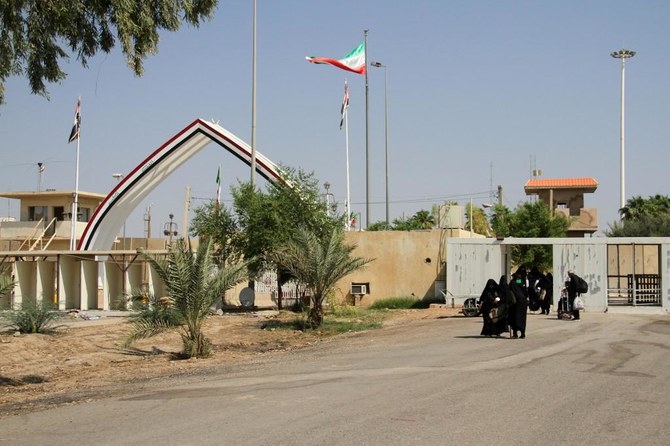
Iran says two border crossings to Iraq closed because of unrest in Iraq

The Khosravi border crossing is used by Iranian Shiite Muslim for their pilgrimage in Iraq. (File/AFP)
Updated 05 October 2019
Follow

Iran says two border crossings to Iraq closed because of unrest in Iraq

  • Khosravi and Chazabeh crossings have been closed since Wednesday
  • The first crossing is used by Shiite Muslims for pilgrimage in Iraq

DUBAI: Two border crossings between Iran and Iraq, including one due to be used by hundreds of thousands of Shiite Muslim worshippers at an annual pilgrimage this month, have been closed because of unrest in Iraq, Iran’s border guards said on Thursday.
Anti-government protests have turned violent in recent days in Iraq.
Iranian border guards commander General Qasem Rezaei said the Khosravi and Chazabeh crossings had been closed since late Wednesday, Iran’s semi-official Mehr news agency reported.
A senior Iranian pilgrimage official told state television that the Khosravi border crossing was closed, but other crossings were open ahead of an annual Shiite Muslim pilgrimage in Iraq.
Iranian Interior Minister Abdolreza Rahmani Fazli said last week 3 million Iranian pilgrims were expected to visit Iraq’s southern city of Karbala later this month for the religious ritual of Arbaeen, which marks the end of a 40-day mourning period for the grandson of the Prophet Muhammad.


Assad forces injured 35 in 2016 chlorine attack: watchdog

Updated 6 sec ago
Follow

Assad forces injured 35 in 2016 chlorine attack: watchdog

  • “There are reasonable grounds to believe that one Mi8/17 helicopter of the Syrian Arab Air Force dropped at least one yellow pressurised cylinder,” OPCW said
  • The team interviewed dozens of witnesses, analyzed samples and reviewed satellite images

THE HAGUE: Former Syrian president Bashar Assad’s forces deployed chlorine gas in a 2016 attack that injured at least 35 people, the world’s chemical weapons watchdog concluded Thursday.
The October 2016 attack near a field hospital outside the town of Kafr Zeita, in western Syria, was already well-documented but the Organization for the Prohibition of Chemical Weapons (OPCW) for the first time accused Assad’s forces.
“There are reasonable grounds to believe that one Mi8/17 helicopter of the Syrian Arab Air Force dropped at least one yellow pressurised cylinder,” the OPCW said in a report.
“Upon impact, the cylinder ruptured and released chlorine gas, which dispersed through the Wadi Al-Aanz valley, injuring 35 named individuals and affecting dozens more,” OPCW investigators concluded.
The team interviewed dozens of witnesses, analyzed samples and reviewed satellite images.
Assad was repeatedly accused of using chemical weapons during Syria’s 13-year civil war, and there has been widespread concern about the fate of Syria’s stocks since his 2024 ouster.
In a landmark speech last year, the foreign minister of the new Syrian government pledged to dismantle any remnants of Assad’s chemical weapons program.
The OPCW welcomed the “full and unfettered access” the new Syrian authorities granted their investigators.
It was the “first instance of cooperation by the Syrian Arab Republic with an... investigation,” the OPCW said.
The OPCW wants to establish a permanent presence in Syria to draw up an inventory of chemical weapons sites and start the destruction of the stockpiles.