

UK's Johnson to meet EU's Juncker on Monday for Brexit talks

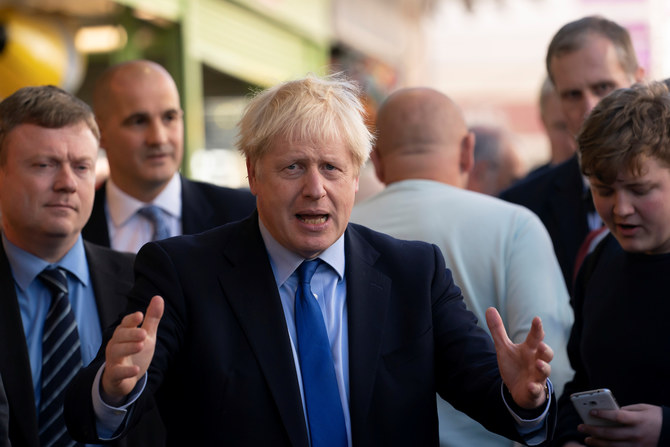
Britain's Prime Minister Boris Johnson visits Doncaster Market, in Doncaster, Britain, September 13, 2019. (Reuters)
Updated 13 September 2019
Follow

UK's Johnson to meet EU's Juncker on Monday for Brexit talks

  • Johnson will "hold talks with President Juncker on Brexit," his Downing Street office said without providing further details
  • On Thursday, British Prime Minister Boris Johnson denied that he had lied to Queen Elizabeth II when requesting she suspend Parliament this month in the run-up to Brexit

LONDON: Boris Johnson will meet EU chief Jean-Claude Juncker in Luxembourg on Monday, officials said, as the British prime minister bids to broker a Brexit compromise ahead of the October 31 deadline.
Johnson will "hold talks with President Juncker on Brexit," his Downing Street office said without providing further details.
EU spokeswoman Natasha Bertaud told reporters that the two would have a working lunch that was arranged by "common accord".
The British pound gained one percent against the dollar in Friday trading on speculation that the two sides were edging closer to a compromise over the contentious Irish border issue.
Johnson refuses to sign off on an agreement that includes the "backstop," a compromise intended to keep the frontier open for trade and crossings in all post-Brexit scenarios.
It was accepted by his predecessor Theresa May but repeatedly failed to win backing in the British parliament.
Eurosceptics fear the stop-gap measures designed for the border between EU member Ireland and the UK province of Northern Ireland would keep Britain indefinitely trapped in bloc's trade zone.
The Times reported on Friday that the DUP, a small Northern Irish party that had helped the ruling Conservatives in London form a majority in parliament since 2017, was now ready to abide by some EU rules.
But DUP leader Arlene Foster denied the report, calling it "nonsense".
"UK must leave as one nation," she tweeted.
Johnson no longer commands a working majority in the House of Commons, and lawmakers have instructed him to seek a deadline extension from Brussels if no deal emerges.
Johnson has refused, vowing to get Brexit done on schedule and insisting he would strike a new deal.

On Thursday, British Prime Minister Boris Johnson denied that he had lied to Queen Elizabeth II when requesting she suspend Parliament this month in the run-up to Brexit.
Johnson asked the British head of state to shutter Parliament for five weeks from last Tuesday, claiming it was necessary ahead of rolling out a new domestic agenda.
The unusually long suspension — known as prorogation — was widely seen as a bid to thwart opposition to a no-deal Brexit on October 31 and provoked uproar across the political spectrum as well as legal challenges.
The government was forced Wednesday to release its no-deal Brexit contingency plans after a parliamentary vote, but the opposition has accused it of withholding information.
A Scottish court this week sided with critics of the prorogation, ruling it was “unlawful” and intended to “stymie parliament.”
Asked if he had misled Queen Elizabeth over his motives for the suspension, which will see the House of Commons closed until Oct.14, Johnson said: “Absolutely not.”
“We need to get on and do all sorts of things at a national level,” he added.
Johnson’s government has appealed against Wednesday’s decision by Scotland’s highest civil court and the case is set to be heard in Britain’s Supreme Court next Tuesday.
In the meantime, Parliament remains suspended.
Northern Ireland’s High Court on Thursday dismissed several lawsuits filed there arguing the prorogation was illegal and that a no-deal Brexit would breach the terms of the province’s 1998 peace accord.
Tom Brake, Brexit spokesman for the pro-EU opposition Liberal Democrats, said the government was sitting on internal documents, messages and emails about the decision to prorogue Parliament.

“I suspect that those documents ... will confirm that the prime minister lied about the reason why,” he said.
“We all know that the reason he wanted to shut down parliament is because he didn’t want parliament holding him to account.”


EU leaders to reassess US ties despite Trump U-turn on Greenland

Updated 22 January 2026
Follow

EU leaders to reassess US ties despite Trump U-turn on Greenland

  • Diplomats stressed that, although Thursday’s emergency EU talks in Brussels would now lose some of their urgency, the longer-term issue of how to handle the relationship with the US remained

BRUSSELS: EU leaders will rethink their ties with the US at an emergency summit on Thursday after Donald Trump’s threat of tariffs and even military action to ​acquire Greenland badly shook confidence in the transatlantic relationship, diplomats said.
Trump abruptly stepped back on Wednesday from his threat of tariffs on eight European nations, ruled out using force to take Greenland, a semi-autonomous territory of NATO ally Denmark, and suggested a deal was in sight to end the dispute.
German Chancellor Friedrich Merz, welcoming Trump’s U-turn on Greenland, urged Europeans not to be too quick to write off the transatlantic partnership.
But EU governments remain wary of another change of mind by a mercurial president who is increasingly seen as a bully that Europe will have to stand up to, and they are focused on coming up with a longer-term plan on how to deal with the ‌United States under this ‌administration and possibly its successors too.
“Trump crossed the Rubicon. He might do ‌it ⁠again. ​There is no ‌going back to what it was. And leaders will discuss it,” one EU diplomat said, adding that the bloc needed to move away from its heavy reliance on the US in many areas.
“We need to try to keep him (Trump) close while working on becoming more independent from the US It is a process, probably a long one,” the diplomat said.
EU RELIANCE ON US
After decades of relying on the United States for defense within the NATO alliance, the EU lacks the needed intelligence, transport, missile defense and production capabilities to defend itself against a possible Russian attack. This gives the US substantial leverage.
The US ⁠is also Europe’s biggest trading partner, making the EU vulnerable to Trump’s policies of imposing tariffs to reduce Washington’s trade deficit in goods, and, as in ‌the case of Greenland, to achieve other goals.
“We need to discuss where ‍the red lines are, how we deal with this bully ‍across the Atlantic, where our strengths are,” a second EU diplomat said.
“Trump says no tariffs today, but does ‍that mean also no tariffs tomorrow, or will he again quickly change his mind? We need to discuss what to do then,” the second diplomat said.
The EU had been considering a package of retaliatory tariffs on 93 billion euros ($108.74 billion) on US imports or anti-coercive measures if Trump had gone ahead with his own tariffs, while knowing such a step would harm Europe’s economy as well ​as the United States.
WHAT’S THE GREENLAND DEAL?
Several diplomats noted there were still few details of the new plan for Greenland, agreed between Trump and NATO Secretary General Mark Rutte late on ⁠Wednesday on the sidelines of the World Economic Forum in Davos, Switzerland.
“Nothing much changed. We still need to see details of the Greenland deal. We are a bit fed up with all the bullying. And we need to act on a few things: more resiliency, unity, get our things together on internal market, competitiveness. And no more accepting tariff bullying,” a third diplomat said.
Rutte told Reuters in an interview in Davos on Thursday that under the framework deal he reached with Trump the Western allies would have to step up their presence in the Arctic.
He also said talks would continue between Denmark, Greenland and the US on specific issues.
Diplomats stressed that, although Thursday’s emergency EU talks in Brussels would now lose some of their urgency, the longer-term issue of how to handle the relationship with the US remained.
“The approach of a united front in solidarity with Denmark and Greenland while focusing on de-escalation and finding an off-ramp has worked,” a fourth EU diplomat said.
“At the ‌same time it would be good to reflect on the state of the relationship and how we want to shape this going forward, given the experiences of the past week (and year),” he said.