

From Vietnam to Taiwan, foreign investors offload Asian equities

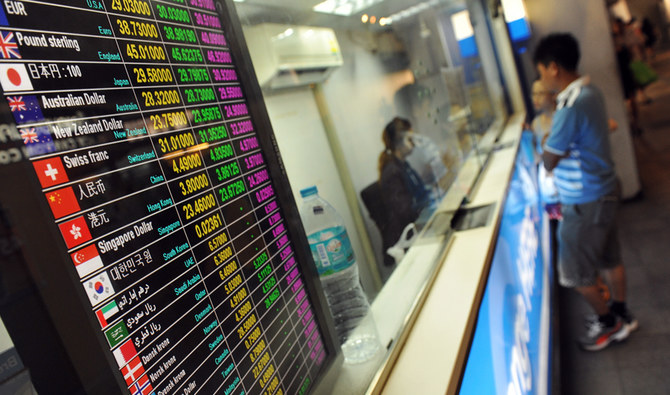
Foreign investors dumped Asian equities in the first six days of August after two months of buying. (Shutterstock)
Updated 07 August 2019
Follow

From Vietnam to Taiwan, foreign investors offload Asian equities

  • MSCI Asia-ex-Japan index has fallen 6.4 percent this month

BENGALURU: Foreign investors dumped Asian equities in the first six days of August after two months of buying, as the US ramped up pressure on China with a $300 billion trade barrage last week.

Overseas investors sold about $4.5 billion of regional equities during the period, data from stock exchanges in South Korea, Taiwan, India, Thailand, Philippines, Indonesia, and Vietnam showed.

Sharp outflows from Asian markets point to increased worries that trade tensions between the world’s two top economies could escalate, and regional economies and corporate earnings might deteriorate further.

US President Donald Trump said last Thursday he would slap a 10 percent tariff on the remaining $300 billion of Chinese imports starting Sept. 1, marking an end to a truce in the year-long trade war that was struck in June.

In response, China let its currency weaken 1.4 percent on Monday, sending it past the key 7-per-dollar level for the first time in more than a decade, and then the United States labeled Beijing a currency manipulator.

MSCI Asia-ex-Japan index had fallen 6.4 percent this month as of Tuesday’s close, after shedding 1.7 percent in July.

“Recent foreign outflows from Asian equities clearly suggest that investors are getting nervous on markets given escalating trade tensions,” said Chetan Seth, a strategist for Nomura Securities in Singapore.

It might get harder for the US and China to ease or soften these tensions given how events have unfolded over the last few days, he said.

Goldman Sachs said markets were pricing in a less than 15 percent chance of a trade deal being agreed. It estimated 13 percent and 8 percent cumulative earnings downside for MSCI China and MSCI Asia-ex-Japan in 2019-2020 under a “no deal” scenario.

Taiwan and India saw the biggest outflows in Asia, with net selling of $1.8 billion and $1.1 billion respectively. South Korea also witnessed outflows, of $919 million.

Taiwan and South Korean companies are more exposed to the Sino-US trade tussle as they have extensive ties with tech firms in China and are part of their supply chains.

Indian shares were undermined last month after the federal budget raised import tariffs on many items, hiked taxes on the rich and proposed changes in shareholding norms.

A slew of disappointing earnings by Asian firms for the second quarter also increased investor caution on regional markets.

Refinitiv data showed major Asian firms such as Tata Motors , Canon Inc. and Nissan have posted second-quarter earnings below expectations.

“So far 1H earnings in Asia-ex-Japan markets have been below estimates – although still early days. The question investors need to answer is what happens to 2020 earnings as markets in 2H will start discounting next year’s earnings,” said Nomura’s Seth.

“If trade tensions persist, there may be more downside to current consensus earnings estimates.”

In July, foreigners had invested $234 million in Asia, much lesser than $4.2 billion inflows in June.


Reforms target sustained growth in Saudi real estate sector, says Al-Hogail

Updated 26 January 2026
Follow

Reforms target sustained growth in Saudi real estate sector, says Al-Hogail

RIYADH: The Real Estate Future Forum opened its doors for its first day at the Four Seasons Riyadh, with prominent global and local figures coming together to engage with one of the Kingdom’s most prospering sectors.

With new regulations, laws, and investments underway, 2026 is expected to be a year of momentous progress for the real estate sector in the Kingdom.

The forum opened with a video highlighting the sector’s progress in the Kingdom, during which an emphasis was placed on the forum’s ability to create global reach, representation, as well as agreements worth a cumulative $50 billion

With the Kingdom now opening up real estate ownership to foreigners, this year’s Real Estate Future Forum is placing a great deal of importance on this new milestone and its desired outcomes and impact on the market. 

Aside from this year’s forum’s unique discussions surrounding those developments, it will also be the first of its kind to launch the Real Estate Excellence Award and announce its finalist during the three-day summit.

Minister of Municipalities and Housing and Chairman of the Real Estate General Authority Majed Al-Hogail took to stage to address the diverse audience on the real estate market’s achievements thus far and its milestones to come.

Of those important milestones, he underscored “real estate balance” as a key pillar of the sector’s decisions to implement regulatory tools “with the aim of constant growth which can maintain the vitality of this sector.” He pointed to examples of those regulatory measures, such as the White Land Tax.

On 2025’s progress, the minister highlighted the jump in Saudi family home ownership, which went from 47 percent in 2016 to 66 percent in 2025, keeping the Kingdom’s Vision 2030 goal of 70 percent by the end of the decade on track.

He said the opening of the real estate market to foreigners is an indicator of the sector’s maturity under the leadership of Crown Prince Mohammed bin Salman. He said his ministry plans to build over 300,000 housing units in Riyadh over the next three years.

Speaking to Arab News,  Al-Hogail elaborated on these achievements, stating: “Today, demand, especially local demand, has grown significantly. The mortgage market has reached record levels, exceeding SR900 billion ($240 billion) in mortgage financing, we are now seeing SRC (Saudi Real Estate Refinance Co.) injecting both local and foreign liquidity on a large scale, reaching more than SR54 billion”

Al-Hogail described Makkah and Madinah as unique and special points in the Kingdom’s real estate market as he spoke of the sector’s attractiveness.

 “Today, the Kingdom of Saudi Arabia has become, in international investment indices, one that takes a good share of the Middle East, and based on this, many real estate investment portfolios have begun to come in,” he said. 

Al-Ahsa Gov. Prince Saud bin Talal bin Badr Al-Saud told Arab News the Kingdom’s ability to balance both heritage sites with real estate is one of its strengths.

He said: “Actually the real estate market supports the whole infrastructure … the whole ecosystem goes back together in the foundation of the real estate; if we have the right infrastructure we can leverage more on tourism plus we can leverage more on the quality of life … we’re looking at 2030, this is the vision … to have the right infrastructure the time for more investors to come in real estate, entertainment, plus tourism and culture.”