

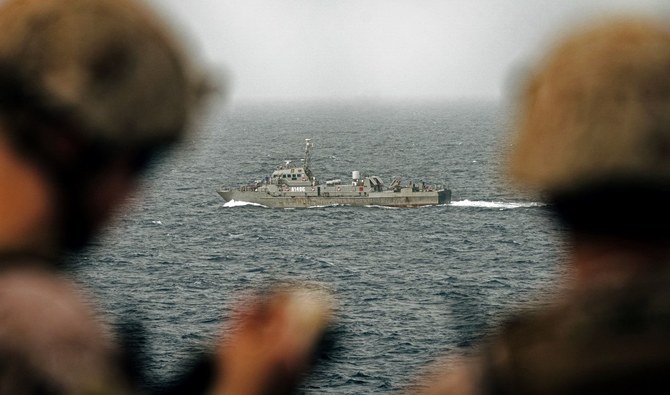
New US-led patrols in Arabian Gulf raise stakes with Iran

The US Navy is trying to put together a new coalition of nations to counter what it sees as a renewed maritime threat from Iran. (
Updated 03 September 2019
Follow

New US-led patrols in Arabian Gulf raise stakes with Iran

  • For decades, the US has considered the waters of the Arabian Gulf as critical to its national security
  • Iran finds itself backed into a corner and ready for a possible conflict it had 30 years for which to prepare

DUBAI: As the US tries a new way to protect shipping across the Arabian Gulf amid tensions with Iran, it finds itself sailing into uncertain waters.

For decades, the US has considered the waters of the Arabian Gulf as critical to its national security. Through the gulf’s narrow mouth, the Strait of Hormuz, 20 percent of all crude oil sold passes onto the world market. Any disruption there likely will see energy prices spike.

The US has been willing to use its firepower to ensure that doesn’t happen. It escorted ships here in the so-called 1980s “Tanker War.” America fought its last major naval battle in these waters in 1988 against Iran.

Now, the US Navy is trying to put together a new coalition of nations to counter what it sees as a renewed maritime threat from Iran. But the situation decades later couldn’t be more different.

The US public is fatigued from years of Mideast warfare after the Sept. 11 attacks. The demand for Arabian Gulf oil has switched to Asia. Gulf Arab nations poured billions of dollars into their own weapons purchases while inviting a host of nations to station their own forces here, even as infighting dominates their relations.

Meanwhile, Iran finds itself backed into a corner and ready for a possible conflict it had 30 years for which to prepare. It stands poised this week to further break the terms of its 2015 nuclear deal with world powers, over a year after President Donald Trump unilaterally withdrew America from the accord and imposed crippling sanctions on the country.

“It is plausible to imagine a scenario where these forces stumble into some type of accidental escalation,” said Becca Wasser, a senior policy analyst at the RAND Corp. who studies the region. “While US efforts are intended to deter, Iran may view increased US maritime presence as offensive in nature or as preparation for a larger attack on Iran and respond accordingly.”


Syrian leader to meet Putin, Russia seeks deal on military bases

Updated 28 January 2026
Follow

Syrian leader to meet Putin, Russia seeks deal on military bases

  • Russia’s continued sheltering of Assad and his wife since their ouster remains a thorny issue

MOSCOW: Syrian President Ahmed Al-Sharaa will meet Russian counterpart Vladimir Putin in Moscow on Wednesday, as the Kremlin seeks to secure the future of its military bases in the country.
Putin and Sharaa struck a conciliatory tone at their previous meeting in October, their first since Sharaa’s rebel forces toppled Moscow-ally Bashar Assad in 2024.
But Russia’s continued sheltering of Assad and his wife since their ouster remains a thorny issue. Sharaa has repeatedly pushed Russia for their extradition.
Sharaa, meanwhile, has embraced US President Donald Trump, who on Tuesday praised the Syrian leader as “highly respected” and said things were “working out very well.”
Putin, whose influence in the Middle East has waned since Assad’s ouster, is seeking to maintain Russia’s military footprint in the region.
Russia withdrew its forces from the Qamishli airport in Kurdish-held northeast Syria earlier this week, leaving it with only the Hmeimim air base and Tartus naval base on Syria’s Mediterranean coast — its only military outposts outside the former Soviet Union.
“A discussion is planned on the status of bilateral relations and prospects for developing them in various fields, as well as the current situation in the Middle East,” the Kremlin said of the upcoming meeting in a statement on Tuesday.
Russia was a key ally of Assad during the bloody 14-year Syrian civil war, launching air strikes on rebel-held areas of Syria controlled by Sharaa’s Islamist forces.
The toppling of Assad dealt a major blow to Russia’s influence in the region and laid bare the limits of Moscow’s military reach amid the Ukraine war.
The United States, which cheered Assad’s demise, has fostered ever-warmer ties with Sharaa — even as Damascus launched a recent offensive against Kurdish forces long backed by the West.
Despite Trump’s public praise, both the United States and Europe have expressed concern that the offensive in Syria’s northeast could precipitate the return of Islamic State forces held in Kurdish-held jails.