

Misk Academy launches 14 programs to train young Saudis

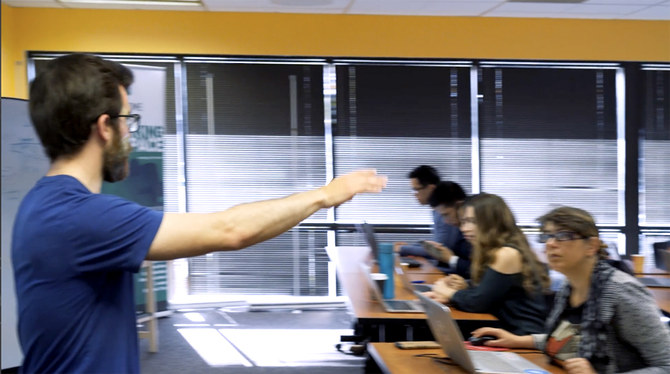
A Screen grab from a Misk Academy video shows an instructor giving an animated lecture during a Udacity Connect in-person learning session. (Courtesy: Misk Academy)
Updated 02 September 2019
Follow

Misk Academy launches 14 programs to train young Saudis

  • Over 1,900 people ready to develop skills in digital world

RIYADH: The Misk Academy, part of the Prince Mohammed bin Salman bin Abdul Aziz Foundation (Misk), has launched the third round of the Misk Udacity Program, in partnership with Udacity which aims to develop and build skills in the digital world.

Over 6,000 people have applied to the program, with 1,966 accepted to 14 online programs in programming, data, digital marketing and artificial intelligence.

In addition to the online course, students based in Riyadh and Makkah will attend a weekly session with their trainer, with seminars also being held at other locations across the country, in other areas, in order to initiate debates about the subjects and review contents and ideas raised.

The Misk Udacity Program is considered a proactive step to develop technological pioneers’ skills in the Kingdom.

HIGHLIGHTS

• The Misk Udacity Program is considered a proactive step to develop technological pioneers’ skills in the Kingdom.

• It aims to build and raise the knowledge and technical skills of Saudi job seekers, and also aims to develop their employability in the data and technology sector.

It aims to build and raise the knowledge and technical skills of Saudi job seekers, and also aims to develop their employability in the data and technology sector.

The program reflects Misk’s academic methodology which aims to present a comprehensive educational system that starts with training and ends with empowering graduates to become successful in the job market and compete at an international levels; 65 percent of graduates achieve progress in their career six months after the end of the program.

Misk is a nonprofit organization dedicated to educating and providing opportunities for the Kingdom’s youth and leading them to a bright future through Vision 2030 in transforming and diversifying the Saudi economy.


‘Cake not hate’ campaign becomes ‘Dates not hate’ in Madinah

“The Joshie-Man” and his father Dan Harris in the courtyard of the Prophet’s Mosque in Madinah. (Supplied)
Updated 02 February 2026
Follow

‘Cake not hate’ campaign becomes ‘Dates not hate’ in Madinah

  • Dan said he was very impressed by Saudi hospitality and that his family was warmly welcomed
  • He said being in Madinah exposed him to the true diversity of Islam

LONDON: A British autistic and non-verbal boy who has been visiting UK mosques and distributing cakes to promote solidarity amid an increase in far-right support in the country has taken his message of love to Madinah.

Joshua Harris, or “The Joshie-Man” as the 12-year-old is known to his social media fans, has handed out hundreds of his baked goods to worshipers at mosques in major British cities over the last few months.

The “Cake not hate” campaign came about after an Islamophobic attack on a mosque in his home city of Peterborough in October 2025.

Harris and his father visited Masjid Darassalaam, the mosque that was targeted, with cakes that the boy had baked and distributed them to the congregation soon after the attack. Since then, Harris has visited dozens of mosques in the UK.

On a recent trip to the Middle East, he and his father visited Madinah. In a local twist that pays tribute to the holy city’s famous date varieties including ajwa and ambar, Harris handed out dates to people in the courtyard of the Prophet’s Mosque. The “Cake not hate” campaign became “Dates not hate” for Saudi Arabia.

“He was greeted really, really warmly. There were some really touching moments where people were kissing his hands and his head. It was really lovely,” his father, Dan Harris, said.

Dan, the founder of global charity Neurodiversity in Business, said being in Madinah exposed him to the true diversity of Islam.

“We met people from all around the world. It was amazing. It’s like the United Nations there, you get people from different countries and it just goes to show you that the Muslim community, or the Ummah more generally, is not a homogeneous group,” he said.

“We saw people from Tajikistan and Uzbekistan and it was really interesting for us.”

Dan said his visit to Madinah, considered the second holiest city in Islam after Makkah for Muslims, was “profound and life-changing.”

He added: “I would say it’s my favourite city in the world due to the peace and tranquillity I felt there.”

Dan added that he was very impressed by Saudi hospitality: “Everywhere we went, people were taking down my number and insisting that we come for dinner, insisting they pick us up from the location. They were extremely attentive to Joshie as well, making sure his needs were met. We felt a great sense of welcome, something Saudi Arabia is known for.”