Pakistan hopes to ‘refresh’ US ties with PM Khan’s visit

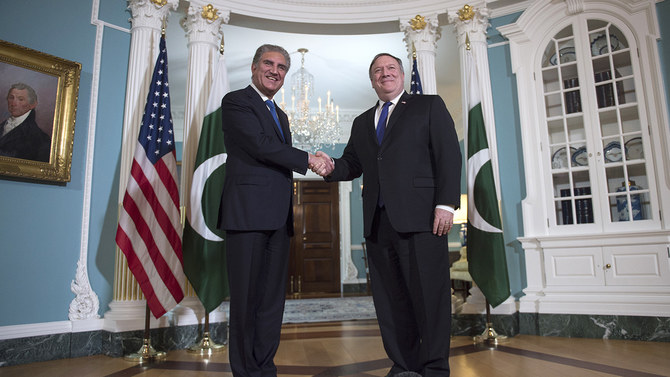
Observers believe that the nearly 18-year conflict will be the major focus of talks between PM Imran Khan and President Donald Trump when they meet on July 22. (AFP/File)
Updated 22 July 2019
Follow

Pakistan hopes to ‘refresh’ US ties with PM Khan’s visit

  • PM Khan is slated to meet Trump on July 22
  • Pakistan has been facilitating the US-Taliban talks in good faith, says FM Qureshi

ISLAMABAD: Pakistan expressed hopes Tuesday that Prime Minister Imran Khan’s maiden trip to the White House later this month would help repair its acrimonious relationship with Washington as the US seeks its help in ending the war in Afghanistan.
Observers believe that the nearly 18-year conflict will be the major focus of talks between Khan and President Donald Trump when they meet on July 22, as Washington presses for Pakistani assistance in securing a peace deal.
“Pakistan has been facilitating the US-Taliban talks in good faith, underscoring that it remains a shared responsibility,” Foreign Minister Shah Mehmood Qureshi said during a seminar in Islamabad.
“It will, therefore, be appropriate to work for broader engagement from Afghanistan to bilateral issues, economic and trade cooperation, to peace and stability in South Asia,” he added.
Khan and Trump — both celebrities-turned-politicians whose love lives once made regular tabloid fare — have clashed in the past, with the Pakistani premier once describing a potential meeting with the US president as a “bitter pill” to swallow.
But on Tuesday, Qureshi said that Trump’s invitation to Khan reflected the “importance of the relationship for both sides.”
Relations between Pakistan and the United States have been turbulent since Trump took office in 2017, with the US leader frequently singling out Islamabad for failing to rein in extremists and being an unfaithful partner in the fight against militants.
The White House has repeatedly accused the shadowy Pakistani military establishment of helping fund and arm the Taliban, both for ideological reasons and to counter rising Indian influence in Afghanistan.
Pakistan denies the claims and says it has paid the price for its alliance with the US in the so-called “war on terror,” with thousands of its citizens killed in its long struggle with militancy.
Last year, Trump suspended $300 million in military aid to Islamabad, saying Pakistan has given Washington “nothing but lies & deceit, thinking of our leaders as fools.”


Pakistani religious scholars condemn Islamabad mosque blast, call it contrary to Islamic teachings

Updated 10 sec ago
Follow

Pakistani religious scholars condemn Islamabad mosque blast, call it contrary to Islamic teachings

  • Daesh claimed responsibility for the attack that killed 32 worshippers, injured over 150 others at Imam Bargah Qasr-e-Khadijatul Kubra
  • Religious scholars say the entire nation stands by the government and armed forces in uprooting the menace of militancy from the country

ISLAMABAD: Pakistani religious scholars on Sunday condemned last week’s suicide bombing at a mosque in the federal capital of Islamabad, saying the attack was contrary to Islamic teachings.

At least 32 people were killed and over 150 others sustained injuries in the blast that targeted Imam Bargah Qasr-e-Khadijatul Kubra mosque in the Tarlai Kallan area on Islamabad’s outskirts.

The blast occurred during Friday prayers, when mosques around the country are packed with worshippers, with Daesh saying one of its militants had targeted the congregation by detonating an explosive vest.

Religious scholars, at a meeting presided over by Religious Affairs Minister Sardar Muhammad Yousuf, called for patience, piety and mutual empathy to thwart divisive conspiracies of the enemy.

“The suicide attack during Friday prayers in Islamabad was condemned in the strongest terms,” read a joint statement issued after the meeting. “It was clarified that targeting innocent worshippers in places of worship is entirely contrary to Islamic teachings as well as constitutional and ethical principles.”

Friday’s mosque blast was the deadliest in Islamabad since a 2008 suicide bombing at the Marriott Hotel that killed 63 people and wounded more than 250. In November, a suicide bomber struck outside a court in the capital, killing 12 people.

The latest attack comes as Prime Minister Shehbaz Sharif’s government deals with a surge in militancy across Pakistan.

Religious scholars pledged to play their role in disseminating messages of peace, tolerance and mutual respect to safeguard the younger generation from extremism.

“It was unanimously declared that the entire nation, along with the Ulema and Mashaikh, stands shoulder to shoulder with the Government of Pakistan and the Armed Forces of Pakistan, and is resolute in uprooting the menace of terrorism from its roots,” the joint statement added.