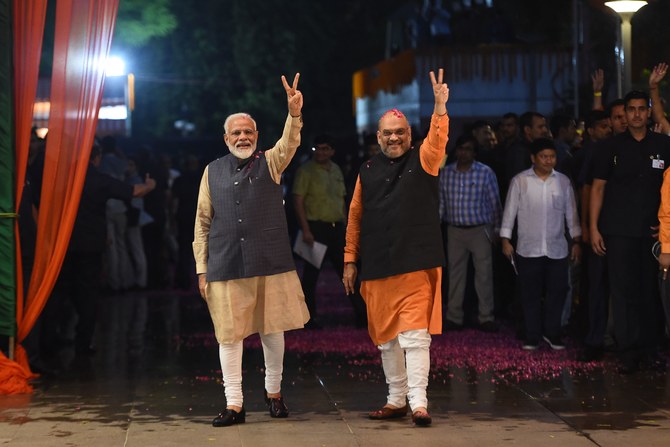
ISLAMABAD: Pakistani Prime Minister Imran Khan on Thursday congratulated India’s Narendra Modi on the runaway election win of his Hindu-nationalist Bharatiya Janata Party (BJP), a victory achieved on the plank of a tougher stand on national security, including ties with arch-rival Islamabad.
The two nations have had tense relations in recent months following a confrontation that saw them carry out an aerial bombing mission against each other earlier this year, and even fight a brief dogfight, before tensions subsided.
“I congratulate Prime Minister Modi on the electoral victory of BJP and allies,” Khan said in a Twitter post. “Look forward to working with him for peace, progress and prosperity in South Asia.”
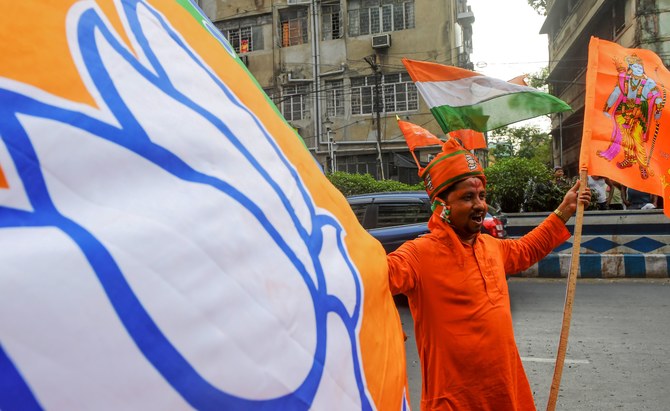
Official data from India’s Election Commission showed Modi’s BJP ahead in at least 300 of the 542 seats available, well over the 272 seats needed for a majority in the lower house of parliament. This gives it the first back-to-back majority for a single party since 1984.
While tackling economic problems at home, Modi will also keep a close eye on relations with Pakistan during his second term as prime minister.
Pakistan on Wednesday signaled a willingness to open talks, with Foreign Minister Shah Mehmud Qureshi saying after briefly meeting his Indian counterpart Shushma Swaraj at the sidelines of a meeting of the Shanghai Cooperation Organization member states in the Kyrgyz capital, Bishkek: “We never speak bitterly, we want to live like good neighbors and settle our outstanding issues.”
“I told Sushma that we are still firm on the statement of Prime Minister Imran Khan that if India takes one step forward, Pakistan would reciprocate with two,” Qureshi added.
Despite the foreign minister’s reconciliatory tone, as it became clear on Thursday that Modi was set to win the massive, multi-stage poll, Pakistan’s army test fired a surface-to-surface ballistic missile capable of delivering conventional and nuclear weapons in what was seen as a veiled warning to India.
“Pakistan will be in a position to present the new Indian government with a historic opportunity to frame a new deal for this region and its prosperity,” Mosharraf Zaidi, columnist and foreign policy analyst, told Arab News, commenting on prospects for peace between India and Pakistan following India’s landmark poll.
Zaidi said all issues including Kashmir could be resolved through dialogue and urged political consensus within Pakistan before proceeding with negotiations with India.
“None of these issues are unresolvable. But at least within Pakistan, a serious effort at detente and normalization with India demands a wide spectrum of political ownership,” Zaidi added.
In an interview with Independent Urdu on Wednesday, Indian High Commissioner to Pakistan Ajay Bisaria also expressed hope for dialogue between both the nuclear-armed neighbors after the Indian election.
“Both the countries will have to take small steps to bridge the trust deficit,” Bisaria said, adding that “proxy wars” [by both India and Pakistan] for terrorism should come to an end.”
Quaid-e-Azam University professor Aasim Sajjad Akhtar, was skeptical the right-wing, ultra-right BJP party would work for peace with Pakistan.
“Given its election campaign trail, the BJP-led government doesn’t seem to be in a position to initiate any serious and consistent effort for dialogue with Pakistan,” Akhtar said.


![]()
![]()

Pakistan’s Khan congratulates India’s Modi on runaway election win
Pakistan’s Khan congratulates India’s Modi on runaway election win
- PM says looking forward to working with Modi for “peace, progress and prosperity in South Asia”
- Pakistani analysts between hope and despair that new Indian administration will provide opening to fix tense ties
Latest updates




© 2026 SAUDI RESEARCH & PUBLISHING COMPANY, All Rights Reserved And subject to Terms of Use Agreement.