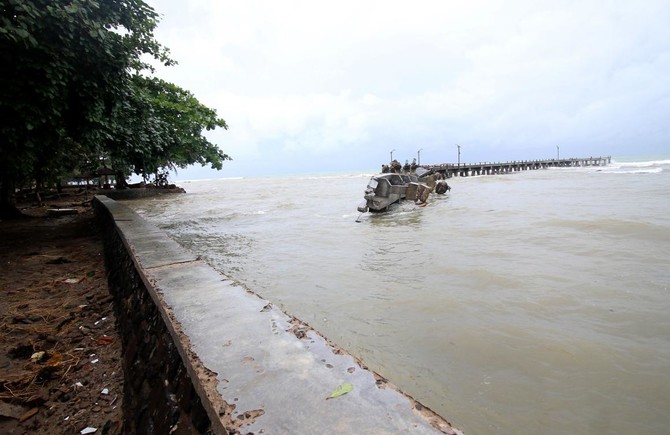
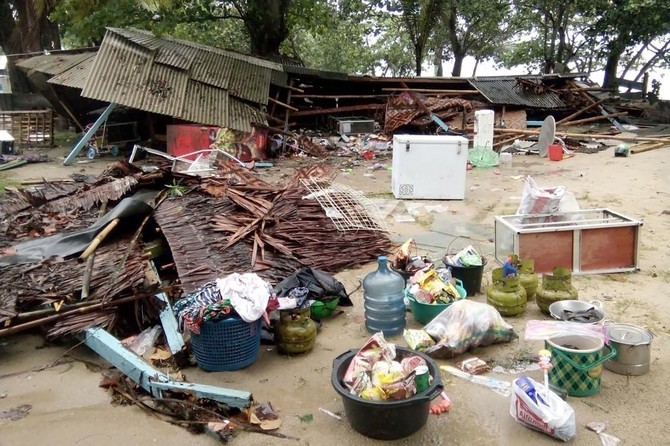
JAKARTA: An unpredictable chain of events and an inadequate early warning system combined to deadly effect with the tsunami that slammed into coastal areas of Indonesia killing nearly 300 people, disaster officials and experts said Monday.
The killer wave struck tourist beaches and low-lying settlements on both sides of the Sunda Strait with devastating force on Saturday night, catching both residents and disaster monitors totally unawares.
In a series of tweets later deleted with a stricken apology, the national disaster agency had stated there was “no tsunami threat” even as the wave crashed over parts of southern Sumatra and the western tip of Java.
“The lack of an early warning system is why the tsunami was not detected,” acknowledged disaster agency spokesman Sutopo Purwo Nugroho.
“Signs that a tsunami was coming weren’t detected and so people did not have time to evacuate,” he added.
Indonesia is one of the most disaster-prone nations on Earth due to its position straddling the so-called Pacific Ring of Fire, where tectonic plates collide.
A quake-tsunami that struck Palu on Sulawesi island in September killed around 2,200 people, with thousands more missing and presumed dead.
Tide-monitoring stations and data-modelling are the main tools Indonesia monitoring agencies use to predict tsunamis — usually in the wake of an earthquake.
But even if all the country’s stations are working, the network is recognized to be limited and in any case gives people little time to flee as they only detect waves once they are close to shore.
Efforts to improve systems have been beset by problems, from a failure to properly maintain new equipment to bureaucratic bickering.
Experts say Saturday’s disaster was most likely caused by a moderate eruption of the Anak Krakatoa volcano in the Sunda Strait that triggered either a large and very fast moving flow of molten rock into the sea or a sudden and massive submarine landslide.
In either case, large volumes of water would have been displaced, resulting in a tsunami.
“Such triggers would not have been detected by Indonesia’s tsunami early warning system because that is geared-up to detect earthquake-triggered tsunamis,” said Richard Teeuw, a disaster risk reduction expert at the University of Portsmouth in England.
“The night-time occurrence of the tsunami would have added to the chaos, with little chance of seeing the incoming tsunami wave and running to safety,” Teeuw said.
And the fact that Anak Krakatoa had been displaying significant activity for months, meant that Saturday’s minor eruption would have sparked no particular cause for alarm.
After the catastrophic Indian Ocean quake-tsunami in 2004, Indonesia deployed a number of early-warning marine buoys to detect tsunamis, but Nugroho said they had been out of action for the past six years.
“Vandalism, limited budgets and technical issues are the reasons why we currently don’t have tsunami buoys,” he said. “We must rebuild them to strengthen Indonesia’s Tsunami Early Warning System.”
Such buoys are normally deployed along underwater tectonic plate boundaries — the focus again on detecting earthquake-generated tsunamis rather than those triggered by volcanic activity.
David Rothery, a professor of planetary geosciences at Britain’s Open University, noted that a blanket deployment of buoys would still have a limited warning impact if the tsunami was generated close to the shore.
“Even if there had been such a buoy right next to Anak Krakatau, this is so close to the affected shorelines that warning time would have been minimal given the high speeds at which tsunami waves travel,” Rothery said.

No warning meant no escape from Indonesia tsunami
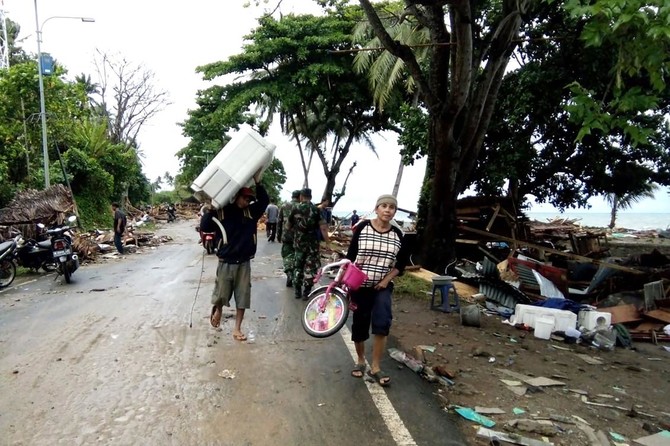
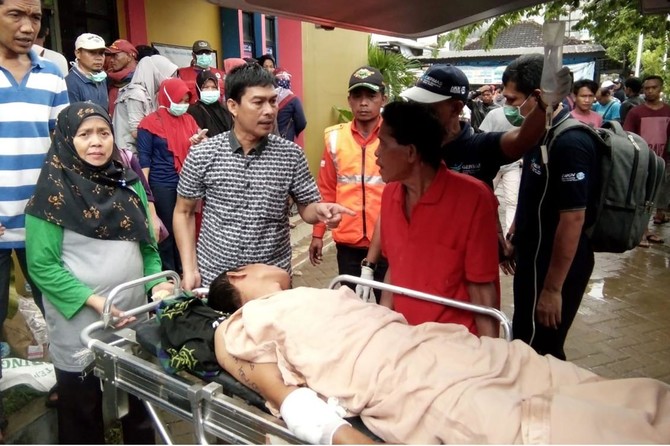
- “The lack of an early warning system is why the tsunami was not detected,” acknowledged disaster agency spokesman Sutopo Purwo Nugroho
- Indonesia is one of the most disaster-prone nations on Earth due to its position straddling the so-called Pacific Ring of Fire, where tectonic plates collide
Justice Department says it’s releasing 3 million pages from its Jeffrey Epstein files
- The documents were disclosed under the Epstein Files Transparency Act
- “Today’s release marks the end of a very comprehensive document identification and review process to ensure transparency to the American people,” Blanche said
NEW YORK: The Justice Department said Friday that it was releasing many more records from its investigative files on Jeffrey Epstein, resuming disclosures under a law intended to reveal what the government knew about the millionaire financier’s sexual abuse of young girls and his interactions with rich and powerful people including Donald Trump and Bill Clinton.
Deputy Attorney General Todd Blanche said the department was releasing more than 3 million pages of documents in the latest Epstein disclosure, as well as more than 2,000 videos and 180,000 images.
The files, which were being posted to the department’s website, include some of the several million pages of records that officials said were withheld from an initial release of documents in December.
The documents were disclosed under the Epstein Files Transparency Act, the law enacted after months of public and political pressure that requires the government to open its files on the late financier and his confidant and onetime girlfriend, Ghislaine Maxwell.
“Today’s release marks the end of a very comprehensive document identification and review process to ensure transparency to the American people and compliance with the act,” Blanche said at a news conference announcing the disclosure.
The prospect of previously unseen records tying Epstein to famous figures has long animated online sleuths, conspiracy theorists and others who have clamored for a full accounting that even Blanche acknowledged might not be met by the latest document dump.
“There’s a hunger, or a thirst, for information that I don’t think will be satisfied by review of these documents,” he said.
He insisted that, “We did not protect President Trump. We didn’t protect — or not protect — anybody,” Blanche said.
After missing a Dec. 19 deadline set by Congress to release all of the files, the Justice Department said it tasked hundreds of lawyers with reviewing the records to determine what needs to be redacted, or blacked out.
Among the materials being withheld from release Friday is information that could jeopardize any ongoing investigation or expose the identities of potential victims of sex abuse. All women other than Maxwell have been redacted from videos and images being released Friday, Blanche said.
The number of documents subject to review has ballooned to roughly six million, including duplicates, the department said.
The Justice Department released tens of thousands of pages of documents just before Christmas, including photographs, interview transcripts, call logs and court records. Many of them were either already public or heavily blacked out.
Those records included previously released flight logs showing that Trump flew on Epstein’s private jet in the 1990s, before they had a falling out, and several photographs of Clinton. Neither Trump, a Republican, nor Clinton, a Democrat, has been publicly accused of wrongdoing in connection with Epstein, and both have said they had no knowledge he was abusing underage girls.
Also released last month were transcripts of grand jury testimony from FBI agents who described interviews they had with several girls and young women who said they were paid to perform sex acts for Epstein.
Epstein killed himself in a New York jail cell in August 2019, a month after he was indicted on federal sex trafficking charges.
In 2008 and 2009, Epstein served jail time in Florida after pleading guilty to soliciting prostitution from someone under the age of 18. At the time, investigators had gathered evidence that Epstein had sexually abused underage girls at his home in Palm Beach, but the US attorney’s office agreed not to prosecute him in exchange for his guilty plea to lesser state charges.
In 2021, a federal jury in New York convicted Maxwell, a British socialite, of sex trafficking for helping recruit some of his underage victims. She is serving a 20-year prison sentence at a prison camp in Texas, after being moved there from a federal prison in Florida. She denies any wrongdoing.
US prosecutors never charged anyone else in connection with Epstein’s abuse of girls, but one of his victims, Virginia Roberts Giuffre, accused him in lawsuits of having arranged for her to have sexual encounters at age 17 and 18 with numerous politicians, business titans, noted academics and others, all of whom denied her allegations.
Among the people she accused was Britain’s Prince Andrew, now known as Andrew Mountbatten-Windsor after the scandal led to him being stripped of his royal titles. Andrew denied having sex with Giuffre but settled her lawsuit for an undisclosed sum.
Giuffre died by suicide at her farm in Western Australia last year at age 41.