

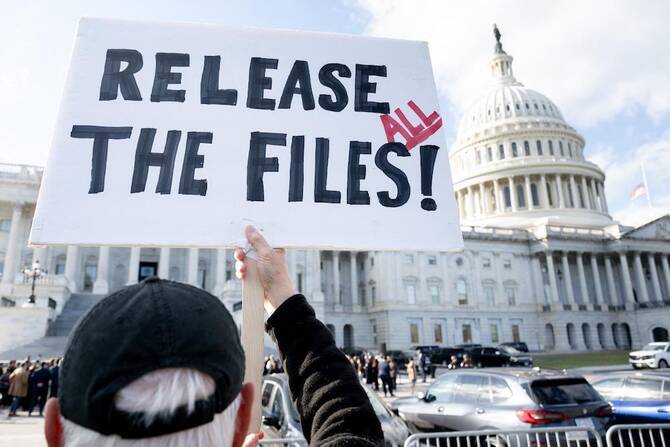

WASHINGTON: A huge new tranche of files on millionaire financier and sex offender Jeffrey Epstein released Friday revealed details of his communications with the wealthy and powerful, some not long before he died by suicide in 2019.
The Justice Department said it was disclosing more than 3 million pages of documents, as well as thousands of videos and photos, as required by a law passed by Congress. By Friday evening, more than 600,000 documents had been published online. Millions of files that prosecutors had identified as potentially subject to release under the law remain under wraps, however, drawing criticism from Democrats.
Here’s what we know so far about the files now being reviewed by a team of Associated Press reporters:
Epstein talked politics with Steve Bannon and an ex-Obama official
The documents show Epstein exchanged hundreds of friendly texts with Steve Bannon, a top adviser to President Donald Trump, some months before Epstein’s death.
They discussed politics, travel and a documentary Bannon was said to be planning that would help salvage Epstein’s reputation.
In March 2019, Bannon asked Epstein if he could supply his plane to pick him up in Rome.
A couple of months later, Epstein messaged to Bannon, “Now you can understand why trump wakes up in the middle of the night sweating when he hears you and I are friends.”
The context is unclear from the documents, which were released with many redactions and little clear organization.
Another 2018 exchange focused on Trump’s threats at the time to oust Federal Reserve Chairman Jerome Powell, whom he had named to the post just the year prior.
Around the same time, Epstein also communicated with Kathy Ruemmler, a lawyer and former Obama White House official. In a typo-filled email, he warned that Democrats should stop demonizing Trump as a Mafia-type figure even as he derided the president as a “maniac.”
Bannon did not immediately respond to a message from the AP seeking comment. Ruemmler said through a spokesperson she was associated with Epstein professionally during her time as a lawyer in private practice and now “regrets ever knowing him.”
He also chatted with Elon Musk and Howard Lutnick about island visits
Billionaire Tesla founder Elon Musk e-mailed Epstein in 2012 and 2013 about visiting his infamous island compound, the scene of many allegations of sexual abuse.
Epstein inquired in an email about how many people Musk would like flown by helicopter, and Musk responded that it would likely be just him and his partner at the time. “What day/night will be the wildest party on =our island?” he wrote, according to the Justice Department records.
It’s not immediately clear if the island visits took place. Spokespersons for Musk’s companies, Tesla and X, didn’t immediately respond to emails seeking comment Friday.
Musk has maintained that he repeatedly turned down the disgraced financier’s overtures. “Epstein tried to get me to go to his island and I REFUSED,” he posted on X in 2025.
Epstein also invited Commerce Secretary Howard Lutnick to the island in Dec. 2012. Lutnick’s wife enthusiastically accepted the invitation and said they would arrive on a yacht with their children. The two also had drinks on another occasion in 2011, according to a schedule. Six years later, they e-mailed about the construction of a building across the street from both of their homes.
Lutnick has distanced himself from Epstein, calling him “gross” and saying in 2025 that he cut ties decades ago. He didn’t respond to an e-mailed request for comment on Friday afternoon.
The records also have new details on Epstein’s incarceration and suicide
Epstein was arrested on federal sex trafficking charges in July 2019, and found dead in his cell just over a month later.
The latest batch of documents includes emails between investigators about Epstein’s death, including an investigator’s observation that his final communication doesn’t look like a suicide note. Multiple investigations have determined that Epstein’s death was a suicide.
The records also detail a trick that jail staffers used to fool the media gathered outside while Epstein’s body was removed: they used boxes and sheets to create what appeared to be a body and loaded it into a white van labeled as belonging to the Office of the Chief Medical Examiner.
The reporters followed the van when it left the jail, not knowing that Epstein’s actual body was loaded into a black vehicle, which departed “unnoticed,” according to the interview notes.


