

Death toll from Indonesia tsunami rises to 281: officials

1 / 14
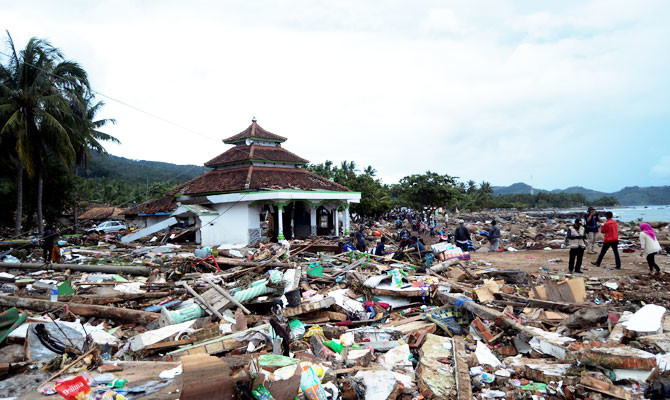
An aerial photo shows damaged buildings in Carita on December 23, 2018, after the area was hit by a tsunami on December 22 following an eruption of the Anak Krakatoa volcano. (AFP)
2 / 14
A motorist passes a car damaged by a tsunami, in Tanjung Lesung, Indonesia, Monday, Dec. 24, 2018. (AP)
3 / 14
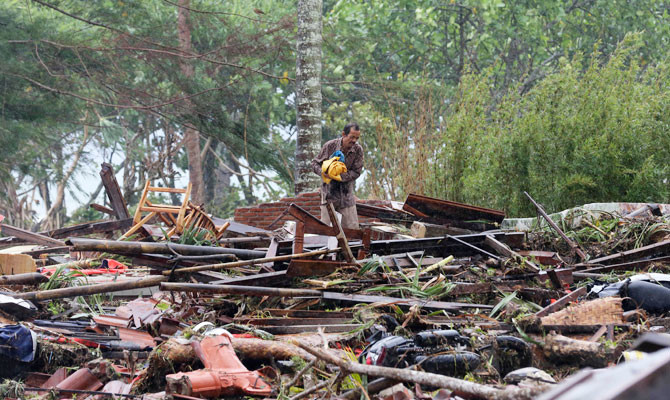
Debris seen after a tsunami hit at Rajabasa district in South Lampung, Indonesia, December 23, 2018 in this photo taken by Antara Foto. (Reuters)
4 / 14
A resident inspects a his house damaged by a tsunami, near Sumur village, Indonesia, Monday, Dec. 24, 2018. (AP)
5 / 14
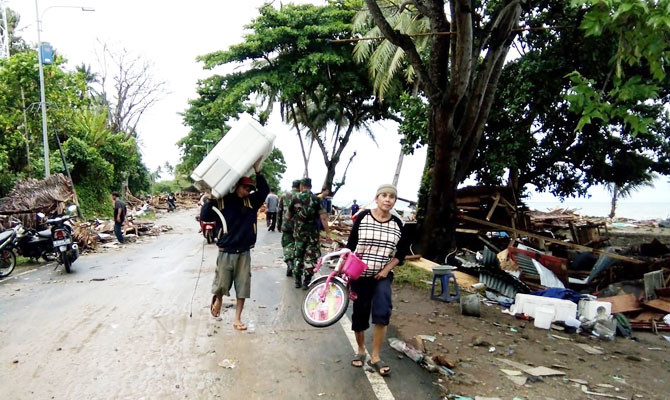
Debris from damaged buildings is seen on a street on Carita beach on December 23, 2018, after the area was hit by a tsunami on December 22 that was triggered by an eruption of the Anak Krakatoa volcano. (AFP)
6 / 14
Indonesian villagers remove water from a hole where the remains of the 2004 tsunami and earthquake victims were discovered in Kajhu, Aceh province on December 19, 2018. (AFP)
7 / 14
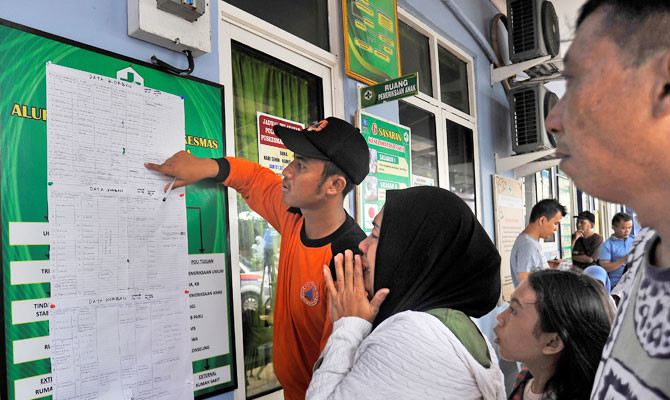
A woman cries as she reads a list of victims who were killed in a tsunami, at Carita in Padeglang, Banten province, Indonesia, December 23, 2018 in this photo taken by Antara Foto. (Reuters)
8 / 14
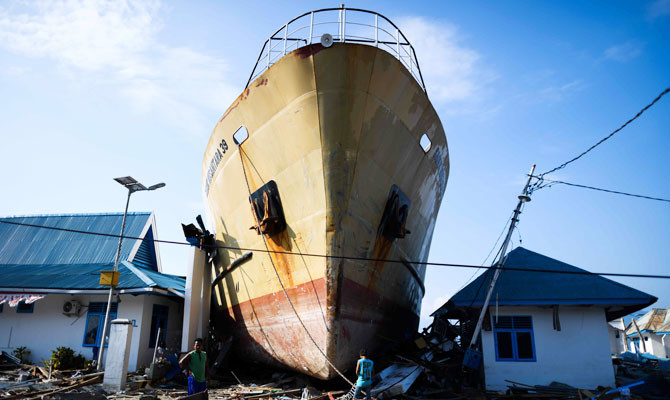
Quake survivors make their way past a washed out passenger ferry in Wani, Indonesia's Central Sulawesi on October 3, 2018, after an earthquake and tsunami hit the area on September 28. (AFP)
9 / 14
This aerial photo shows Indonesian soldiers burying quake victims in a mass grave in Poboya in Indonesia's Central Sulawesi on October 2, 2018, after an earthquake and tsunami hit the area on September 28. (AFP)
10 / 14
Indonesian villagers carry the remains of the 2004 tsunami and earthquake victims discovered in Kajhu, Aceh province on December 19, 2018. (AFP)
11 / 14
Residents evacuate from damaged homes on Carita beach on December 23, 2018, after the area was hit by a tsunami on December 22 that may have been caused by the Anak Krakatoa volcano. (AFP)
12 / 14
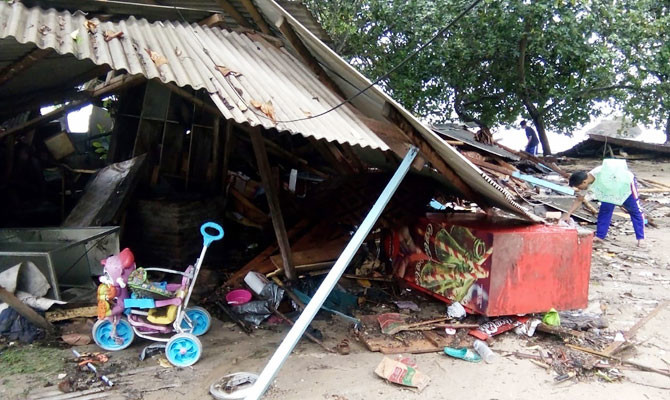
People look for salvageable items from a damaged home on Carita beach on December 23, 2018, after the area was hit by a tsunami that may have been caused by the Anak Krakatoa volcano. (AFP)
13 / 14
Debris from damaged buildings is seen on a street on Carita beach on December 23, 2018, after the area was hit by a tsunami on December 22 that was triggered by an eruption of the Anak Krakatoa volcano. (AFP)
14 / 14
Rescuers retrieve the body of a tsunami victim near Sumur village, Indonesia, Monday, Dec. 24, 2018. (AP)
Updated 24 December 2018
Follow

Death toll from Indonesia tsunami rises to 281: officials

  • More than a thousand injured and hundreds of buildings damaged by huge wave thought to be triggered by volcanic eruption
  • Officials in Indonesia apologize for response to tsunami

JAKARTA: The tsunami that struck the Indonesian islands of Java and Sumatra late on Saturday has so far claimed 281 lives, injured more than 1,000 people and damaged hundreds of buildings. It was thought to have been caused by undersea landslides following the Mount Anak Krakatau volcanic eruption in Sunda Strait, between the two islands.

Indonesian social media was abuzz with criticism toward the country’s official response for downplaying initial reports of a tsunami. 

The Meteorology, Climatology and Geophysics Agency (BMKG) tweeted on Saturday night that the waves which hit coastal areas on both sides of the strait were high tidal waves caused by the full moon. It advised people to stay calm and ended its tweet with a sunglasses emoji. 

It revised the tweet shortly afterwards and announced that the agency had not recorded any seismic activities that could have triggered a tsunami. It also acknowledged that the emoji on its previous tweet was inappropriate.

The spokesman for the National Disaster Mitigation Agency (BNPB), Sutopo Purwo Nugroho, who has become a reliable source for the series of disasters that have hit Indonesia, announced shortly after midnight on Sunday that tidal waves had swamped beaches in Lampung province on the southern tip of Sumatra and in Banten on the western coast of Java. 

BMKG head Dwikorita Karnawati said in an early morning, televised press conference said the agency’s tide gauges detected a rise on the sea level but could not immediately determine whether it was a tsunami and needed more time to analyze it.

“Further analysis showed that the wave was indeed a tsunami. The pattern of the waves were similar to that in Palu,” Karnawati said, referring to the tsunami triggered by undersea landslide that followed a 7.5 magnitude earthquake and hit Palu and its neighboring districts on Sept 28. The BMKG was also under fire for lifting its tsunami early warning too early following the Palu earthquake.  

BNPB’s Nugroho has since apologized for the error in his earlier announcement which stated that the wave was only tidal surge waves instead of a tsunami, saying that BNPB based its announcement on the BMKG’s analysis. 

“The BMKG and the Geology Agency are still examining the undersea landslides,” Nugroho said in a press conference from Yogyakarta on Sunday afternoon. “It was difficult to provide early warning for tsunami caused by undersea landslides,” he added. 

No tsunami warning was issued as the result of the confusion on the agencies’ initial assessment. The BMKG said that, based on the geology agency’s record, the eruption occurred at 9.03pm on Saturday, and the tsunami hit coastal areas in Lampung and Banten at 9.27pm. The authorities have not provided information on the height of the waves.

The worst hit area was the Pandeglang district of Banten, where popular beach resorts were packed with holiday-goers spending the Christmas and New Year holiday season. The western Java transmission unit of the state electricity company, PLN, was having a staff and family outing at one resort and had hired a band called Seventeen. Video footage showed the wave crashing over the stage as the band performed. The band said it had lost its bassist, guitarist and road manager, and that other members, including the wife of the singer, were still unaccounted for. 

Nugroho said 164 people were killed in the district, with 446 houses, nine hotels, 350 vessels and boats and 73 vehicles badly damaged. 

“This is a lesson for us because we don’t have early warning system for tsunami triggered by undersea landslides or volcanic activities,” Nugroho said. 

The Mount Anak Krakatau volcano is a new volcano that began to form in 1927 in the caldera of Krakatau, decades after that volcano's major eruption in 1883 that triggered a mega tsunami and killed about 36,000 people in the then Dutch Indies. The sound of its eruption was heard as far as the western part of Australia and its volcanic ash drifted as far as Europe. 

The volcano, which is one of the 127 active volcanoes that dot the Indonesian archipelago, has continued to form and its activity has increased its height by 4 to 6 meters every year, Nugroho said.


Carney says Canada has no plans to pursue free trade agreement with China as Trump threatens tariffs

Updated 5 sec ago
Follow

Carney says Canada has no plans to pursue free trade agreement with China as Trump threatens tariffs

TORONTO: Canadian Prime Minister Mark Carney said Sunday his country has no intention of pursuing a free trade deal with China. He was responding to US President Donald Trump’s threat to impose a 100 percent tariff on goods imported from Canada if America’s northern neighbor went ahead with a trade deal with Beijing.
Carney said his recent agreement with China merely cuts tariffs on a few sectors that were recently hit with tariffs.
Trump claims otherwise, posting that “China is successfully and completely taking over the once Great Country of Canada. So sad to see it happen. I only hope they leave Ice Hockey alone! President DJT”
The prime minister said under the free trade agreement with the US and Mexico there are commitments not to pursue free trade agreements with nonmarket economies without prior notification.
“We have no intention of doing that with China or any other nonmarket economy,” Carney said. “What we have done with China is to rectify some issues that developed in the last couple of years.”
In 2024, Canada mirrored the United States by putting a 100 percent tariff on electric vehicles from Beijing and a 25 percent tariff on steel and aluminum. China had responded by imposing 100 percent import taxes on Canadian canola oil and meal and 25 percent on pork and seafood.
Breaking with the United States this month during a visit to China, Carney cut its 100 percent tariff on Chinese electric cars in return for lower tariffs on those Canadian products.
Carney has said there would be an initial annual cap of 49,000 vehicles on Chinese EV exports coming into Canada at a tariff rate of 6.1 percent, growing to about 70,000 over five years. He noted there was no cap before 2024. He also has said the initial cap on Chinese EV imports was about 3 percent of the 1.8 million vehicles sold in Canada annually and that, in exchange, China is expected to begin investing in the Canadian auto industry within three years.
Trump posted a video Sunday in which the chief executive of the Canadian Vehicle Manufacturers’ Association warns there will be no Canadian auto industry without US access, while noting the Canadian market alone is too small to justify large scale manufacturing from China.
“A MUST WATCH. Canada is systematically destroying itself. The China deal is a disaster for them. Will go down as one of the worst deals, of any kind, in history. All their businesses are moving to the USA. I want to see Canada SURVIVE AND THRIVE! President DJT,” Trump posted on social media.
Trump’s post on Saturday said that if Carney “thinks he is going to make Canada a ‘Drop Off Port’ for China to send goods and products into the United States, he is sorely mistaken.”
“We can’t let Canada become an opening that the Chinese pour their cheap goods into the U.S,” US Treasury Secretary Scott Bessent said on ABC’s “This Week.”
“We have a , but based off — based on that, which is going to be renegotiated this summer, and I’m not sure what Prime Minister Carney is doing here, other than trying to virtue-signal to his globalist friends at Davos.”
Trump’s threat came amid an escalating war of words with Carney as the Republican president’s push to acquire Greenland strained the NATO alliance.
Carney has emerged as a leader of a movement for countries to find ways to link up and counter the US under Trump. Speaking in Davos before Trump, Carney said, “Middle powers must act together because if you are not at the table, you are on the menu” and he warned about coercion by great powers — without mentioning Trump’s name. The prime minister received widespread praise and attention for his remarks, upstaging Trump at the World Economic Forum.
Trump’s push to acquire Greenland has come after he has repeatedly needled Canada over its sovereignty and suggested it also be absorbed into the United States as a 51st state. He posted an altered image on social media this week showing a map of the United States that included Canada, Venezuela, Greenland and Cuba as part of its territory.