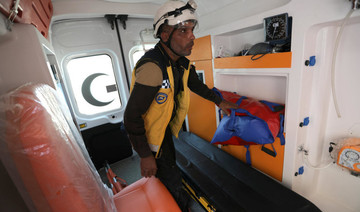
Jordan says nearly 300 Syrian ‘White Helmets’ leave country for West

In July the rescue workers, fleeing advancing Russian-backed Syrian government troops. (AFP)
Updated 17 October 2018
Follow

Jordan says nearly 300 Syrian ‘White Helmets’ leave country for West

AMMAN: Around 300 Syrian “White Helmet” rescue workers who fled Syria for Jordan three months ago have now left for resettlement in Western countries, a Jordanian foreign ministry statement said on Wednesday.
In July the rescue workers, fleeing advancing Russian-backed Syrian government troops, slipped over the Israeli-occupied Golan Heights frontier and into Jordan, with the help of Israeli soldiers and Western powers.
Israeli Prime Minister Benjamin Netanyahu said at the time he had helped the evacuation at the request of US President Donald Trump and other leaders and that there had been fears that the rescue workers’ lives were at risk.
Jordan had accepted them after getting guarantees their stay would be temporary and they would be given asylum in Canada, Germany and Britain, Jordanian officials said.
The “White Helmets,” known officially as Syria Civil Defense, have been credited with saving thousands of people in rebel-held areas during years of bombing by Syrian government and Russian forces in the country’s civil war.
Its members say they are neutral. Syrian President Bashar Assad and his backers describe them as tools of Western propaganda and Islamist-led insurgents.


Turkiye blocks aid convoy to Syria’s Kobani: NGOs

Updated 5 sec ago
Follow

Turkiye blocks aid convoy to Syria’s Kobani: NGOs

  • They said the aid was blocked before it reached the Turkiye-Syria border
  • “Blocking humanitarian aid trucks carrying basic necessities is unacceptable,” said the platform

ANKARA: Turkish authorities have blocked a convoy carrying aid to Kobani, a predominantly Kurdish town in northern Syria encircled by the Syrian army, NGOs and a Turkish MP said on Saturday.
They said the aid was blocked before it reached the Turkiye-Syria border, despite an agreement announced on Friday between the Syrian government and the country’s Kurdish minority to gradually integrate the Kurds’ military and civilian institutions into the state.
Twenty-five lorries containing water, milk, baby formula and blankets collected in Diyarbakir, the main city in Turkiye’s predominantly Kurdish southeast, “were prevented from crossing the border,” said the Diyarbakir Solidarity and Protection Platform, which organized the aid campaign.
“Blocking humanitarian aid trucks carrying basic necessities is unacceptable, both from the point of view of humanitarian law and from the point of view of moral responsibility,” said the platform, which brings together several NGOs.
Earlier this week, residents of Kobani told AFP they were running out of food, water and electricity because the city was overwhelmed with people fleeing the advance of the Syrian army.
Kurdish forces accused the Syrian army of imposing a siege on Kobani, also known as Ain Al-Arab in Arabic.
“The trucks are still waiting in a depot on the highway,” said Adalet Kaya, an MP from Turkiye’s pro-Kurdish DEM party who was accompanying the convoy.
“We will continue negotiations today. We hope they will be able to cross at the Mursitpinar border post,” he told AFP.
Mursitpinar is located on the Turkish side of the border, across from Kobani.
Turkish authorities have kept the border crossing closed since 2016, while occasionally opening it briefly to allow humanitarian aid to pass through.
DEM and Turkiye’s main opposition CHP called this week for Mursitpinar to be opened “to avoid a humanitarian tragedy.”
Turkish authorities said aid convoys should use the Oncupinar border crossing, 180 kilometers (110 miles) away.
“It’s not just a question of distance. We want to be sure the aid reaches Kobani and is not redirected elsewhere by Damascus, which has imposed a siege,” said Kaya.
After months of deadlock and fighting, Damascus and the Syrian Kurds announced an agreement on Friday that would see the forces and administration of Syria’s Kurdish autonomous region gradually integrated into the Syrian state.
Kobani is around 200 kilometers from the Kurds’ stronghold in Syria’s far northeast.
Kurdish forces liberated the city from a lengthy siege by the Daesh group in 2015 and it took on symbolic value as their first major victory against the militants.
Kobani is hemmed in by the Turkish border to the north and government forces on all sides, pending the entry into the force of Friday’s agreement.