

Driven from home, White Helmet rescuers start over in north Syria

1 / 3
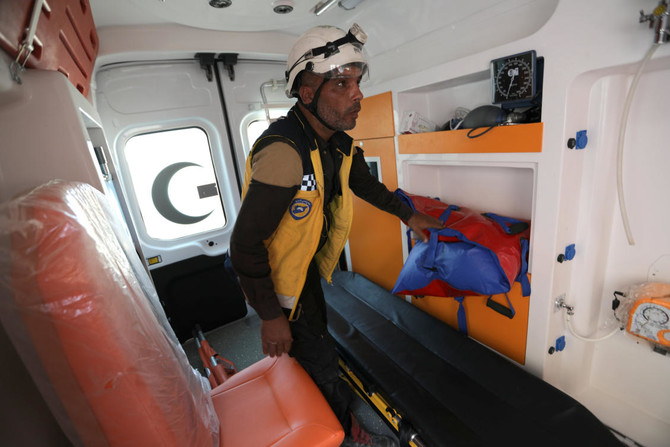
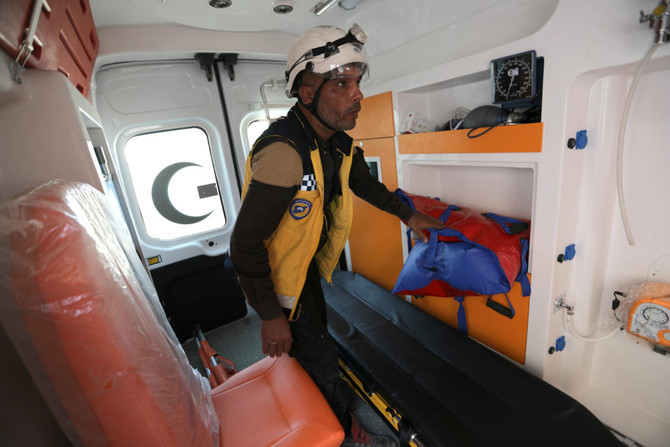
Syrian rescue worker Samir Salim is seen in an ambulance during an interview with Reuters in Azaz, Syria July 8, 2018. (Reuters)
2 / 3
Syrian rescue worker Samir Salim sits next to his colleague Ahmed Rashid during an interview with Reuters in Azaz, Syria July 8, 2018. (Reuters)
3 / 3
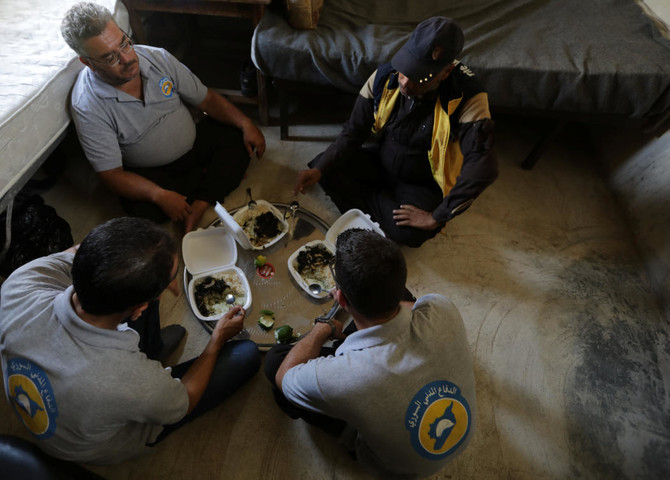
Syrian rescue worker Samir Salim eats lunch with his colleagues during an interview with Reuters in Azaz, Syria July 8, 2018. Picture taken July 8, 2018. (Reuters)
Updated 27 August 2018
Follow

Driven from home, White Helmet rescuers start over in north Syria

  • The White Helmets have often said they worried about reprisals as government forces defeated rebel enclaves with Russian and Iranian help
  • The civil defense service, which receives funding from Western governments, pulls people from the rubble of air strikes in rebel territory

Syrian rescue worker Samir Salim found his mother’s body under their collapsed house, but there was no time for a funeral.
“We buried her and went back to work. There were a lot of people under the rubble,” he said. Months later, he can no longer even visit her grave.
When Syrian government forces clawed back his eastern Ghouta hometown, near the capital Damascus, Salim followed hundreds of thousands of others who had fled to the northwest under rebel surrender deals.
Now, he and “White Helmet” workers driven from different parts of Syria have come together in the rebel-controlled town of Azaz to try to rebuild their lives near the Turkish border.
Their work has changed drastically: with no warplanes cruising overhead, they help the opposition authorities put out fires, clean the streets, and plant trees.
Azaz falls within a de facto buffer zone which Turkey has carved out since 2016. The northwest corner remains Syria’s last major insurgent stronghold and is now in President Bashar Assad’s crosshairs.
The White Helmets have often said they worried about reprisals as government forces defeated rebel enclaves with Russian and Iranian help.
The civil defense service, which receives funding from Western governments, pulls people from the rubble of air strikes in rebel territory. Assad has accused it of being a Western-sponsored front for Al-Qaeda’s branch in Syria.

New Life, Foreign Place

Salim said many comrades stayed behind in eastern Ghouta.
Before leaving, he helped burn down the emergency center he had once helped establish in his town, where his three brothers also worked.
As buses shuttled evacuees out through government territory, including Salim’s wife, five children, and relatives, some people cursed and threw stones at them, he added.
“We arrived with great misery,” said Salim, 45. “Our peers gave us an exceptional welcome.”
Azaz is worlds apart from Ghouta, which lived through years of bitter siege and air strikes — far from the Turkish influence of the northwest.
Salim recalled a sarin gas attack that killed hundreds of people in 2013 in the rebel enclave. “People were running down the streets screaming ‘chemicals’ and there were a lot of civilians lying in the streets foaming at the mouth.”
He said he injured his spleen during an air strike on a market in 2016 and had part of his intestines removed.
The White Helmet first responders say Damascus has specifically targeted them during the more than seven-year conflict. The government says it only targets militants.
“We fear building a new life in a foreign place and then having to leave once again,” Salim said. “I fear northern Syria will face what we did in Ghouta.”
His family now lives in the nearby Afrin region, where a Turkish assault earlier this year ousted Syrian Kurdish fighters. Those forces have accused Turkey of expelling Afrin’s residents to resettle other people, which Ankara denies.

Harsher Times

Salim’s new team includes Ahmed Rashid, 30, who was bussed out of eastern Aleppo two years ago after fighter jets levelled entire districts.
The bloody battle for Aleppo in northern Syria marked a turning point in the war as pro-government forces swept through the insurgent half of the city. Rashid said 12 friends from his center in Aleppo were killed.
“Nobody expected me to persevere, especially since my parents are in Turkey. But I cannot leave the civil defense,” the former shoe designer said.
“In Aleppo, the bombing was so heavy we couldn’t sleep. “Here (in Azaz), there is no such pressure.”
Nayef Al-Aboud, also part of the same team, said they largely work on services like helping with car accidents.
“Today, our center has workers from the displaced populations,” said Aboud, 22, who is from Azaz. “Our strength has grown because they are here, we learn from their experiences, they lived through harsher times.”


Ceasefire with Kurdish-led force extended for another 15 days, Syrian army says

Updated 25 January 2026
Follow

Ceasefire with Kurdish-led force extended for another 15 days, Syrian army says

  • The defense ministry said the extension was in support of an operation by US forces to transfer accused Daesh militants to Iraq
  • The Kurdish-led Syrian Democratic Forces confirmed the ceasefire extension

RAQQA, Syria: Hours after the expiration of a four-day truce between the Syrian government and Kurdish-led fighters Saturday, Syria’s defense ministry announced the ceasefire had been extended by another 15 days.
The defense ministry said in a statement that the extension was in support of an operation by US forces to transfer accused Daesh militants who had been held in prisons in northeastern Syria to detention centers in Iraq.
The Kurdish-led Syrian Democratic Forces confirmed the ceasefire extension.
“Our forces affirm their commitment to the agreement and their dedication to respecting it, which contributes to de-escalation, the protection of civilians, and the creation of the necessary conditions for stability,” the group said in a statement.
Over the past three weeks, there have been intense clashes between government forces and the SDF, in which the SDF lost large parts of the area they once controlled.
Earlier in the day, the Kurdish-led force called on the international community to prevent any escalation.
The end of the truce came as government forces have been sending reinforcements to Syria’s northeast.
Syria’s interim government signed an agreement last March with the SDF for it to hand over territory and to eventually merge its fighters with government forces. In early January, a new round of talks failed to make progress over the merger, leading to renewed fighting between the two sides.
A new version of the accord was signed last weekend, and a four-day ceasefire was declared Tuesday. Part of the new deal is that SDF members will have to merge into the army and police forces as individuals.
The SDF said in a statement Saturday that military buildups and logistical movements by government forces have been observed, “clearly indicating an intent to escalate and push the region toward a new confrontation.” The SDF said it will continue to abide by the truce.
On Saturday, state TV said authorities on Saturday released 126 boys under the age of 18 who were held at the Al-Aqtan prison near the northern city of Raqqa that was taken by government forces Friday. The teenagers were taken to the city of Raqqa where they were handed over to their families, the TV station said.
The prison is also home to some of the 9,000 members of the Daesh group who are held in northeastern Syria. Most of them remain held in jails run by the SDF. Government forces have so far taken control of two prisons while the rest are still run by the SDF.
Earlier this week, the US military said that some 7,000 Daesh detainees will be transferred to detention centers in neighboring Iraq.
On Wednesday, the US military said that 150 prisoners have been taken to Iraq.