

Out of this world: The disorientating delights of Singapore

Singapore cityscape. (Shutterstock)
Updated 17 October 2018
Follow

Out of this world: The disorientating delights of Singapore

  • Singapore feels like a vision of the future
  • A dreamlike sense of utopia accompanies the city

AMMAN: More than anywhere else I’ve visited, Singapore feels like a vision of the future. Sure, there are cities with taller skyscrapers, faster trains and a more fervent embrace of LED lights, but there’s something about the uniform modernity, efficiency — and, yes, cleanliness — of the southernmost Asian Tiger that seems like a very particular glimpse of an imagined sci-fi world. There is certainly nowhere else on earth you can stroll through a simulated cloud forest, in the world’s largest greenhouse, and be back at the roulette table, or sleeping in a five-star hotel, within minutes.
All this is possible within Singapore’s ultra-modern waterside core, which radiates outwards from the skyline-hugging, S$8 billion, Marina Bay Sands resort — an imposing row of three skyscrapers linked by the 340-meter SkyPark. Such brazen disregard for the rules of nature have led to inevitable comparisons with the Gulf’s vertiginous post-globalized metropolizes (which are not always unfounded — the Sands bears more than a passing resemblance to Abu Dhabi’s The Gate Towers).
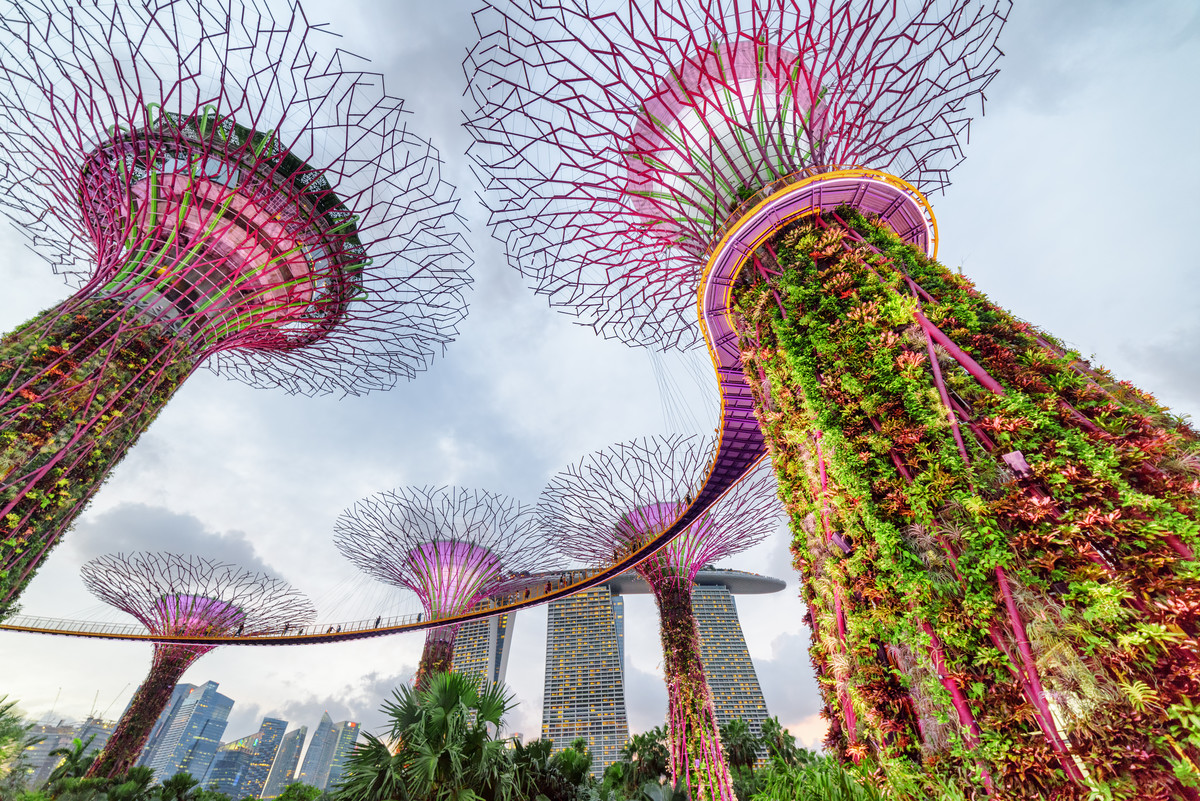

In front sits the ultra-modern, and excellent, ArtScience Museum, its curved outcrops shaped to resemble a lotus flower (or an open hand). Behind you’ll find the beguiling Gardens by the Bay, a 100-hectare stretch of exotic vegetation that has no business in a tropical climate, punctuated by giant dancing steel “supertrees” serving a nightly lightshow. The real freakery takes place inside two huge ticketed greenhouses, the technicolor splendor of the Flower Dome and the Cloud Forest, which eerily simulates climbing a mountain. If feels, of course, nothing like a real forest — but an imagined reconstruction by post-apocalyptic survivors.
But Singapore’s architectural and horticultural conjuring is only part of the story. A sense of post-national futurism feels stamped in the spiritual DNA of the place. Singapore has four official languages — but non-native English is the most widely understood, with 80 percent fluency. In this imagined future, a global tongue overcomes all tribalism.
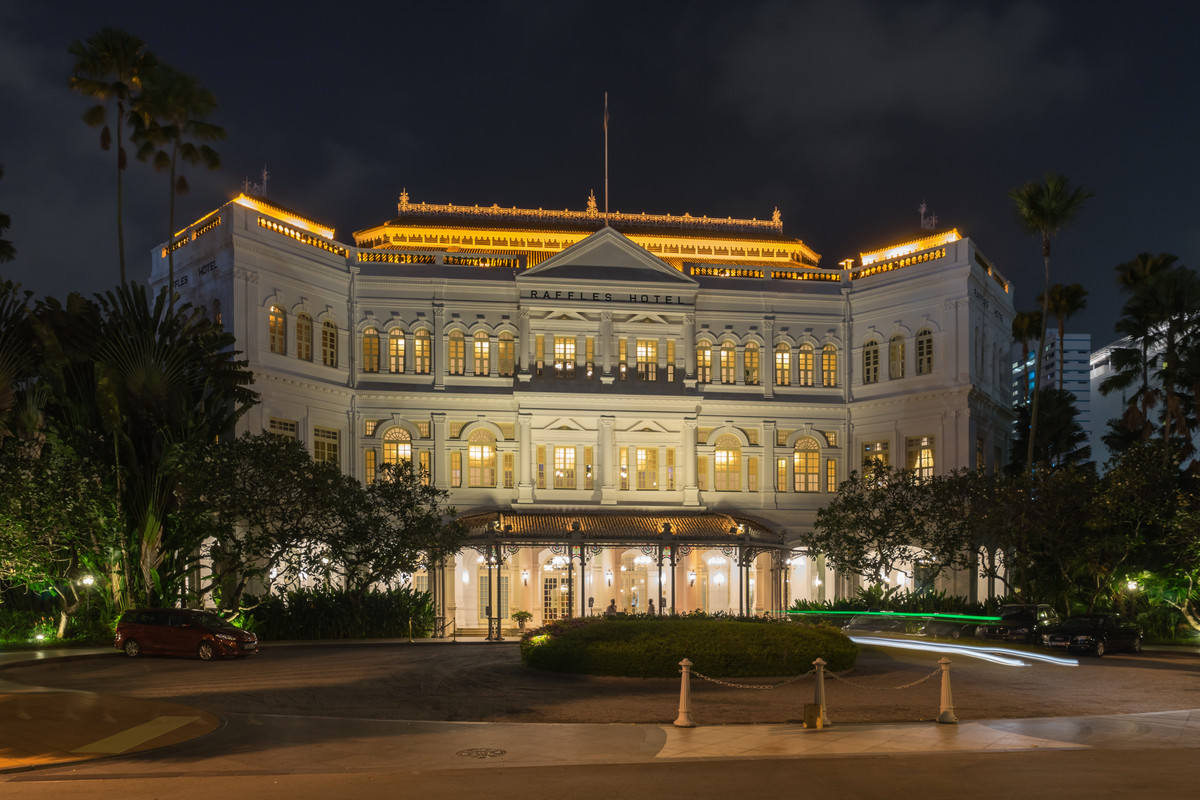
Singapore’s fabled orderliness really is a thing. After a few hours in the country, spotting a discarded cigarette butt feels like proof of a minor insurrection. It’s notable that one selling point of the famed Long Bar at Raffles Hotel — established in 1887 and named after the Brit who founded the city — is being allowed, nay encouraged, to throw peanut shells on the floor, in some arcane colonial ritual. Fun has never felt quite so organized.
Leisure takes place where and when its supposed to, such as on Sentosa — a former POW camp brutally used by the Japanese in World War Two, now a resort island that’s home to 14 hotels, two golf courses, Universal Studios Singapore and the city’s second casino. A five-square-kilometer super-real whirl of primary colors, it’s hard to imagine a more artificial environment outside of Disneyland.

This dreamlike sense of utopia accompanies one across the city. Most unnerving is a visit to the much-hyped Chinatown, Little India and Arab Street — traditional neighborhoods which have been brazenly gentrified into sanitized tourist attractions. Strolling through the former, I look up at rows of brightly colored banners waving from every window of an apartment building. What looked like a vibrant display of individuality unraveled when I realized every banner was of a uniform size and placement.
But this could teach the Gulf’s rapidly modernizing cities a valuable trick: Rather than decimating low-income neighborhoods, often home to colorful communities — give them a clever name and market them as cultural destinations. Who wouldn’t want to visit Mini Manila or Little Lagos, after all?


Russian cyclist finds warm welcome on Saudi Arabia’s roads 

Updated 20 January 2026
Follow

Russian cyclist finds warm welcome on Saudi Arabia’s roads 

  • Anna Rodnishcheva’s ride through Kingdom is defining chapter in solo expedition
  • Rodnishcheva cycled to Aqaba, crossed the border into Saudi Arabia, and has since traveled through Tabuk, AlUla, Madinah, Jeddah, and Taif on her way to Riyadh

MAKKAH: Solo adventurer Anna Rodnishcheva, 27, has undertaken an ambitious journey that spans countries, climates and cultures — on a bicycle. 

Born and raised in Moscow and trained as a biologist before becoming an event photographer, she now finds herself pedaling thousands of kilometers across unfamiliar landscapes in pursuit of discovery, connection, and the simple joy of movement.

In her conversation with Arab News, Rodnishcheva offered a detailed account of her ongoing route in Saudi Arabia, describing how the expedition is her third major cycling adventure.

After previously riding from Moscow to Sochi and later from Vladivostok to Sochi — a route that stretches across the entirety of Russia — she felt compelled to explore foreign lands by bicycle.

She set off from Moscow heading south last June, passing through Russia, Georgia, and Turkiye before flying from Antalya to Amman. She cycled to Aqaba, crossed the border into Saudi Arabia, and has since traveled through Tabuk, AlUla, Madinah, Jeddah, and Taif on her way to Riyadh.

Rodnishcheva explained that physical preparation played only a small role in her planning. She began slowly and allowed her body to adapt naturally over the first month. 

The true challenge, she said, was in the mental and financial preparation. She spent a year and a half planning the journey, even though she originally intended to postpone it for several more years. 

Ultimately, her belief that “life is short” convinced her to start with the resources she already had. Although she sought medical evaluations and additional vaccinations, she was unable to complete them all and decided to continue regardless.

Her journey through Georgia and Turkiye presented unexpected difficulties. Simple tasks such as finding groceries or locating bicycle repair shops became more challenging outside of Russia, where she knew how to navigate on a budget. 

She also encountered language barriers, though the situation improved when a local cyclist joined her in Georgia. The intense midsummer heat added another layer of difficulty, but she had prepared herself for such conditions.

One of the most striking moments of her trip occurred as she crossed from Jordan into Saudi Arabia. She described the experience as surreal and emotionally overwhelming, likening it to the adventures of a literary hero traveling across the Arabian Peninsula. 

Her anxiety eased unexpectedly when she got a flat tire at the border, bringing her back to the present. 

Despite being warned that crossing by bicycle would be prohibited, the process went smoothly, and she was struck by the friendliness of both Jordanian and Saudi officials. She expressed particular surprise at meeting a female Saudi passport officer, an encounter that challenged her previous assumptions about women’s roles in the Kingdom.

Rodnishcheva said the hospitality she had experienced in Saudi Arabia surpassed anything she had encountered on previous journeys. Drivers frequently stop to offer her water, fruit, or sweets, and several families have generously hosted her in their homes or guest flats. 

She emphasized that she feels completely safe traveling across the Kingdom, especially on the open roads between cities, noting the strong and visible security presence.

She has also observed significant differences in weather. While the stretch from the border to Jeddah was hot despite being winter, the climate changed dramatically after climbing Al-Hada in Taif, turning cooler and windier — a climate she compared to Russian summers.

Rodnishcheva documents her travels primarily through Russian-language platforms such as VK and Telegram. Although she maintains YouTube and Instagram accounts, she explained that her schedule left little time for frequent updates.

Offering a message to women around the world who dream of embarking on similar adventures, she said such journeys were “not as scary as they seem before you start,” though they may not suit everyone.

Her closing advice? “Listen to your heart.”