PYEONGTAEK, South Korea: North Korea on Friday returned the remains of what are believed to be US servicemen killed during the Korean War, the White House said, with a USmilitary plane making a rare trip from a US base in South Korea to a coastal city in the North to retrieve the remains.
The handover follows through on a promise Kim Jong Un made to President Donald Trump when the leaders met in June and is the first tangible result from the much-hyped summit.
An Associated Press journalist at Osan Air Base outside of Seoul saw the plane land, and the White House earlier confirmed that a US Air Force C-17 aircraft containing remains of fallen service members had departed Wonsan, North Korea, on its way to Osan. A formal repatriation ceremony will be held there Aug. 1.
At Osan, US servicemen and a military honor guard lined up on the tarmac to receive the remains, which were carried in boxes covered in blue United Nations flags.
Details of what specifically the US had picked up were unclear, but reports said previously that Pyongyang would return about 55 sets of remains from the 1950-53 Korean War.
About 7,700 US soldiers are listed as missing from the Korean War, and 5,300 of the remains are believed to still be in North Korea. The war killed millions, including 36,000 American soldiers.
Despite soaring rhetoric about denuclearization ahead of their meeting, Trump and Kim’s summit ended with only a vague aspirational goal for a nuclear-free Korean Peninsula without describing when and how that would occur. Friday’s handover will be followed by a lengthy series of forensic examinations and tests to determine if the remains are human, and whether they are actually American or allied troops killed in the conflict.
Officials in North Korea had no immediate comment on the possible return of the remains Friday, the 65th anniversary of the end of the Korean War, which the country celebrates as the day of “victory in the fatherland liberation war.”
Friday’s repatriation could be followed by strengthened North Korean demands for fast-tracked discussions with the United States on reaching a declaration to formally end the war, which was stopped with an armistice and not a peace treaty. South Korea’s Defense Ministry also said that the North agreed to general-level military talks next week at a border village to discuss reducing tensions across the countries’ heavily armed border.
The remains are expected to be flown to Joint Base Pearl Harbor-Hickam in Hawaii for scientific testing to identify them.
The US military last month said that 100 wooden “temporary transit cases” built in Seoul were sent to the Joint Security Area at the Korean border as part of preparations to receive and transport remains in a dignified manner. US Forces Korea spokesman Col. Chad Carroll also said, at the time, that 158 metal transfer cases were sent to a US air base and would be used to send the remains home.
The remains are believed to be some of the more than 200 that North Korea has held in storage for some time, and were likely recovered from land during farming or construction. The vast majority of the war dead, however, have yet to be located and retrieved from cemeteries and battlefields across the countryside.
Efforts to recover American war dead had been stalled for more than a decade because of a standoff over North Korea’s nuclear program and a previous US claim that security arrangements for its personnel working in the North were insufficient.
From 1996 to 2005, joint US-North Korea military search teams conducted 33 recovery operations that collected 229 sets of American remains. The last time North Korea turned over remains was in 2007, when Bill Richardson, a former UN ambassador and New Mexico governor, secured the return of six sets.
The North marked Friday’s anniversary with ceremonies at war-related memorials; the capital Pyongyang and other cities were decked out in national flags and bright red banners. For the first time since 2015, Kim Jong Un has announced a general amnesty will be granted for prisoners who have committed crimes against the state.
North Korea has held out the return of remains as a symbol of its goodwill and intention to improve ties with Washington. Officials have bristled, however, at criticism from the US that it seeks to profit from the repatriations by demanding excessive fees for handling and transporting the remains.
Pyongyang has nevertheless expressed its willingness to allow the resumption of joint search missions in the country to retrieve more remains. Such missions had been held from 1996 until they were canceled by President George W. Bush amid heightening tensions over the North’s nuclear program in 2005.
Post Kim-Trump summit talks between US Secretary of State Mike Pompeo and senior North Korean officials got off to a rocky start earlier this month, with the North accusing the Americans of making “unilateral and gangster-like” demands on denuclearization. The North also said US officials came up with various “conditions and excuses” to backtrack on the issue of formally ending the war.
“The adoption of the declaration on the termination of war is the first and foremost process in the light of ending the extreme hostility and establishing new relations between the DPRK and the US,” the North’s Korean Central News Agency said in a statement on Tuesday, referring to North Korea by its official name, the Democratic People’s Republic of Korea. “Peace can come only after the declaration of the termination of war.”
Pompeo said Wednesday that a great deal of work remains ahead of a North Korea denuclearization deal, but he dodged requests to identify a specific denuclearization timeline in testimony to members of the Senate Foreign Relations Committee.
Experts say a declaration to officially end the war, which could also involve Seoul and Beijing, would make it easier for Pyongyang to direct the discussions with Washington toward a peace treaty, diplomatic recognition, security assurance and economic benefits. Some analysts believe that North Korea would eventually demand that the United States withdraw or dramatically reduce the 28,500 troops it keeps in South Korea as a deterrent.
Washington has maintained Pyongyang wouldn’t get sanctions relief and significant security and economic rewards unless it firmly commits to a process of completely and verifiably eliminating its nuclear weapons. There are lingering doubts on whether Kim would ever agree to fully relinquish his nukes, which he may see as a stronger guarantee of survival than whatever security assurance the United States could offer.


![]()
![]()
![]()
![]()

White House says North Korea returns remains of US war dead


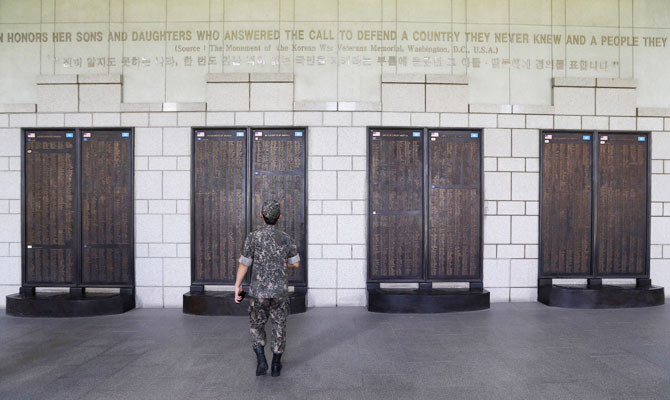
White House says North Korea returns remains of US war dead
- North Korea transfers remains of soldiers from 1950-53 Korean War
- Transfer seen as positive gesture after landmark June summit


Latest updates


© 2026 SAUDI RESEARCH & PUBLISHING COMPANY, All Rights Reserved And subject to Terms of Use Agreement.