Report: US to send caskets to North Korea to return war remains

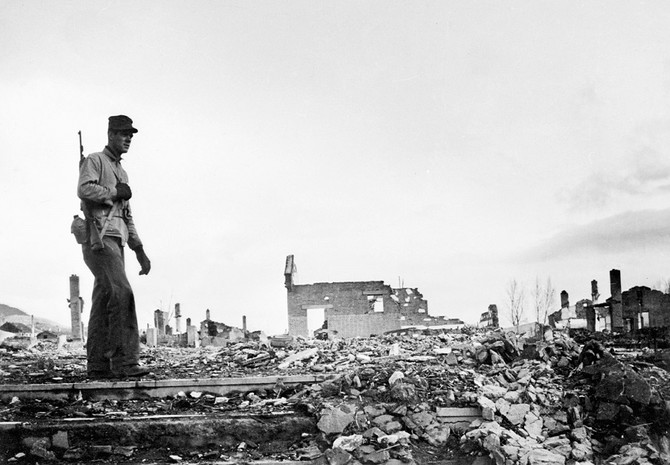
Undated picture taken in Hamhung, Korea, shows an US soldier walking among the ruins of the city (FILE/AFP)
Updated 23 June 2018
Follow

Report: US to send caskets to North Korea to return war remains

  • South Korean media say the US military plans to send 215 caskets to North Korea through a border village
  • North Korea agreed to send home US war remains during a June 12 meeting between North Korean leader Kim Jong Un and President Donald Trump

SEOUL, South Korea: South Korean media say the US military plans to send 215 caskets to North Korea through a border village so that the North could begin the process of returning the remains of US soldiers who have been missing since the 1950-53 Korean War.
Officials from the United States Forces Korea and South Korea’s Defense Ministry on Saturday did not immediately return calls for comment.
South Korea’s Yonhap news agency cited an unnamed source as saying that about 30 US military vehicles carrying the caskets were expected to cross into the North on Saturday afternoon.
North Korea agreed to send home US war remains during a June 12 meeting between North Korean leader Kim Jong Un and President Donald Trump.


US warns UK to stop arresting Palestine Action supporters

Updated 19 January 2026
Follow

US warns UK to stop arresting Palestine Action supporters

  • Undersecretary of state for diplomacy: Arrests doing ‘more harm than good’ and ‘censoring’ free speech
  • Group was banned in July 2025 after series of break-ins

LONDON: UK authorities should stop arresting protesters showing support for banned group Palestine Action, the White House has warned.

The US undersecretary of state for diplomacy said arrests are doing “more harm than good” and are “censoring” free speech.

Sarah Rogers told news site Semafor: “I would have to look at each individual person and each proscribed organization. I think if you support an organization like Hamas, then depending upon whether you’re coordinating, there are all these standards that get applied.

“This Palestine Action group, I’ve seen it written about. I don’t know what it did. I think if you just merely stand up and say, ‘I support Palestine Action’, then unless you are really coordinating with some violent foreign terrorist, I think that censoring that speech does more harm than good.”

So far, more than 2,000 people have been arrested in the UK for showing support for the group.

It was banned in July 2025 after a series of break-ins nationwide, including at a facility owned by a defense manufacturer and a Royal Air Force base, during which military aircraft were damaged.

Last year, Swedish climate activist Greta Thunberg was among those arrested while protesting for Palestine Action.

The group is challenging its ban, saying it should not be compared to terrorist organizations such as the Irish Republican Army, Daesh or Al-Qaeda.

The ban has been criticized by numerous bodies, with Amnesty International calling it a case of “problematic, overly broad and draconian restrictions on free speech.”

In Scotland, prosecutors have been offering to drop charges against some protesters in return for accepting a fine of £100 ($134.30). 

Adam McGibbon, who was arrested at a demonstration in Edinburgh last year, refused the offer, saying: “The fact that the authorities are offering fines equivalent to a parking ticket for a ‘terrorism offence’ shows just how ridiculous these charges are. Do supporters of (Daesh) get the same deal?

“I refuse to pay this fine, as has everyone else I know who has been offered one. Just try and put all 3,000 of us who have defied this ban so far in jail.”

Rogers said the UK is also wrong to arrest people using the phrase “globalize the intifada” while demonstrating in support of Palestine, after police in Manchester said in December that it would detain people chanting it.

“I’m from New York City where thousands of people were murdered by jihadists,” she said. referring to the terror attacks of Sept. 11, 2001. “I don’t want an intifada in New York City, and I think anyone who does is disgusting, but should it be legal to say in most contexts? Yes.”