EU backs off from new sanctions against Iran — for now

1 / 2
European Union foreign policy chief Federica Mogherini speaks with the media as she arrives for a meeting of EU foreign ministers at the EU Council building in Luxembourg on April 16, 2018. (AP Photo/Virginia Mayo)
2 / 2
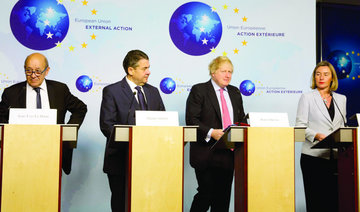
France's Foreign Minister Jean-Yves Le Drian (C), UK's Foreign Secretary Boris Johnson (R), EU foreign policy chief Federica Mogherini (L) and Germany's Foreign Minister Heiko Maas attend an EU foreign affairs council in Luxembourg on April 16, 2018. (AFP / Emmanuel Dunand)
Updated 17 April 2018
Follow

EU backs off from new sanctions against Iran — for now

  • Irish FM stressed need to send a strong signal to Iran about its activities
  • Targets for new sanctions could include both Iranians and non-Iranian militias in Syria

JEDDAH: EU foreign ministers met on Monday for talks on how they could persuade the US not to pull out of the Iran nuclear deal, but stopped short of imposing new sanctions on Tehran.
Britain, France and Germany used a meeting of the EU’s 28 foreign ministers to try to build support for expanding sanctions against Iran to punish it for its regional expansionism and its role in the conflict in Syria.
They hope that by doing so they will persuade US President Donald Trump not to follow through on his threat to abandon the 2015 deal to curb Iran’s nuclear ambitions.
Danish Foreign Minister Anders Samuelson said there was “a very broad majority” in favor of expanding sanctions, as the clock ticks down to a May 12 deadline imposed by Trump to “fix” the agreement.
Simon Coveney, the Irish foreign minister, said there was a need to “send a strong signal to Iran that we’re concerned in relation to some of their activity, particularly in Syria.
“But also to send a message to Washington that we share their concerns in some of those areas,” Coveney said after the talks in Luxembourg.
Targets for new sanctions could include both Iranians and non-Iranian militias in Syria. But any decision would have to have unanimous support, and countries such as Italy and Sweden are not convinced.
“There is no consensus at the moment,” EU diplomatic chief Federica Mogherini said.
“I don’t exclude that this will happen in the future but it’s not the case today.”


Spain highlights importance of Gaza reconstruction

Palestinian prime minister, Mohammed Mustafa, and the Spanish foreign minister, Jose Manuel Albares. (AP)
Updated 02 January 2026
Follow

Spain highlights importance of Gaza reconstruction

  • Spain officially recognized Palestine as a state in May 2024, in a coordinated move alongside Ireland and Norway

RAMALLAH: The Palestinian prime minister, Mohammed Mustafa, and the Spanish foreign minister, Jose Manuel Albares, on Friday discussed the latest developments in the West Bank and Gaza Strip.
During their telephone conversation they emphasized the need to intensify international efforts to end the Israeli occupation and halt attacks and settler violence, and to secure the release of Palestinian funds held by Israeli authorities.
They affirmed the importance of ongoing efforts relating to plans for the reconstruction of Gaza, and Europe’s significant role in this process. Mustafa and Albares highlighted the need to unify Palestinian institutions in Gaza with those in the West Bank, with the aim of establishing a Palestinian state in line with international resolutions, including last year’s New York Declaration.
They also discussed coordination between their countries, and the strengthening of Spain’s political, diplomatic and financial support for Palestine, and Mustafa thanked Spain for its ongoing support.
Spain officially recognized Palestine as a state in May 2024, in a coordinated move alongside Ireland and Norway. Estephan Salameh, the Palestinian finance and planning minister, is set to visit Spain this month to discuss enhanced cooperation, particularly in the areas of development and reconstruction. Meanwhile, Israel continues operating in the occupied West Bank.
The Palestinian Prisoners media office said on Friday that Israel carried out numerous raids across the territory, including the major cities of Ramallah and Hebron, according to The Associated Press.
Nearly 50 people were detained, following the arrest of at least 50 other Palestinians on Thursday, most of those in the Ramallah area.
As 2026 begins, the shaky 12-week-old ceasefire between Israel and Hamas has largely ended large-scale Israeli bombardment of Gaza. 
But Palestinians are still being killed by Israeli fire, especially along the so-called Yellow Line that delineates areas under Israeli control, and the humanitarian crisis is compounded by frequent winter rains and colder temperatures.
On Friday, American actor and film producer Angelina Jolie visited the Rafah border crossing between Egypt and the Gaza Strip. 
The only crossing between the territory and a country other than Israel, it remains closed despite Palestinian requests to reopen it to people and aid.
Jolie met with members of the Red Crescent on the Egyptian side of the Rafah border crossing and then visited a hospital in the nearby city of Arish to speak with Palestinian patients on Friday, according to Egyptian officials.
Aid groups say not enough shelter materials are getting into Gaza during the truce.