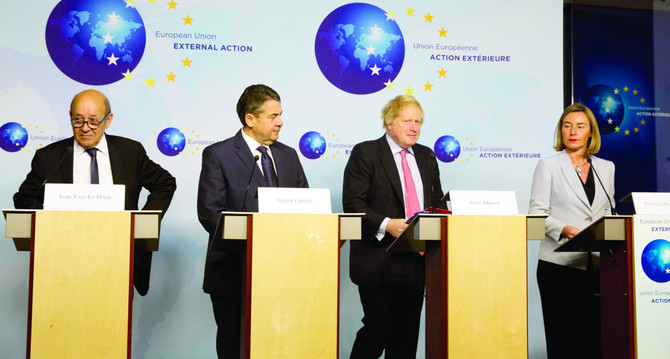
LONDON: European leaders vowed to stand by the Iran nuclear deal on Thursday as US President Donald Trump weighs bringing back sanctions against Tehran.
Speaking after ministers from Britain, France, Germany and Iran met in Brussels, the EU’s diplomatic leader Federica Mogherini insisted that the pact had effectively deterred Iran’s nuclear ambitions.
Despite the show of optimism for the 2015 deal, which lifted sanctions against Iran in return for curbs on the country’s nuclear program, the US president has threatened to follow through with a campaign promise to shred the agreement.
A Friday deadline looms for Trump to renew his support for the sanctions waiver. Top advisers have appealed to the president to adhere to the pact.
Behnam Ben Taleblu, a senior Iran analyst at the Foundation for Defense of Democracies in Washington, said that while it was likely Trump would remain in the nuclear agreement, it was possible that Washington would pursue different avenues to squeeze Tehran.
“Ultimately the president will waive the nuclear sanctions to remain party to the core tenants of the nuclear deal but that doesn’t preclude the US from ramping up this non-nuclear pressure,” Ben Taleblu said.
He added: “The Europeans have wrongly interpreted American enforcement of the deal as an attempt to unravel it.”
The nuclear deal has empowered the Islamic Revolutionary Guard Corps (IRGC) and its militias in the region due to the sanctions relief, Majid Rafizadeh, a Harvard-educated Iranian-American political scientist, told Arab News.
“This has further radicalized, militarized and destabilized the region,” he said, adding: “Iran continues to ratchet up its antagonistic policy toward other Arab nations, the US, and the West.”
While waiting for the Congress to act, Rafizadeh said, Trump administration will more likely impose additional sanctions targeting Iran’s ballistic missile program and individuals involved in human rights violations. “This would give the administration more robust platform to persuade the EU nations to fix the nuclear agreement or to abandon it.”
One major reason that EU powers desire to keep the nuclear deal is the increased trade and business deals between some EU countries and the Iranian regime, said Rafizadeh.
“Trump will more likely give the congress additional time to work on a legislation that would fix the loopholes in the deal, such as requiring Iran to allow its military sites be inspected for nuclear development, research, weaponization and proliferation,” he added.
Iran is also not adhering to the spirit of the nuclear deal due to its heightened interventionist and expansionist policies in the Arab world and due to its human rights violations domestically, he said.

Europeans ‘wrongly interpret’ US enforcement of Iran nuclear deal
Arab Coalition announces ‘limited’ airstrike targeting two ships that smuggled weapons to Yemen
- Coalition urges evacuation of the Port of Mukalla, signaling that a major military operation to force an STC withdrawal could be imminent
- Spokesman says the two ships transported weapons from the UAE port of Fujairah to Mukalla without getting permission from Coalition command
RIYADH: The Coalition to Support Legitimacy in Yemen on Tuesday said it conducted a “limited” airstrike targeting two ships that smuggled weapons and other military hardware into Mukalla in southern Yemen.
In a statement carried by the Saudi Press Agency (SPA), the Coalition Forces spokesman, Major General Turki Al-Maliki, said that two ships coming from the port of Fujairah in the United Arab Emirates entered the Port of Mukalla in Hadramaut without obtaining official permits from the Joint Forces Command of the Coalition.
“The crews of the two ships disabled the tracking systems of the two ships and unloaded a large quantity of weapons and combat vehicles to support the Southern Transitional Council forces in the eastern governorates of Yemen (Hadramawt, Al-Mahra) with the aim of fueling the conflict. This is a clear violation of imposing a truce and reaching a peaceful solution, as well as a violation of UN Security Council Resolution No. (2216) of 2015 AD,” said the spokesman.
The coalition urged civilians and fishermen to evacuate the Port of Mukalla, signaling that a major military operation to force an STC withdrawal could be imminent.
Al-Maliki said the Coalition Forces acted on a request by Rashad Al-Alimi, the president of the Yemeni Presidential Leadership Council, “to take all necessary military measures to protect civilians in the governorates of Hadramawt and Al-Mahra.”
Al-Alimi, the president of the Yemeni Presidential Leadership Council, warned last week that unilateral actions by the STC were pushing the country toward a dangerous tipping point.
“Given the danger and escalation posed by these weapons, which threaten security and stability, the Coalition Air Forces conducted a limited military operation this morning targeting weapons and combat vehicles unloaded from the two ships at the port of Al-Mukalla. This was done after documenting the unloading, and the military operation was carried out in accordance with international humanitarian law and its customary rules, ensuring no collateral damage occurred,” spokesman Al-Maliki said on Tuesday.
READ MORE: Analysis: The risks of carving up Yemen
He affirmed the Coalition’s "continued commitment to de-escalation and enforcing calm in the governorates of Hadramawt and Al-Mahra, and to prevent any military support from any country to any Yemeni faction without coordination with the legitimate Yemeni government and the Coalition. This is aimed at ensuring the success of the Kingdom and the Coalition’s efforts to achieve security and stability and prevent the conflict from spreading.”
Disregarding previous agreements with the Coalition, the group calling itself Southern Transitional Council, or STC, launched a sweeping military campaign early in December, seizing the governorates of Hadramaut along the Saudi border and the eastern governorate of Al-Mahra in Yemen’s border with Oman.
The UAE-backed STC forces captured the city of Seiyun, including its international airport and the presidential palace. They also took control of the strategic PetroMasila oilfields, which account for a massive portion of Yemen’s remaining oil wealth.
This prompted Saudi Arabia to issue a firm demand for the STC to withdraw and hand over the seized areas to the National Shield Forces, a Saudi-backed unit.
The coalition warned that any military movements undermining de-escalation efforts would be dealt with immediately to protect civilians, according to the Saudi Press Agency.
On Dec. 26, the UAE issued a statement welcoming Saudi Arabia’s efforts to support security and stability in Yemen.
The statement carried by state news agency WAM praised Saudi Arabia’s constructive role in advancing the interests of the Yemeni people and supporting their legitimate aspirations for stability and prosperity.