Mideast undersea cable at heart of security scare as Russian navy floats around

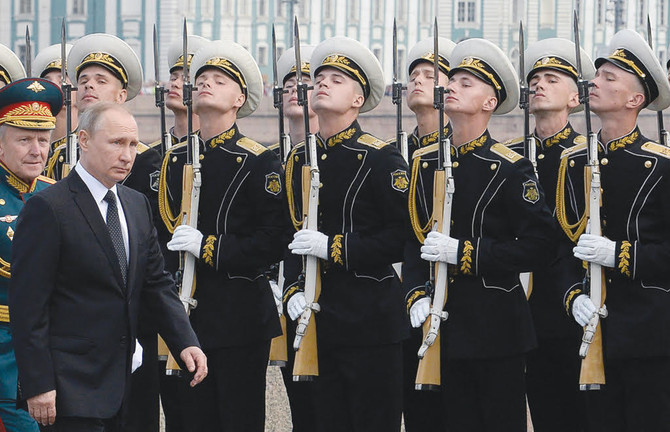
Russian President Vladimir Putin attends a ceremony for Russia’s Navy Day in Saint Petersburg. Washington is worried about the presence of the Russian navy around key undersea cable sites. (AFP )
Updated 30 March 2018
Follow

Mideast undersea cable at heart of security scare as Russian navy floats around

WASHINGTON: Russian ships are prowling around underwater communications cables, causing the US and its allies to worry that the Kremlin might be taking information warfare to new depths.
Is Moscow interested in cutting or tapping the cables? Does it want the West to worry it might? Is there a more innocent explanation? Unsurprisingly, Russia isn’t saying.
But whatever Moscow’s intentions, US and Western officials are increasingly troubled by their rival’s interest in the 400 fiber-optic cables that carry most of world’s calls, emails and texts, as well as $10 trillion worth of daily financial transactions.
“We’ve seen activity in the Russian navy, and particularly undersea in their submarine activity, that we haven’t seen since the 1980s,” Gen. Curtis Scaparrotti, commander of the US European Command, told Congress this month.
Without undersea cables, a bank in Asian countries couldn’t send money to Saudi Arabia to pay for oil. US military leaders would struggle to communicate with troops fighting extremists in Afghanistan and the Middle East. A student in Europe wouldn’t be able to Skype his parents in the US.
All this information is transmitted along tiny glass fibers encased in undersea cables that, in some cases, are little bigger than a garden hose. All told, there are 620,000 miles of fiber-optic cable running under the sea, enough to loop around the earth nearly 25 times.
Most lines are owned by private telecommunications companies, including giants such as Google and Microsoft. Their locations are easily identified on public maps, with swirling lines that look like spaghetti. While cutting one cable might have limited impact, severing several simultaneously or at choke points could cause a major outage.
The Russians “are doing their homework and in the event of a crisis or conflict with them, they might do rotten things to us,” said Michael Kofman, a Russian military expert at nonprofit research group CNA Corp. It is not Moscow’s warships and submarines that are making NATO and US officials uneasy but Russia’s Main Directorate of Deep Sea Research, whose specialized surface ships, submarines, underwater drones and mini-subs conduct reconnaissance, underwater salvage and other work.
One ship run by the directorate is the Yantar, a modest, 354-foot oceanographic vessel that holds a crew of about 60. Most recently the ship was off South America’s coast helping Argentina search for a lost submarine.
Parlamentskaya Gazeta, the Russian parliament’s publication, said last October the Yantar has equipment “designed for deep-sea tracking” and “connecting to top-secret communication cables.”
The publication said that in September 2015, the Yantar was near Kings Bay, Georgia, home to a US submarine base, “collecting information about the equipment on American submarines, including underwater sensors and the unified (US military) information network.” Rossiya, a Russian state TV network, has said the Yantar can not only connect to top-secret cables, but could cut them and “jam underwater sensors with a special system.”
Russia’s Defense Ministry did not respond to a request for comment. There is no hard evidence that the ship is engaged in nefarious activity, said Steffan Watkins, an information technology security consultant in Canada tracking the ship. But he wonders what the ship is doing when it is stopped over critical cables or when its Automatic Identification System tracking transponder isn’t on.
Of the Yantar’s crew, he said: “I don’t think these are the actual guys who are doing any sabotage. I think they’re laying the groundwork for future operations.” Members of Congress are wondering, too. Rep. Joe Courtney, a Connecticut Democrat on a House subcommittee on sea power, said of the Russians: “The mere fact that they are clearly tracking the cables and prowling around the cables shows that they are doing something.”
Democratic Sen. Gary Peters of Michigan, an Armed Services Committee member, said Moscow’s goal appears to be to “disrupt the normal channels of communication and create an environment of misinformation and distrust.”
The Yantar’s movements have previously raised eyebrows. On Oct. 18, 2016, a Syrian telecom company ordered emergency maintenance to repair a cable in the Mediterranean that provides Internet connectivity to several countries, including Syria, Libya and Lebanon. The Yantar arrived in the area the day before the four-day maintenance began. It left two days before the maintenance ended. It is unknown what work it did while there.
Watkins described another episode on Nov. 5, 2016, when a submarine cable linking Arabian Gulf nations experienced outages in Iran. Hours later, the Yantar left Oman and headed to an area about 60 miles west of the Iranian port city of Bushehr, where the cable runs ashore. Connectivity was restored just hours before the Yantar arrived on Nov. 9.
The boat stayed stationary over the site for several more days. Undersea cables have been targets before.
At the beginning of World War I, Britain cut a handful of German underwater communications cables and tapped the rerouted traffic for intelligence. In the Cold War, the US Navy sent American divers deep into the Sea of Okhotsk off the Russian coast to install a device to record Soviet communications, hoping to learn more about the USSR’s submarine-launched nuclear capability.
More recently, British and American intelligence agencies have eavesdropped on fiber-optic cables, according to documents released by Edward Snowden, a former National Security Agency contractor.
In 2007, Vietnamese authorities confiscated ships carrying miles of fiber-optic cable that thieves salvaged from the sea for profit. The heist disrupted service for several months. And in 2013, Egyptian officials arrested three scuba divers off Alexandria for attempting to cut a cable stretching from France to Singapore. Five years later, questions remain about the attack on a cable responsible for about a third of all Internet traffic between Egypt and Europe. Despite the relatively few publicly known incidents of sabotage, most outages are due to accidents. About 200 cable-related outages take place each year. Most occur when ship anchors snap cables or commercial fishing equipment snags the lines. Others break during tsunamis, earthquakes and other natural disasters. But even accidental cuts can harm US military operations.
In 2008 in Iraq, unmanned US surveillance flights almost came to a halt one day at Balad Air Base not because of enemy mortar attacks or dusty winds but because an anchor had snagged a cable hundreds of miles away from the base, situated in the “Sunni Triangle” northwest of Baghdad. The severed cable had linked controllers based in the US with unmanned aircraft flying intelligence, surveillance and recognizance missions for coalition forces in the skies over Iraq, said Ret. Air Force Col. Dave Lujan, of Hampton, Virginia.
“Say you’re operating a remote-controlled car and, all of a sudden, you can’t control it,” said Lujan, who was deputy commander of the 332nd Expeditionary Operations Group at the base when the little-publicized outage lasted for two to three days. “That’s a big impact,” he said, describing how US pilots had to fly the missions instead.


Saudi youth turn to AI for art and culture

Updated 13 February 2026
Follow

Saudi youth turn to AI for art and culture

  • Creativity, heritage and technology converge in a new generation of artists

RIYADH: As Saudi Arabia’s Vision 2030 places creativity, culture and technological innovation at the core of national development, the impact of these priorities is becoming increasingly visible across a wide range of disciplines and practices.

Through the use of artificial intelligence, young Saudis are integrating technology into their creative work both as a practical tool and as a medium in its own right. In doing so, they are expanding their capabilities, exploring personal and collective identity, and finding new ways to preserve and reinterpret cultural heritage.

“AI gives young Saudis a new way to interact with their own cultural inheritance,” said Dmitry Zaytsev, founder of Dandelion Civilization, a platform designed to help individuals shape unique professional paths.

Dmitry Zaytsev, founder of Dandelion Civilization. (Supplied)

“Traditional design elements such as calligraphy or geometric motifs were once difficult to modify. Experimentation required resources and formal approval. AI removes that barrier and makes exploration immediate. A creator can test many versions of a pattern and see which ones still feel authentic to them,” he told Arab News.

According to Zaytsev, this emerging form of expression does not signal a rejection of tradition, but rather a deeper engagement with it. “The young creator discovers what can change and what must remain constant. AI becomes a sketchbook that allows culture to evolve through curiosity rather than fear. When creators correct a model or push it toward local rhythm, they strengthen rather than dilute cultural identity,” he explained.

Sarah AlBaiz, an art adviser, researcher and artist, uses code to blend visual art with concepts drawn from culture and philosophy. While her early practice focused primarily on painting, her trajectory shifted during the 2020 AI Artathon, a pioneering international event highlighting collaboration between humans and machines in artmaking, where she discovered how to merge her engineering background with her creative work.

DID YOU KNOW?

• Saudi youth are using AI as a creative tool to reinterpret heritage, from calligraphy to folklore.

• AI is helping artists experiment faster without the traditional barriers of resources or formal approval.

• The Kingdom is backing creative AI nationally, with programs like SAMAI aiming to empower 1 million Saudis for an AI-driven future.

Operating within the field of computational creativity, where technology actively participates in the artistic process, AlBaiz explores themes of finance and faith. “Because they’re two sides of who I am,” she said. “When you talk about values, for example, that is both a term used in finance and trade from an objective perspective, but also moral and spiritual value.”

“When you understand prompting in AI, you can get it to produce almost anything. But it’s also informed by the training data it has,” she said.

Sarah Albaiz's "Diriyah II (2020)" melds a traditional Saudi landmark with the avant-garde. This generative artwork rejuvenates the historic Alsalwa Palace in Diriyah. By infusing Munira AlTheeb's artistry through GAN style transfer, the piece stands as a testament to the evolving narrative of Saudi heritage. (Supplied)

Rather than relying on a single platform, AlBaiz experiments with multiple AI models to test their limitations and audience reception. “I work a lot with language as well, so large language models are right up my street when it comes to computational creativity.”ee

Her work has gained international recognition. At the 2022 Islamic Arts Biennale in Jeddah, she co-created an artwork under the banner of Super Artistic AI that generated Al-Qatt Al-Asiri motifs from southern Saudi Arabia. The piece received an Audience Award.

Beyond her artistic practice, AlBaiz is developing an intelligent art advisory system aimed at helping users navigate the Saudi art landscape. Designed as an initial point of contact, the system would guide users through potential pathways before they engage with a human adviser.

Inverting established gender norms, Sarah Albaiz's digital collage reimagines masculinity. Set against a generative backdrop, its core message "real men cry" challenges familial WhatsApp discourses. (Supplied)

“It’s about understanding what role AI plays in the pursuit of what you want,” she said. “When I decided to focus on Qantara and building the advisory, I recognized that many of the systems required would need to be intelligent systems that offload a lot of work from me and the team.”

“When AI is an enabler rather than the end result, it becomes less intimidating because it feels risk-free for the end user,” she added.

Zaytsev echoed this idea, describing AI as a kind of rehearsal space. “Young people practice conversations, explore sensitive topics and organize their thoughts without social risk. This builds emotional clarity and confidence,” he said.

While generative tools such as large language models attract much of the attention, AI’s creative applications extend far beyond text and image generation.

Fairooz Alawami, trained as both an architect and engineer, uses AI to create self-expressive visual works inspired by dance.

Fairooz AlAwami's work. (Supplied)

“My practice is focused on contextualizing movement,” she said. “Because of my architectural training, I work with 3D modeling software called Rhino, which includes a visual coding language. Within that environment, you can also write code in Python, JavaScript or C#.”

Alawami employs OpenPose to analyze videos of her dancing by mapping points across her body. She then applies another computer vision model, MIDAS, which converts images or videos into depth frames. “If OpenPose gives me a skeleton, MIDAS gives me depth,” she explained. The resulting data is fed into 3D modeling software, where it is refined and manipulated into finished artworks.

She began dancing at a young age. “I didn’t find it, it found me,” she said. Movement later became the foundation of her artistic practice, leading to her first major project around three years ago while completing her master’s degree using the Grasshopper plugin. At the time, the workflow was slow and fragmented, but the arrival of ChatGPT helped streamline the process by making it easier to write and learn code.

Fairooz AlAwami's work. (Supplied)

“I think my love for dance and my love for art and design came together in a way that felt uniquely me,” she said. “Once I found that space, I just ran with it. It is my singular voice.”

Her work also draws heavily on cultural and musical heritage. One recent project was inspired by folklore referenced in the iconic song “Al Leila wa Leila” by Umm Kulthum. Alawami extracted musical stems from the track and mapped them to characters within the narrative. “The vocals were Shahrazad, the storyteller, and each stem represented a different narrative element,” she said. Earlier works were influenced by Islamic architecture and the geometric patterns found throughout Saudi Arabia and the wider Arab world.

“There are some incredible artists using generative AI to do very impressive things, and I don’t think I fall into that camp,” she said. “For me, AI is more like a skills-gap tool that helps me reach where I want to go.

“As humans, whether we realize it or not, the act of creating feeds us in some way. Lowering the barrier to entry makes creativity less intimidating.”

Opinion

This section contains relevant reference points, placed in (Opinion field)

Today, Saudi Arabia’s creative sector is supported by expanding national infrastructure. Initiatives such as the Cultural Scholarship Program place Saudi students in more than 60 universities worldwide, spanning disciplines from archaeology and literature to design, filmmaking and culinary arts. In parallel, the Kingdom launched the SAMAI initiative last year, aiming to equip 1 million Saudis with the skills needed to engage confidently in an AI-driven world.

Within Vision 2030, culture, tourism, digitalization and AI are treated as strategic sectors rather than peripheral concerns. As Saudi Arabia develops its creative economy as a form of soft power, its youth are becoming increasingly digitally fluent. AI tools are now embedded within creative workflows, enabling a new generation to explore heritage, remix traditional aesthetics and develop narratives that resonate on a global stage.