

Russia ramps up diplomatic expulsions, hauls in ambassadors

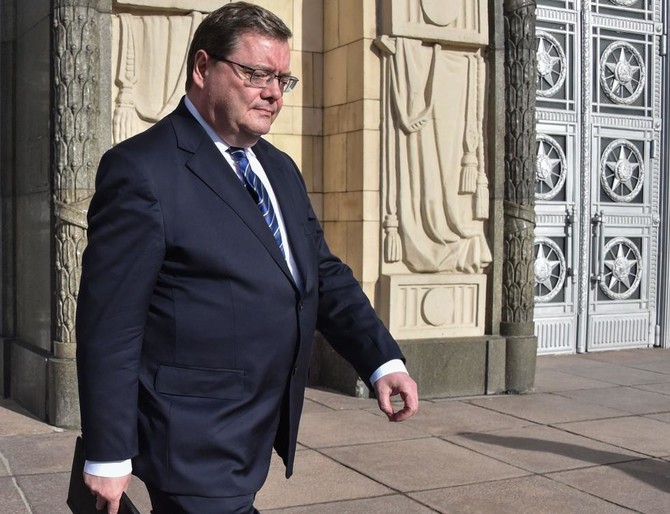
Irish ambassador to Russia Adrian McDaid leaves the Russian Foreign Ministry in Moscow. Russia says it has informed ambassadors of most of the countries that ordered the expulsion of Russian diplomats that an equal number of their diplomats have been declared persona non grata. (AFP)
Updated 30 March 2018
Follow

Russia ramps up diplomatic expulsions, hauls in ambassadors

LONDON: The Russian foreign ministry ominously summoned the ambassadors of Albania, Denmark, Ireland and Spain as it looks to follow through on its promise to expel the same number of diplomats from each nation that has expelled Russian diplomats.

Russia said it had informed ambassadors of most of the countries that ordered the expulsion of Russian diplomats that an equal number of their diplomats have been declared persona non grata. A ministry statement Friday said the ambassadors were from 23 of the countries that are expelling Russians in connection with the poisoning in Britain of a former Russian double agent and his daughter.

Russia had on Thursday announced it was expelling 60 US diplomats and closing the consulate in St. Petersburg in retaliation to Washington’s moves.

Russia also ordered new cuts to the number of British envoys in the country, escalating a dispute with the West. The massive expulsion of diplomats on both sides has reached a scale unseen even at the height of the Cold War.

Two dozen countries, including the US and many EU nations, and NATO ordered out more than 150 Russian diplomats in a show of solidarity with Britain over the poisoning of Russian ex-spy Sergei Skripal and his daughter that London blamed on Russia.
Moscow has vehemently denied involvement in the March 4 nerve agent attack in the city of Salisbury and has busily set about a tit-for-tat series of expulsions.

Russia expelled four German diplomats, Foreign Minister Heiko Maas said, as the Kremlin responds in kind to expulsions of its own officials. “The news from Moscow comes as no surprise,” Maas said in a statement. “Even in the current climate we remain ready for dialogue with Russia and we will work on both European security and constructive future relations between our countries.”

Germany had earlier this week expelled four Russian diplomats.

Russia expelled one Irish diplomat, Ireland’s foreign ministry said on Friday, following Dublin’s decision to expel a Russian diplomat over a nerve agent attack in England that the British government has blamed on Russia.

“There is no justification for this expulsion. Our staff do not engage in activities which are incompatible with their diplomatic status,” a spokesman for the Irish foreign ministry said.

Britain needs to step up defense spending faster, says Starmer

Britain's Prime Minister Keir Starmer takes part in a panel discussion in Munich, Germany. (AP file photo)
Updated 5 sec ago
Follow

Britain needs to step up defense spending faster, says Starmer

  • Britain’s budget watchdog, the Office for Budget Responsibility, said last year that raising defense spending to 3 percent of the GDP would cost an additional £17.3 billion a year ($24 billion) in 2029-30

LONDON: Britain should step up and accelerate its ​defense spending, Prime Minister Keir Starmer said on Monday, following a report that the government was considering bringing forward its target to spend 3 percent of economic output on defense.
Britain, which has warned of the risks posed by Russia, said in February 2025 that it would lift annual defense spending to 2.5 percent of the GDP by 2027 and aim for 3 percent in the next Parliament, which is expected to begin after an ‌election due in ‌2029.
The BBC reported that the government was ​now ‌exploring ways to ​reach the 3 percent target by 2029. It said no decision had been taken but the government recognized current plans would not cover rising defense costs.

HIGHLIGHT

The BBC reported that the government is ​now ‌exploring ways to ​reach the 3 percent target by 2029.

Asked whether he would bring the target forward to 2029, Starmer echoed comments he made at the Munich Security Conference, where he said Europe had united to support Ukraine with the supply of weapons and munitions and to strengthen military readiness.
“We need to step up. That means on ‌defense spending, we need to go faster,” ‌Starmer told reporters on Monday. “We’ve obviously made commitments ​already in relation to that, but ‌it goes beyond just how much you spend.”
Latest NATO estimates show ‌that Britain spent 2.3 percent of the GDP on defense in 2024, above the alliance’s 2 percent guideline. But like other European countries, it has faced US pressure to spend more to protect the continent. Struggling with high debt and spending commitments, the government last ‌year cut its international aid budget to fund the hike in defense spending to 2.5 percent of GDP but is yet to publish an investment plan with spending priorities, something that has frustrated the defense industry.
Britain’s budget watchdog, the Office for Budget Responsibility, said last year that raising defense spending to 3 percent of the GDP would cost an additional £17.3 billion a year ($24 billion) in 2029-30.
Finance Minister Rachel Reeves has struggled to stay on track with her plans to repair the public finances. The BBC said the Finance Ministry was believed to be cautious about the new defense spending proposals.
A government spokesperson said Britain was “delivering ​the largest sustained increase in defense ​spending since the Cold War.”