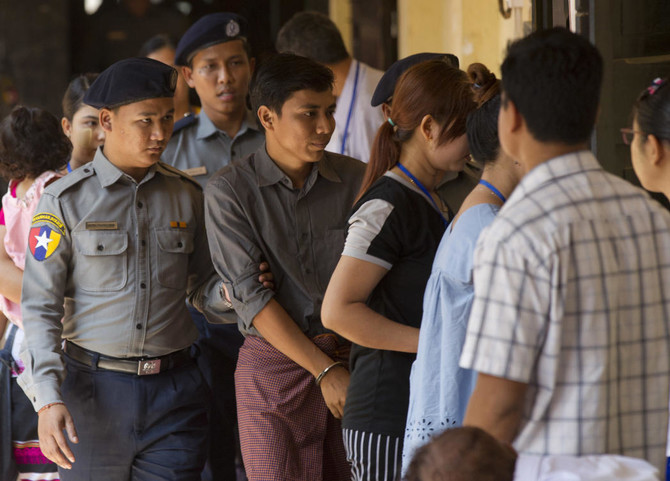
YANGON: Two Reuters reporters appeared in a Myanmar court for the 11th time on Wednesday, which marked 100 days since they were arrested in December and accused of possessing secret government papers.
A Yangon court is holding preliminary hearings to decide whether reporters Wa Lone, 31, and Kyaw Soe Oo, 28, will face charges under the colonial-era Officials Secrets Act, which carries a maximum penalty of 14 years in prison.
“They have been detained in Myanmar since December 12 simply for doing their jobs as journalists,” Reuters President and Editor-in-Chief Stephen J. Adler said in a statement.
“Wa Lone and Kyaw Soe Oo are exemplary individuals and outstanding reporters who are dedicated to their families and their craft. They should be in the newsroom, not in prison. We call on the authorities in Myanmar to release them as soon as possible and allow them to return to their families and their jobs.”
Government spokespeople have declined to comment on the case, citing the ongoing court proceedings.
The journalists have told relatives they were arrested almost immediately after being handed some rolled up papers after being invited to a restaurant by two officers they had not met before.
Wa Lone and Kyaw Soe Oo had been investigating the killing of 10 Rohingya Muslim men in a village in western Myanmar’s Rakhine state during a military crackdown in August.
The crackdown, which the United Nations has said was ethnic cleansing, has sent nearly 700,000 people fleeing to Bangladesh.
After the arrests of the reporters, the military admitted its soldiers took part in the killing.
Senior United Nations officials, western nations and press freedom advocates have called for the release of the journalists.
On Wednesday, diplomats from countries including the United States, Canada, Sweden and the European Union were attending the court hearing in Myanmar’s largest city, Yangon.
The Danish embassy, which has closely monitored the case, said the pair had spent “100 days behind bars for ensuring the public’s right to information”.
“The embassy of Denmark in Myanmar strongly urges the Government of Myanmar to drop all charges against Wa Lone and Kyaw Soe Oo and to release them immediately,” the embassy said before the hearing.

Reuters reporters in court 100 days after their arrest in Myanmar

UAE outlines approach to AI governance amid regulation debate at World Economic Forum
- Minister of State Maryam Al-Hammadi highlights importance of a robust regulatory framework to complement implementation of AI technology
- Other experts in panel discussion say regulators should address problems as they arise, rather than trying to solve problems that do not yet exist
DUBAI: The UAE has made changes to 90 percent of its laws in the past four years, Maryam Al-Hammadi, minister of state and the secretary-general of the Emirati Cabinet, told the World Economic Forum in Davos on Wednesday.
Speaking during a panel discussion titled “Regulating at the Speed of Code,” she highlighted the importance of having a robust regulatory framework in place to complement the implementation of artificial intelligence technology in the public and private sectors.
The process of this updating and repealing of laws has driven the UAE’s efforts to develop an AI model that can assist in the drafting of legislation, along with collecting feedback from stakeholders on proposed laws and suggesting improvements, she said.
Although AI might be more agile at shaping regulation, “there are some principles that we put in the model that we are developing that we cannot compromise,” Al-Hammadi added. These include rules for human accountability, transparency, privacy and data protection, along with constitutional safeguards and a thorough understanding of the law.
At this stage, “we believe AI can advise but still (the) human is in command,” she said.
Authorities in the UAE are aiming to develop, within a two-year timeline, a shareable model to help other nations learn and benefit from its experiences, Al-Hammadi added.
Argentina’s minister of deregulation and state transformation, Federico Sturzenegger, warned against overregulation at the cost of innovation.
Politicians often react to a “salient event” by overreacting, he said, describing most regulators as “very imaginative of all the terrible things that will happen to people if they’re free.”
He said that “we have to take more risk,” and regulators should wait to address problems as they arise rather than trying to create solutions for problems that do not yet exist.
This sentiment was echoed by Joel Kaplan, Meta’s chief global affairs officer, who said “imaginative policymakers” often focus more on risks and potential harms than on the economic and growth benefits of innovation.
He pointed to Europe as an example of this, arguing that an excessive focus on “all the possible harms” of new technologies has, over time, reduced competitiveness and risks leaving the region behind in what he described as a “new technological revolution.”