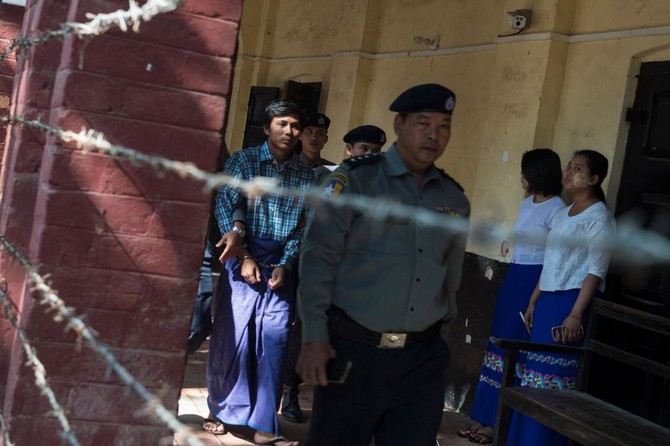
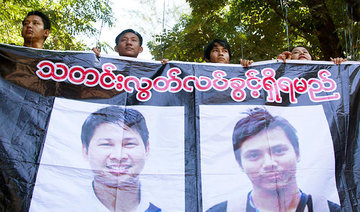
BANGKOK: Two Reuters journalists detained for two months by Myanmar authorities were arrested over their investigation of a massacre of 10 Rohingya men, the news agency said in a report that detailed the grisly killings.
It is the first time Reuters has publicly confirmed what Myanmar nationals Wa Lone, 31, and Kyaw Soe Oo, 27, were working on when they were arrested on December 12 on the outskirts of Yangon.
The pair are now facing up to 14 years in prison on charges of possessing classified documents in violation of the colonial-era Official Secrets Act.
Their plight has sparked global alarm over withering press freedoms in Myanmar and government efforts to curb reporting in northern Rakhine state — a crisis-hit region where troops are accused of waging an ethnic cleansing campaign against Rohingya Muslims.
Nearly 700,000 Rohingya have fled the area since last August, carrying stories of atrocities at the hands of troops and vigilante groups in the Buddhist-majority country.
Myanmar authorities deny the allegations but have virtually cut off northern Rakhine, barring independent media from accessing the conflict-hit areas.
On Thursday Reuters published a report describing how Myanmar troops and Buddhist villagers executed 10 Rohingya men in Rakhine’s Inn Dinn village on September 2, 2017 before dumping their bodies into a mass grave.
“The Reuters investigation of the Inn Din massacre was what prompted Myanmar police authorities to arrest two of the news agency’s reporters,” the report said.
The account was based on testimony from Buddhist villagers, security officers and relatives of the slain men.
It included graphic photographs of the victims, hands bound kneeling on the floor before the killing — and of their bodies in a pit after.
A month after the journalists’ arrests, Myanmar’s army issued a rare statement admitting that security forces took part in extrajudicial killings of 10 Rohingya “terrorists” in Inn Din village.
The Reuters report said witnesses denied there had been any major attack from Rohingya militants before the alleged massacre.
A Myanmar government spokesman could not be immediately reached for comment.
But Myanmar vehemently denies systematic abuses by its security officers, despite a mounting volume of evidence pointing to atrocities.
Judges have denied bail to the two reporters during a pre-trial hearing period, despite calls for their release from human rights groups and diplomats around the globe.
The next hearing is scheduled for February 14.

Reuters says Myanmar held journalists for probing Rohingya massacre
Disinformation the new enemy in disaster zones, says Red Cross
- “Harmful information and dehumanizing narratives” undermines humanitarian aid and putting lives of aid workers at risk
- Between 2020 and 2024, disasters affected nearly 700 million people, displaced over 105 million, and killed more than 270,000 — doubling the number in need of humanitarian aid
GENEVA: The rise of disinformation is undermining humanitarian aid and putting lives at risk, while disasters are affecting ever more people, the Red Cross warned Thursday.
“Between 2020 and 2024, disasters affected nearly 700 million people, caused more than 105 million displacements, and claimed over 270,000 lives,” the International Federation of Red Cross and Red Crescent Societies said.
The number of people needing humanitarian assistance more than doubled in the same timeframe, the IFRC said in its World Disasters Report 2026.
But the world’s largest humanitarian network said that “harmful information and dehumanizing narratives” were increasingly undermining trust, putting the lives of aid workers at risk.
“In polarized and politically-charged contexts, humanitarian principles such as neutrality and impartiality are increasingly misunderstood, misrepresented or deliberately attacked online,” it said.
The IFRC has more than 17 million volunteers across more than 191 countries.
“In every crisis I have witnessed, information is as essential as food, water and shelter,” said the Geneva-based federation’s secretary general Jagan Chapagain.
“But when information is false, misleading or deliberately manipulated, it can deepen fear, obstruct humanitarian access and cost lives.”
He said harmful information was not a new phenomenon, but it was now moving “with unprecedented speed and reach.”
Chapagain said digital platforms were proving “fertile ground for lies.”
The IFRC report said the challenge nowadays was no longer about the availability of information but its reliability, noting that the production and spread of disinformation was easily amplified by artificial intelligence.
- ‘Life and death’ -
The report cited numerous recent examples of harmful information hampering crisis response.
During the 2024 floods in Valencia, false narratives online accused the Spanish Red Cross of diverting aid to migrants, which in turn fueled “xenophobic attacks on volunteers,” the IFRC said.
In South Sudan, rumors that humanitarian agencies were distributing poisoned food “caused people to avoid life-saving aid” and led to threats against Red Cross staff.
In Lebanon, false claims that volunteers were spreading Covid-19, favoring certain groups with aid and providing unsafe cholera vaccines eroded trust and endangered vulnerable communities, the IFRC said.
And in Bangladesh, during political unrest, volunteers faced “widespread accusations of inaction and political alignment,” leading to harassment and reputational damage, it added.
Similar events were registered by the IFRC in Sudan, Myanmar, Peru, the United States, New Zealand, Canada, Kenya and Bulgaria.
The report underlined that around 94 percent of disasters were handled by national authorities and local communities, without international interventions.
“However, while volunteers, local leaders and community media are often the most trusted messengers, they operate in increasingly hostile and polarized information environments,” the IFRC said.
The federation called on governments, tech firms, humanitarian agencies and local actors to recognize that reliable information “is a matter of life and death.”
“Without trust, people are less likely to prepare, seek help or follow life-saving guidance; with it, communities act together, absorb shocks and recover more effectively,” said Chapagain.
The organization urged technology platforms to prioritize authoritative information from trusted sources in crisis contexts, and transparently moderate harmful content.
And it said humanitarian agencies needed to make preparing to deal with disinformation “a core function” of their operations, with trained teams and analytics.