

UAE outlines approach to AI governance amid regulation debate at World Economic Forum

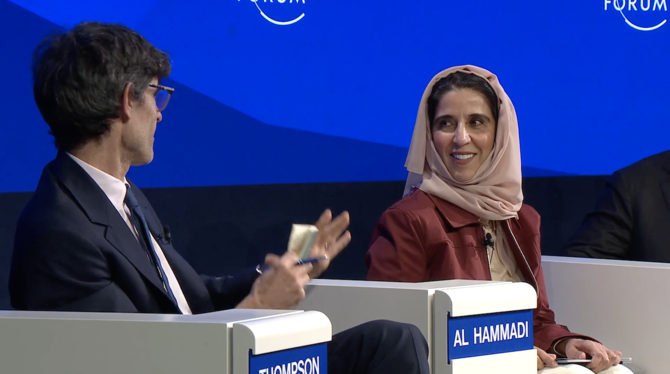
UAE Minister of State Maryam Al-Hammadi highlighted the importance a robust regulatory framework at WEF. (Screenshot/WEF)
Short Url
Updated 22 January 2026
Follow

UAE outlines approach to AI governance amid regulation debate at World Economic Forum

  • Minister of State Maryam Al-Hammadi highlights importance of a robust regulatory framework to complement implementation of AI technology
  • Other experts in panel discussion say regulators should address problems as they arise, rather than trying to solve problems that do not yet exist

DUBAI: The UAE has made changes to 90 percent of its laws in the past four years, Maryam Al-Hammadi, minister of state and the secretary-general of the Emirati Cabinet, told the World Economic Forum in Davos on Wednesday.

Speaking during a panel discussion titled “Regulating at the Speed of Code,” she highlighted the importance of having a robust regulatory framework in place to complement the implementation of artificial intelligence technology in the public and private sectors.

The process of this updating and repealing of laws has driven the UAE’s efforts to develop an AI model that can assist in the drafting of legislation, along with collecting feedback from stakeholders on proposed laws and suggesting improvements, she said.

Although AI might be more agile at shaping regulation, “there are some principles that we put in the model that we are developing that we cannot compromise,” Al-Hammadi added. These include rules for human accountability, transparency, privacy and data protection, along with constitutional safeguards and a thorough understanding of the law.

At this stage, “we believe AI can advise but still (the) human is in command,” she said.

Authorities in the UAE are aiming to develop, within a two-year timeline, a shareable model to help other nations learn and benefit from its experiences, Al-Hammadi added.

Argentina’s minister of deregulation and state transformation, Federico Sturzenegger, warned against overregulation at the cost of innovation.

Politicians often react to a “salient event” by overreacting, he said, describing most regulators as “very imaginative of all the terrible things that will happen to people if they’re free.”

He said that “we have to take more risk,” and regulators should wait to address problems as they arise rather than trying to create solutions for problems that do not yet exist.

This sentiment was echoed by Joel Kaplan, Meta’s chief global affairs officer, who said “imaginative policymakers” often focus more on risks and potential harms than on the economic and growth benefits of innovation.

He pointed to Europe as an example of this, arguing that an excessive focus on “all the possible harms” of new technologies has, over time, reduced competitiveness and risks leaving the region behind in what he described as a “new technological revolution.”


TikTok finalizes a deal to form a new American entity

Updated 59 min 29 sec ago
Follow

TikTok finalizes a deal to form a new American entity

  • The social video platform company signed agreements with major investors including Oracle, Silver Lake and MGX to form the joint venture
  • The company said in a statement that the new version will operate under “defined safeguards” with an emphasis on data protections and software assurances for US users

TikTok has finalized a deal to create a new American entity, avoiding the looming threat of a ban in the United States that has been in discussion for years on the platform now used by more than 200 million Americans.
The social video platform company signed agreements with major investors including Oracle, Silver Lake and the Emirati investment firm MGX to form the new TikTok US joint venture. The new version will operate under “defined safeguards that protect national security through comprehensive data protections, algorithm security, content moderation and software assurances for US users,” the company said in a statement Thursday. American TikTok users can continue using the same app.
President Donald Trump praised the deal in a Truth Social post, thanking Chinese leader Xi Jinping specifically “for working with us and, ultimately, approving the Deal.” Trump add that he hopes “that long into the future I will be remembered by those who use and love TikTok.”
The Chinese government has not yet publicly commented on TikTok’s announcement. Earlier on Thursday and ahead of the statement, Liu Pengyu, spokesperson Chinese embassy in Washington, said “China’s position on TikTok has been consistent and clear.”
Adam Presser, who previously worked as TikTok’s head of operations and trust and safety, will lead the new venture as its CEO. He will work alongside a seven-member, majority-American board of directors that includes TikTok’s CEO Shou Chew.
The deal ends years of uncertainty about the fate of the popular video-sharing platform in the United States. After wide bipartisan majorities in Congress passed — and President Joe Biden signed — a law that would ban TikTok in the US if it did not find a new owner in the place of China’s ByteDance, the platform was set to go dark on the law’s January 2025 deadline. For a several hours, it did. But on his first day in office, President Donald Trump signed an executive order to keep it running while his administration sought an agreement for the sale of the company.
Apart from an emphasis on data protection, with US user data being stored locally in a system run by Oracle, the joint venture will also focus on TikTok’s algorithm. The content recommendation formula, which feeds users specific videos tailored to their preferences and interests, will be retrained, tested and updated on US user data, the company said in its announcement.
The algorithm has been a central issue in the security debate over TikTok. China previously maintained the algorithm must remain under Chinese control by law. But the US regulation passed with bipartisan support said any divestment of TikTok must mean the platform cuts ties — specifically the algorithm — with ByteDance. Under the terms of this deal, ByteDance would license the algorithm to the US entity for retraining.
The law prohibits “any cooperation with respect to the operation of a content recommendation algorithm” between ByteDance and a new potential American ownership group, so it is unclear how ByteDance’s continued involvement in this arrangement will play out.
“Who controls TikTok in the US has a lot of sway over what Americans see on the app,” said Anupam Chander, a professor of law and technology at Georgetown University.
Oracle, Silver Lake and MGX are the three managing investors, each holding a 15 percent share. Other investors include the investment firm of Michael Dell, the billionaire founder of Dell Technologies. ByteDance retains 19.9 percent of the joint venture.