Myanmar court denies bail to Reuters journalists held under secrecy law

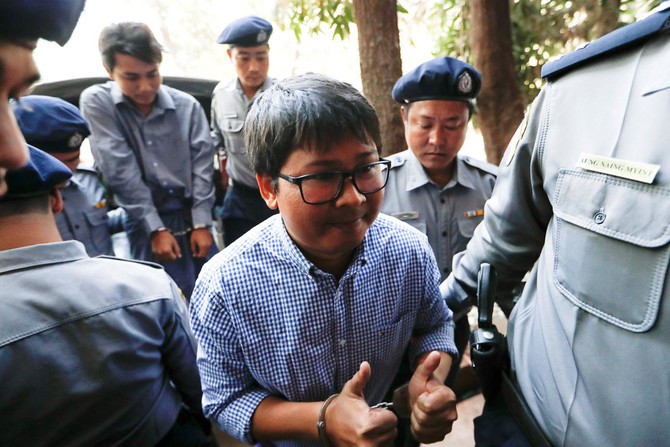
Detained Reuters journalist Wa Lone and Kyaw Soe Oo are escorted by police while arriving for a court hearing in Yangon on February 1. (Reuters)
Updated 01 February 2018
Follow

Myanmar court denies bail to Reuters journalists held under secrecy law

YANGON: A Myanmar court on Thursday denied bail to two Reuters journalists charged under a secrecy act that could see them face up to 14 years in jail, in a case that has sparked outcry over shrinking media freedom.
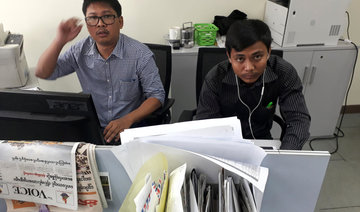
Myanmar nationals Wa Lone, 31, and Kyaw Soe Oo, 27, are accused of possessing classified documents thought to relate to the violent military crackdown on the Rohingya Muslim minority.
The crackdown in northern Rakhine state has forced nearly 700,000 Rohingya Muslims over the border into Bangladesh since August, many carrying allegations of rape, mass murder and arson at the hands of Myanmar’s army.
“The pair can’t be granted bail according to the law ... and the court has decided not to give them bail,” judge Ye Lwin told the Yangon court of charges under the colonial-era Official Secrets Act.
The journalists, who have been in custody since December, say they were given the papers by two policemen who had invited them to dinner in the outskirts of Yangon.
As they left the restaurant, they say they were arrested before they even had a chance to look at the documents.
The court had discretion to grant bail if it deemed that their detention had been unlawful.
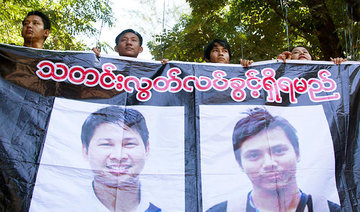
Myanmar authorities have been urged to free the journalists by media freedom campaigners as well as a cast of diplomats and international grandees including former US president Bill Clinton.
Thursday’s bail decision was crucial as pre-trial hearings are expected to drag on for several months before the court officially decides whether to take on the case or not.
The pair are now expected to remain in jail throughout that period.
On hearing the refusal of bail, Wa Lone’s wife Pan Ei Mon cried.
“I hoped to get it,” she said, crying. “I even cleaned his room last night to prepare for him getting bail.”
Reuters has refused to comment on the exact details of what its correspondents were reporting on at the time of their arrest but it is widely thought they were investigating a massacre of Rohingya in the village of Inn Din in northern Rakhine.
The military later acknowledged members of the security forces took part in the extrajudicial killing, saying it would hold those responsible to account.
UN special rapporteur to Myanmar Yanghee Lee added her voice in support of the journalists from a press conference in Seoul, calling the pair “brave” and “fearless.”
She has been banned from Myanmar by authorities who say she is working with a bias against the country.
“I remain deeply perplexed and concerned that they remain in detention despite the military having admitted responsibility for the killings at Inn Din,” she said, adding that “they should be released immediately and the charges against them must be dropped.”


ASEAN should adhere to rule of law in face of ‘unilateral actions,’ Philippines’ top diplomat says

Updated 3 sec ago
Follow

ASEAN should adhere to rule of law in face of ‘unilateral actions,’ Philippines’ top diplomat says

  • Several ASEAN members have expressed deep concern over the US strike that resulted in the arrest of Venezuelan leader Nicolas Maduro
  • Philippines’ top envoy: ‘Across our region, we continue to see tensions at sea, protracted internal conflicts and unresolved border and humanitarian concerns’
CEBU, Philippines: Southeast Asian countries should steadfastly maintain restraint and adhere to international law as acts of aggression across Asia and “unilateral actions” elsewhere in the world threaten the rules-based global order, Manila’s top diplomat said Thursday.
Philippine Foreign Secretary Theresa Lazaro did not provide details of the geopolitical alarm she raised before her counterparts in the 11-nation Association of Southeast Asian Nations who were holding their first major closed-door meetings this year in the Philippines’ central seaside city of Cebu.
Several ASEAN members, however, have expressed deep concern over the secretive US strike that resulted in the arrest of Venezuelan leader Nicolas Maduro on orders from US President Donald Trump. China’s intensifying aggressive stance on Taiwan and in the disputed South China Sea have also troubled the region for years.
Calling out the US and China, among the largest trading and defense partners of ASEAN countries, have been a dilemma and diplomatic tightrope.
“Across our region, we continue to see tensions at sea, protracted internal conflicts and unresolved border and humanitarian concerns,” Lazaro said in her opening speech before ASEAN counterparts.
“At the same time, developments beyond Southeast Asia, including unilateral actions that carry cross-regional implications, continue to affect regional stability and erode multilateral institutions and the rules- based international order,” she said.
“These realities underscore the interim importance of ASEAN’s time-honored principles of restraint, dialogue and adherence to international law in seeking to preserve peace and stability to our peoples.”
The Philippines holds ASEAN’s rotating chair this year, taking what would have been Myanmar’s turn after the country was suspended from chairing the meeting after its army forcibly ousted Aung San Suu Kyi’s democratically elected government in 2021.
Founded in 1967 in the Cold War era, ASEAN has an unwieldy membership of diverse countries that range from vibrant democracies like the Philippines, a longtime treaty ally of Washington, to authoritarian states like Laos and Cambodia, which are close to Beijing.
The regional bloc adopted the theme “Navigating our future, Together” this year but that effort to project unity faced its latest setback last year when deadly fighting erupted between two members, Thailand and Cambodia, over a longtime border conflict.
Aside from discussing the deadly fighting that embroiled Thailand and Cambodia before both forged a US-backed ceasefire last year, the ASEAN foreign ministers will deliberate how to push a five-point peace plan for the war in Myanmar, issued by the regional bloc’s leaders in 2021. The plan demanded, among others, an immediate end to fighting and hostilities, but it has failed to end the violence or foster dialogue among contending parties.
ASEAN foreign ministers are also under pressure to conclude negotiations with China ahead of a self-imposed deadline this year on a so-called “code of conduct” to manage disputes over long-unresolved territorial rifts in the South China Sea. China has expansive claims in the waterway, a key global trade route, that overlap with those of four ASEAN members, the Philippines, Malaysia, Vietnam and Brunei.