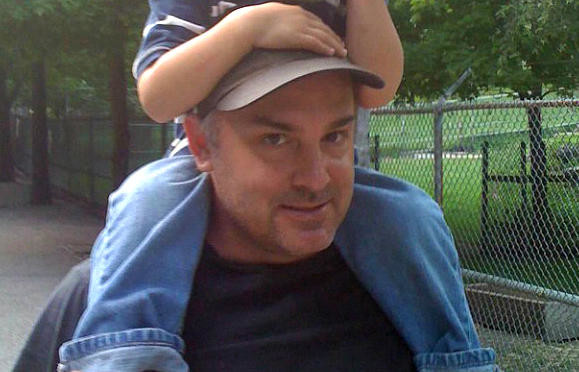
TORONTO: Judi Riley’s 47-year-old brother vanished while on a trip to Toronto nearly five years ago. Her family filed a police report and repeatedly prodded authorities for updates. But there were no leads, until now.
Riley, who lives in Hawaii, started getting emails from friends back in Canada, where she grew up, about the arrest of an alleged serial killer. Potential pieces to a disturbing puzzle began to fall into place.
The suspect, Bruce McArthur, is accused of preying on adult men in a homosexual neighborhood of Toronto where Jon Riley had spent time. The alleged killer owned a landscaping company, the kind of work Judi Riley said her brother was likely seeking at the time he disappeared.
“I literally fell to my knees in grief,” she recalled. “It made too much sense.”
Then Riley got a call from police, who thought it made sense as well. Authorities say McArthur killed at least seven men, but investigators believe more victims will be found as they comb through crime scenes and re-examine long-stale missing person-cases like that of Jon Riley.
McArthur has so far been charged with six deaths and has not yet entered a plea. His lawyer has not responded to repeated requests for comment. Police won’t say how many potential victims there could be, but they are reviewing hundreds of missing person reports in Toronto as well as elsewhere in Canada and places where he has traveled, including Italy and Mexico.
“We are tracing his whereabouts as far back as we can go,” said Sgt. Hank Idsinga, the lead detective in the case.
Police say McArthur allegedly targeted men he met through dating apps that cater to gay men, at bars in the “Gay Village” area of Toronto, as well as male prostitutes. His most recent known alleged murder was in June and he has been charged in the death of a 40-year-old man who disappeared in September 2010.
Families of adults who have been reported missing have been critical of police for not doing enough to find their loved ones. One challenge is the volume. More than 600 people have been reported missing in the police precinct that includes the Gay Village over the last four years and about 30 cases remain open.
Criminal experts say it’s unlikely that someone would become a serial killer later in life, so if the allegations are true, there could be earlier victims. “If it turns out he was killing in the mid-1970’s it would not be unusual. In fact it would be surprising if he had not been,” said Peter Vronsky, a history professor at Ryerson University in Toronto who has written two books about serial killers. “Once you hit that late age, serial killers are retiring.”
McArthur moved to the Toronto area around 2000. He previously lived in a suburb of the city, where he was married, raised two children and worked as a traveling salesman of underwear and socks. His landscaping business was small, but he did periodically hire workers, including the 40-year-old man who disappeared in 2010.
Judi Riley, a children’s book author who now lives on Maui, said her older brother had worked as landscaper in the past, though he didn’t have a steady job at the time of his disappearance. He had left a note for their mother saying he was headed for a few days to Toronto, and in the past had stayed in hostels and shelters in Gay Village.
She said authorities have asked her for photos of her brother and asked about identifying details such as scars. They asked to look at his computer, something she wishes they had done much earlier.
Police also have requested dental records from the family of Abdulbasir Faizi, a 42-year-old who moved to Canada from Iran and disappeared December 2010. His family learned after he vanished that he had been using gay dating apps and visiting bathhouses in Gay Village, according to a relative.
“For sure he is one of the victims,” said the relative, who spoke on condition of anonymity because others in the family do not want to speak publicly about the matter. “He would not have left his family. He had a very good relationship with his daughters.”
Linda Shaw of Waterloo, Ontario, has closely monitored the case for any word of her son, 30-year-old David MacDermott. He was last seen in November 2002 at a gay nightclub in Kitchener, about a 90-minute drive from downtown Toronto. She says she doesn’t have any reason to believe he was a victim of McArthur, but she runs to the phone each time it rings in hopes that it could bring news about him.
“I sit and listen about the McArthur story on TV constantly, constantly,” Shaw said. “You think ‘Wow, could this be the answer, could this please?’ We literally beg God.”
Friends have told Judi Riley not to read about the McArthur case but she can’t help it. “It’s been a devastating time for us. It’s really hard for me to talk about Jon without falling apart,” she said.
“I don’t want it to be true.”

Focus turns to missing in Canadian serial killer case
Florida braces for frost and possible snow flurries as winter storms hit other parts of the US
- The worst seems to be heading toward the Carolinas, but the Sunshine State’s humans, animals and even plants are preparing for winter weather
MIAMI: Florida won’t be getting hit with massive blankets of snow and ice like the rest of the US, but even frosty windshields and a few flurries can feel like Antarctica to people with permanent sandal tans.
The Midwest and South have been getting major winter storms for several days, and a giant cyclone forecast in the Atlantic Ocean is expected to pull that cold weather east as a powerful blizzard this weekend. The worst seems to be heading toward the Carolinas, but the Sunshine State’s humans, animals and even plants are preparing for winter weather.
Florida could experience record cold
Ana Torres-Vazquez, a forecaster with the National Weather Service in Miami, said a cold front earlier this week has already caused temperatures to dip some, but the region could experience record-setting cold this weekend.
“It looks like temperatures across South Florida are dipping into the 30s (Fahrenheit) for most of the metro area and maybe into the 20s for areas near Lake Okeechobee,” Torres-Vazquez said. “And then the windchill could make those temperatures feel even cooler.”
Residents of South Florida are less likely to have heavy coats and other winter clothes, so Torres-Vazquez said it’s important to layer up lighter clothing and limit time spent outside.
Moving north, Tony Hurt, a National Weather Service forecaster for the Tampa Bay area, said there’s a 10 to 20 percent chance of snowfall in that region this weekend.
“Most likely if there’s any snow that does actually materialize, it’ll be primarily in the form of flurries, no accumulations,” Hurt said.
The last two times the area got snow was flurries in January 2010 and December 1989. The record for snowfall was in January 1977, with 2 inches (5 centimeters) of snow about 20 miles (32 kilometers) east of Tampa.
Despite the possibility of snow, Tampa will host the annual Gasparilla Pirate Fest on Saturday. And on Sunday, the Tampa Bay Lightning are set to host the Boston Bruins for an outdoor NHL game at the Tampa Bay Buccaneers’ home NFL stadium.
Few tourists visiting Florida will be swimming in the ocean or laying out on sunny beaches this weekend, but many attractions will remain open. Most of Walt Disney World and Universal Orlando will operate normally, though their water parks will be closed. Most of the state’s zoos and animal parks will also remain open while keepers take steps to protect the inhabitants.
Zoo keepers working to keep animals safe and warm
Zoo Miami spokesman Ron Magill said keepers have been setting up heaters and moving reptiles and smaller mammals to indoor enclosures, while primates like chimpanzees and orangutans are given blankets to keep themselves warm. Big cats and large hoofed animals generally do well in colder temperatures and don’t require much assistance from keepers.
“It can be invigorating for animals like the tiger, so they’ll actually become more active,” Magill said.
Outside the safety of the zoo, Florida’s native wildlife has evolved and learned to survive occasional cold snaps, though casualties will still occur, Magill said. Manatees, for example, have spent decades congregating at the warm-water outflows of about a dozen power plants around Florida.
But invasive, nonnative animals like iguanas and other exotic reptiles will suffer the most, Magill said. Iguanas in South Florida famously enter a torpid state during cold periods and even fall out of trees. They usually wake up when the temperature increases, but many will die after more than a day of extreme cold.
“At the end of the day, they don’t belong here, and that might be nature’s way of trying to clean that up a little bit,” Magill said. “That is a part of natural selection.”
Protecting crops is a priority for farmers
Florida’s agriculture industry is also bracing for the cold. Farmers are working to safeguard their crops as winter harvest continues and spring planting begins in some areas, Florida Fruit & Vegetable Association spokeswoman Christina Morton said.
“Preparations vary by crop and include harvesting and planting ahead of the freeze, increasing water levels in ditches, using overhead irrigation, and, in some cases, deploying helicopters to protect sensitive fields,” Morton said.
The Florida deep freeze comes as the arctic blast from Canada also spreads into southern states where thousands of people remain without power to heat their homes, and people in mid-Atlantic states prepare for possible blizzard conditions as a new storm is expected to churn along the East Coast.
Temperatures in hard-hit northern Mississippi will feel as cold as minus 5 degrees Fahrenheit (minus 21 degrees Celsius) when the expected strong winds are factored in, National Weather Service forecasters say. People in a large part of the southeastern US were under a variety of alerts warning of extremely cold weather on the way.
The storm expected to hit the Eastern Seaboard has prompted more warnings in the Carolinas and nearby states. That storm is expected to bring heavy snow and strong winds, which could create “dangerous, near-blizzard conditions,” the weather service warned.