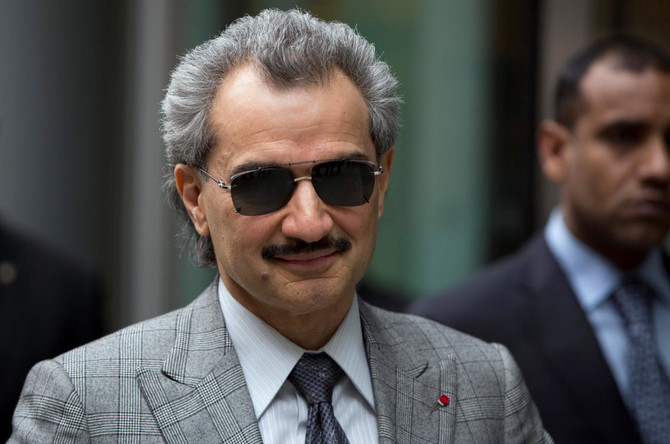
LONDON: Billionaire Saudi Prince Alwaleed bin Talal has revealed plans for a string of new investments in his first interview since being detained at the Ritz-Carlton in Riyadh.
Speaking exclusively to Bloomberg Television, he said that life was now “back to normal” as he gave an intriguing inside account of his detention as part of the Saudi government’s high profile anti-corruption drive.
The Kingdom Holding chief was one of the most high-profile figures to be detained at Riyadh’s Ritz-Carlton Hotel as part of a widespread anti-corruption drive.
In a television interview with Bloomberg, a fast-talking Alwaleed said: “I am for the anti-corruption that took place in Saudi Arabia. Now, unfortunately, I was added to that group. But fortunately, I’m out of it right now and life is back to normal.”
The prince, once dubbed the Warren Buffett of Saudi Arabia, was released from the Ritz-Carlton hotel in early January.
He was among about 350 suspects rounded up since Nov. 4, including some of the Kingdom’s most senior businessmen. As a major investor in several global corporations, his detention sent shockwaves through boardrooms around the world.
Now, after being released, he wants to reassure investors of continuity across his sprawling business empire. “I need to clear my name,” he said. “And to clear up a lot of lies.”
Specifically, Alwaleed rejected claims that he was tortured, detained in a prison and was forced to abandon work on the world’s tallest tower under construction in Jeddah, and instead transfer workers to the recently announced Neom mega-project instead.
To reinforce that point, he held up a letter that he said was from Saudi Binladin Group, the main contractor on the 1,000-meter tower.
He said: “It says the following: ‘Saudi Binladin Group would like to assure Jeddah Economic Company that it remains committed to the completion of the Jeddah project.”
Alwaleed said that no charges had been brought against him and described his detention as a “misunderstanding.”
Asked if it cost him anything to leave, he said: “I will not comment on the content of the agreement between me and the government.”
The prince also revealed how he spent his time at the now world-famous Ritz-Carlton Hotel in Riyadh.
“I really divide my time into a lot of sports, a lot of walking, a lot of meditation, a lot of watching news, a lot of praying.”
The vegan prince said that while he would usually have two meals a day, when he was at the hotel he would instead have six small meals.
But while the interview painted a fascinating picture of his time at the Ritz-Carlton, the precise details of his agreement with the Saudi government were not disclosed.
Still, Alwaleed did reveal that plans were under consideration to spin off some his company’s property holdings in Saudi Arabia into a separate entity which could be a real estate investment trust (REIT).
He said that his company had invested more than $3 billion in Saudi Arabia last year and that Kingdom Holding planned to raise between $1 billion and $2 billion of new debt.
Alwaleed also revealed plans to co-invest with Saudi Arabia’s Public Investment Fund.
“Yes, this will happen. We are in discussion right now with PIF, so we co-invest in certain projects, yes,” he said.
Alwaleed’s interview comes just days after another Ritz-Carlton detainee, Waleed Al-Ibrahim, also outlined new business plans following his release.
The MBC chairman described plans for a new joint venture with the government in an interview with The Wall Street Journal.

Prince Alwaleed reveals planned new investments in Saudi Arabia
First EU–Saudi roundtable on critical raw materials reflects shared policy commitment
RIYADH: The EU–Saudi Arabia Business and Investment Dialogue on Advancing Critical Raw Materials Value Chains, held in Riyadh as part of the Future Minerals Forum, brought together senior policymakers, industry leaders, and investors to advance strategic cooperation across critical raw materials value chains.
Organized under a Team Europe approach by the EU–GCC Cooperation on Green Transition Project, in coordination with the EU Delegation to Saudi Arabia, the European Chamber of Commerce in the Kingdom and in close cooperation with FMF, the dialogue provided a high-level platform to explore European actions under the EU Critical Raw Materials Act and ResourceEU alongside the Kingdom’s aspirations for minerals, industrial, and investment priorities.
This is in line with Saudi Vision 2030 and broader regional ambitions across the GCC, MENA, and Africa.
ResourceEU is the EU’s new strategic action plan, launched in late 2025, to secure a reliable supply of critical raw materials like lithium, rare earths, and cobalt, reducing dependency on single suppliers, such as China, by boosting domestic extraction, processing, recycling, stockpiling, and strategic partnerships with resource-rich nations.
The first ever EU–Saudi roundtable on critical raw materials was opened by the bloc’s Ambassador to the Kingdom, Christophe Farnaud, together with Saudi Deputy Minister for Mining Development Turki Al-Babtain, turning policy alignment into concrete cooperation.
Farnaud underlined the central role of international cooperation in the implementation of the EU’s critical raw materials policy framework.
“As the European Union advances the implementation of its Critical Raw Materials policy, international cooperation is indispensable to building secure, diversified, and sustainable value chains. Saudi Arabia is a key partner in this effort. This dialogue reflects our shared commitment to translate policy alignment into concrete business and investment cooperation that supports the green and digital transitions,” said the ambassador.
Discussions focused on strengthening resilient, diversified, and responsible CRM supply chains that are essential to the green and digital transitions.
Participants explored concrete opportunities for EU–Saudi cooperation across the full value chain, including exploration, mining, and processing and refining, as well as recycling, downstream manufacturing, and the mobilization of private investment and sustainable finance, underpinned by high environmental, social, and governance standards.
From the Saudi side, the dialogue was framed as a key contribution to the Kingdom’s industrial transformation and long-term economic diversification agenda under Vision 2030, with a strong focus on responsible resource development and global market integration.
“Developing globally competitive mineral hubs and sustainable value chains is a central pillar of Saudi Vision 2030 and the Kingdom’s industrial transformation. Our engagement with the European Union through this dialogue to strengthen upstream and downstream integration, attract high-quality investment, and advance responsible mining and processing. Enhanced cooperation with the EU, capitalizing on the demand dynamics of the EU Critical Raw Materials Act, will be key to delivering long-term value for both sides,” said Al-Babtain.
Valere Moutarlier, deputy director-general for European industry decarbonization, and directorate-general for the internal market, industry, entrepreneurship and SMEs at European Commission, said the EU Critical Raw Materials Act and ResourceEU provided a clear framework to strengthen Europe’s resilience while deepening its cooperation with international partners.
“Cooperation with Saudi Arabia is essential to advancing secure, sustainable, and diversified critical raw materials value chains. Dialogues such as this play a key role in translating policy ambitions into concrete industrial and investment cooperation,” she added.