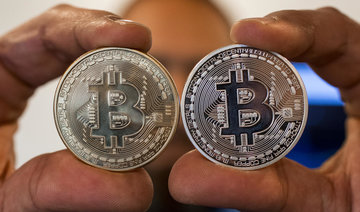
Bitcoins for free? Japanese cryptocurrency exchange lands in hot water again

A Bitcoin automated machine (ATM). A system glitch in Japan let seven customers buy bitcoin with no yen value during a 20-minute window last week. (Reuters)
Updated 21 February 2018
Follow

Bitcoins for free? Japanese cryptocurrency exchange lands in hot water again

TOKYO: A blunder at a Japanese cryptocurrency exchange let investors briefly buy bitcoins for free - though none were able to profit from the mistake.
Zaif, a government-registered exchange run by Osaka-based Tech Bureau Corp, said on Tuesday that a system glitch had let seven customers buy bitcoin with no yen value during a 20-minute window last week.
The exchange voided the trades after discovering the error, which happened on Feb. 16 - though it was still trying to resolve the issue with one customer who tried to transfer the knock-down bitcoins from the exchange, a spokesman told Reuters.
Zaif's operator had already faced checks after last month's theft of $530 million in digital money from Coincheck Inc, with regulators fearing its systems were at risk from cyber-attacks.
The latest flub could draw further attention to security and systems at cryptocurrency exchanges, which were already under scrutiny in the wake of the Coincheck heist. The theft also drew into question Japan's system of overseeing exchanges.
Zaif is one of 16 exchanges registered with the government, which last year allowed a further 16 - including Coincheck - to continue operating pending full registration.
The registered exchanges will form a self-regulatory body from April, sources have told Reuters. They had originally planned to merge two existing industry bodies representing both registered and unregistered exchanges.
The body will set out rules on issues like exchange security and advertising, and will lay out penalties for members who don't follow the policies, the Nikkei business daily reported on Wednesday.
Japan last year rolled out the world's first system to oversee cryptocurrency exchanges, in a bid to protect customers and stamp out illegal uses of cryptocurrencies as it sought to nurture a young and promising sector.
The regulator opted for relatively loose rules to help nurture the industry, mostly populated by start-ups. The Coincheck heist exposed flaws in the system, and - for some experts - raised questions over Japan's dash to regulate the industry amid crackdowns by countries from China to India.
Bitcoin surged more than 1,300 percent last year but lost about half its value at one point this year as more governments and central banks signalled possible regulatory crackdowns.

- Reuters

Education spending surges 251% as students return from autumn break: SAMA

Updated 12 December 2025
Follow

Education spending surges 251% as students return from autumn break: SAMA

RIYADH: Education spending in Saudi Arabia surged 251.3 percent in the week ending Dec. 6, reflecting the sharp uptick in purchases as students returned from the autumn break.

According to the latest data from the Saudi Central Bank, expenditure in the sector reached SR218.73 million ($58.2 million), with the number of transactions increasing by 61 percent to 233,000.

Despite this surge, overall point-of-sale spending fell 4.3 percent to SR14.45 billion, while the number of transactions dipped 1.7 percent to 236.18 million week on week.

The week saw mixed changes between the sectors. Spending on freight transport, postal and courier services saw the second-biggest uptick at 33.3 percent to SR60.93 million, followed by medical services, which saw an 8.1 percent increase to SR505.35 million.

Expenditure on apparel and clothing saw a decrease of 16.3 percent, followed by a 2 percent reduction in spending on telecommunication.

Jewelry outlays witnessed an 8.1 percent decline to reach SR325.90 million. Data revealed decreases across many other sectors, led by hotels, which saw the largest dip at 24.5 percent to reach SR335.98 million. 

Spending on car rentals in the Kingdom fell by 12.6 percent, while airlines saw a 3.7 percent increase to SR46.28 million.

Expenditure on food and beverages saw a 1.7 percent increase to SR2.35 billion, claiming the largest share of the POS. Restaurants and cafes retained the second position despite a 12.6 percent dip to SR1.66 billion.

Saudi Arabia’s key urban centers mirrored the national decline. Riyadh, which accounted for the largest share of total POS spending, saw a 3.9 percent dip to SR4.89 billion, down from SR5.08 billion the previous week.

The number of transactions in the capital settled at 74.16 million, down 1.4 percent week on week.

In Jeddah, transaction values decreased by 5.9 percent to SR1.91 billion, while Dammam reported a 0.8 percent surge to SR713.71 million.

POS data, tracked weekly by SAMA, provides an indicator of consumer spending trends and the ongoing growth of digital payments in Saudi Arabia. 

The data also highlights the expanding reach of POS infrastructure, extending beyond major retail hubs to smaller cities and service sectors, supporting broader digital inclusion initiatives. 

The growth of digital payment technologies aligns with the Kingdom’s Vision 2030 objectives, promoting electronic transactions and contributing to the nation’s broader digital economy.