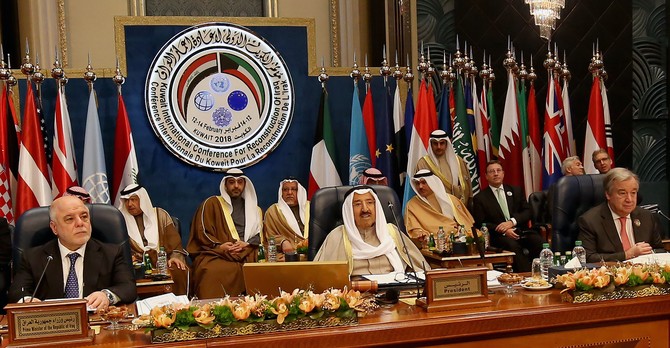
KUWAIT CITY: Saudi Arabia allocated $1.5 billion for the reconstruction of Iraq as foreign donors pledged billions of dollars at a conference in Kuwait on Wednesday.
Governments, global funds, organizations and investors offered $30 billion in loans and investment to repair the structural damage inflicted on the country during the three-year war with Daesh.
Foreign Minister Adel Al-Jubeir said the pledge from Saudi Arabia included a $1 billion loan through the Saudi Fund for Development and $500 million in export credit.
Kuwait said it would provide $1 billion in loans from the Kuwait Fund for Arab Economic Development and $1 billion in direct investments.
Turkey said it would give Iraq $5 billion in credit lines and Qatar announced $1 billion in loans and investments.
The UAE pledged $500 million for rebuilding, Germany said it would provide $350 million in assistance and Britain pledged up to $1 billion annually in export credit over 10 years.
Iraq said it needs $88 billion to rebuild areas of the country decimated by the Daesh occupation and the battle to defeat the extremists.
“Our meeting today is a continuation of our pursuits to counter and combat terrorism and counter the dangers and challenges it brings,” said Kuwait Emir Sheikh Sabah Al-Ahmed Al-Jaber Al-Sabah. “The stability and security of Iraq means the stability and security of Kuwait and the whole region.”
The donations on the third day of the conference still fell far short of the overall figure required by Iraq to rebuild.
Iraqi officials estimate that $17 billion needs to go toward rebuilding homes. The UN estimates 40,000 homes need to be rebuilt in Mosul alone.
“We look at the future of Iraq with confidence…we are determined to succeed to create the inclusiveness (of the Iraqi people) despite the challenges that we face today and will face in the future,” Iraqi Prime Minister, Haider Abadi, said.
He also said the money would not be lost to corruption — “one of the reasons for the rise of terrorism”.
“Last week, we launched a string of measures to simplify procedures for investments,” Abadi said.
EU foreign policy chief Federica Mogherini said Iraqi people were finally united for a common purpose, which is the defeat of Daesh and the rise of a new Iraq.
“Despite years of conflict, there is still a common identity that binds together the people of Iraq,” she said.
“We have to ensure that the dark days of Iraq are gone for good. Investing in infrastructure is essential, so is investing in human capital.”
Mogherini said the EU aid would go toward humanitarian development and stabilization.
Millions of Iraqis have returned to their homes to rebuild their lives, but 2.5 million remained displaced, according to the UN.
UN Secretary-General, António Guterres, used the conference to launch a program focused on revitalizing areas of Iraq most at risk of violence and supporting an inclusive political process.
“Iraqis are building a new Iraq,” Guterres said. “An Iraq that is ready for wide-ranging reforms, including to its public finance and security sectors. The UN system will do its part and stand with you every step of the way.”
Other pledges came from Japan, which said it would contribute $100 million this year through UN agencies and international organizations.
US Secretary of State Rex Tillerson on Tuesday said the Export-Import Bank of the United States was set sign a $3 billion memorandum of understanding with Baghdad, which would “set a stage for future cooperation across key sectors of Iraq’s economy including oil and gas, transportation, and commodities.”
Daesh seized large areas of north and west Iraq in 2014. Baghdad finally announced the extremist’s defeat in December.
Cities like Mosul and Ramadi suffered the worst destruction during the group’s violent occupation. Extensive damage was also done to the country’s infrastructure, including the oil and gas sectors.


![]()
$30bn pledged for Iraq reconstruction
$30bn pledged for Iraq reconstruction


Latest updates


© 2026 SAUDI RESEARCH & PUBLISHING COMPANY, All Rights Reserved And subject to Terms of Use Agreement.