

Pakistan among big nuclear arms spenders amid swelling global tensions — studies

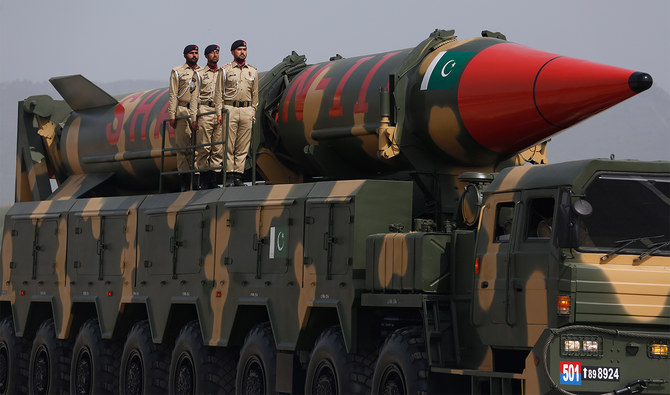
A Pakistani-made Shaheen-III missile, that is capable of carrying nuclear warheads, are displayed during a military parade to mark Pakistan National Day, in Islamabad, Pakistan, on March 23, 2022. (AP)
Short Url
Updated 17 June 2024
Follow

Pakistan among big nuclear arms spenders amid swelling global tensions — studies

  • Spending for 2023 by the nuclear-armed states jumped more than 33 percent from the $68.2 billion spent in 2018
  • SIPRI says “we have not seen nuclear weapons playing such a prominent role in international relations since Cold War”

GENEVA: Nuclear-armed countries hiked spending on atomic weapons arsenals by a third in the past five years as they modernized their stockpiles amid growing geopolitical tensions, two reports showed on Monday.

The world’s nine nuclear-armed states jointly spent $91 billion on their arsenals last year, according to a new report from the International Campaign to Abolish Nuclear Weapons (ICAN).

That report, and a separate one from the Stockholm International Peace Research Institute (SIPRI), indicated that nuclear weapons states are dramatically scaling up spending as they modernize and even deploy new nuclear-armed weapons.

“I think it is fair to say there is a nuclear arms race under way,” ICAN chief Melissa Parke told AFP.

Wilfred Wan, head of SIPRI’s weapons of mass destruction program, meanwhile warned in a statement that “we have not seen nuclear weapons playing such a prominent role in international relations since the Cold War.”

SIPRI’s report showed that the total estimated number of nuclear warheads in the world actually declined somewhat to 12,121 at the start of this year, from 12,512 a year earlier.

But while some of that included older warheads scheduled to be dismantled, it said 9,585 were in stockpiles for potential use — nine more than a year earlier.

And 2,100 were kept in a state of “high operational alert” on ballistic missiles.

Nearly all of those were held by the United States and Russia, but China was for the first time believed to also have some warheads on high operational alert, SIPRI said.

“While the global total of nuclear warheads continues to fall as Cold War-era weapons are gradually dismantled, regrettably we continue to see year-on-year increases in the number of operational nuclear warheads,” SIPRI director Dan Smith said.

The spending surge reported by ICAN appeared to back that up.

The report showed that in 2023 alone, nuclear weapons spending worldwide jumped by $10.8 billion from a year earlier, with the United States accounting for 80 percent of that increase.

The US share of total spending, $51.5 billion, “is more than all the other nuclear-armed countries put together,” said ICAN.

The next biggest spender was China, at $11.8 billion, followed by Russia, spending $8.3 billion.

Britain’s spending meanwhile rose significantly for the second year in a row, swelling 17 percent to $8.1 billion.

Spending for 2023 by the nuclear-armed states — which also include France, India, Israel, Pakistan and North Korea — jumped more than 33 percent from the $68.2 billion spent in 2018, when ICAN first began collecting this data, it said.

Since then, the nuclear armed states have spent an estimated total of $387 billion on the deadly weapons, the report showed.

Parke slammed “the billions of dollars being squandered on nuclear weapons” as “a profound and unacceptable misallocation of public funds.”

She highlighted that that money was more than what the World Food Programme estimates is needed to end world hunger.

“And you could plant a million trees for every minute of nuclear weapons spending,” she said.

“These numbers are obscene, and it is money that the state says is going toward weapons that... will never be used,” she said, pointing to the nuclear deterrence doctrine.

The investments are not only wasteful but also extremely dangerous, she warned.

“What happens when deterrence fails?“

Geneva-based ICAN won the 2017 Nobel Peace Prize for its key role in drafting the Treaty on the Prohibition of Nuclear Weapons, which took effect in 2021.

Seventy countries have ratified it to date and more have signed it, although none of the nuclear weapons states have come on board.

“Instead of investing in Armageddon, the nine nuclear-armed states should follow the example of almost half the world’s countries and join the treaty... and make a real contribution to global security,” said Alicia Sanders-Zakre, a co-author of Monday’s ICAN report.


Pakistan assesses EU-India trade deal as industry warns $9 billion exports at risk

Updated 5 sec ago
Follow

Pakistan assesses EU-India trade deal as industry warns $9 billion exports at risk

  • Textile exporters say India’s tariff-free EU access erodes Pakistan’s GSP+ advantage
  • Analysts urge lower energy costs as commerce ministry meets to assess impact

KARACHI: Pakistan’s government is assessing the impact of a newly signed free trade agreement between India and the European Union, as industry leaders and economists warn the deal could sharply undermine Pakistan’s exports unless production costs, particularly energy tariffs, are urgently reduced.

Officials at the commerce ministry and leading trade bodies held multiple meetings in Islamabad on Wednesday to evaluate how the EU-India agreement may affect Pakistan’s access to European markets, a key destination for the country’s textile and apparel exports.

“There is a meeting scheduled today [Jan.28] to discuss the issue,” a commerce ministry official told Arab News on condition of anonymity, saying the government would be better placed to respond once consultations concluded on the impact of the EI-India FTA. 

The agreement, which India’s Prime Minister Narendra Modi described as the “mother of all trade deals,” grants Indian exporters sweeping tariff-free access to the EU, Pakistan’s second-largest export market. European Commission President Ursula von der Leyen said the deal created a free trade zone of two billion people.

For Pakistan, the concern is that the deal erodes its long-standing tariff advantage under the EU’s Generalized Scheme of Preferences Plus (GSP+), which has allowed duty-free access for many Pakistani exports in return for commitments on labor rights, human rights and governance.

“The European Union is a critical market for Pakistan’s exports,” said Kamran Arshad, chairman of the All Pakistan Textile Mills Association (APTMA), the country’s largest textile trade body.

He said the EU’s 27 member states buy about $8.8 billion, or 27.2 percent, of Pakistan’s total exports and nearly $7 billion, or 39 percent, of its textile shipments each year.

Under GSP+, Pakistan currently enjoys duty-free access on around 66 percent of EU tariff lines, while Indian textile and apparel products previously faced duties of up to 12 percent.

“This dynamic has now fundamentally changed,” Arshad said, adding that India has secured immediate duty-free access on 100 percent of its textile and apparel tariff lines under the new agreement.

“India has become significantly more competitive in the EU market, effectively neutralizing and, in several segments, overtaking Pakistan’s existing GSP+ advantage,” he said.

“NARROW ADVANTAGE“

The shift comes at a fragile moment for Pakistan’s exports. After rising 5 percent to $32.1 billion last fiscal year, exports fell 9 percent to $15.2 billion in the first half of the current year through December, according to Pakistan Bureau of Statistics data.

Analysts say Pakistan’s competitiveness gap is being widened not only by tariff changes, but also by higher domestic production costs.

“The EU-India FTA will have a definite impact on Pakistan’s textile exports to the EU,” said Shankar Talreja, head of research at Karachi-based Topline Securities Ltd.

“Pakistani companies’ competitive advantage to compete against a giant like India needs to be restored in the form of regionally aligned energy tariffs and policy certainty,” he said.

Muhammad Waqas Ghani, head of research at JS Global Capital, said Pakistan’s advantage over India had already been narrow.

“With the FTA now in effect, Pakistan risks losing this already narrow comparative advantage, particularly as India’s higher value addition and stronger vertical integration enhance its competitiveness,” he told Arab News.

Industry executives echoed those concerns. 
Musadaq Zulqarnain, chairman of Interloop Holdings — one of Pakistan’s largest textile exporters supplying global brands such as Nike, Adidas, H&M, Marks & Spencer and Zara — said higher energy costs were the sector’s biggest handicap.

“The real problem for us is the cost of production,” Zulqarnain told Arab News from Faisalabad, Pakistan’s main textile hub. “Because of this, the entire textile industry is suffering.”

He said industrial electricity tariffs in Pakistan were 25–30 percent higher than those faced by regional competitors, adding that electricity prices should fall below 8–10 rupees per unit to remain competitive.

In Islamabad, an APTMA delegation also briefed Finance Minister Muhammad Aurangzeb on the impact of rising input costs and shifting global trade dynamics.

“The government is actively reviewing various issues affecting the cost of doing business for export-oriented industries,” the finance ministry said in a statement, citing Aurangzeb.

Former commerce minister Gohar Ejaz warned that preferential access alone could no longer sustain exports.

“The decision must be taken today, $9 billion exports to EU and 10 million jobs are at risk,” Ejaz said in a post on X.