Hijab-wearing ballerina performs on Alexandria streets to promote tourism

1 / 4
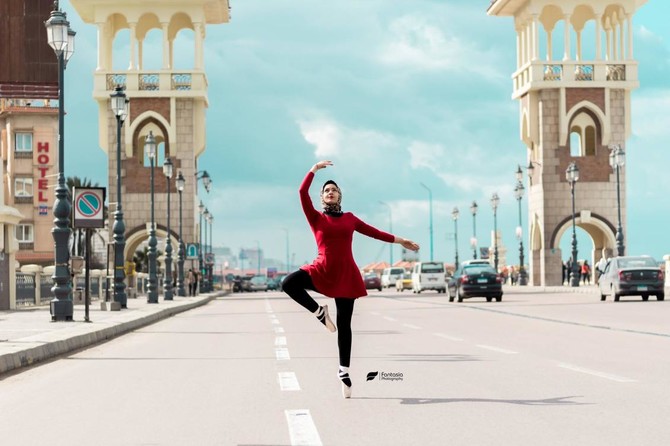
Ballerina Aya Magdy - a student at Alexandria University - performing dance moves around the Egyptian city to promote tourism. (Photo: Hussein Hossam / Fantasia Photography)
2 / 4
Ballerina Aya Magdy - a student at Alexandria University - performing dance moves around the Egyptian city to promote tourism. (Photo: Hussein Hossam / Fantasia Photography)
3 / 4
Ballerina Aya Magdy - a student at Alexandria University - performing dance moves around the Egyptian city to promote tourism. (Photo: Hussein Hossam / Fantasia Photography)
4 / 4
Ballerina Aya Magdy - a student at Alexandria University - performing dance moves around the Egyptian city to promote tourism. (Photo: Hussein Hossam / Fantasia Photography)
Updated 04 February 2018
Follow

Hijab-wearing ballerina performs on Alexandria streets to promote tourism

ALEXANDRIA: Pictures featuring a 20-year-old Egyptian ballerina wearing a hijab as she performs on the streets of Alexandria have proved popular on social media.
Aya Magdy appears in photographs performing dance moves around the city and on its iconic Stanley Bridge while wearing a headscarf and donning a long-sleeved ballet dress.
Magdy, a law student at Alexandria University, says her aim is to showcase the beauty of her city by performing in front of its most famous sites and encourage tourists to visit.
When asked how people in the street react when seeing her, Magdy said: “They were surprised at first, but soon I began to see admiration in the way they looked at me as they see me perform this beautiful art,” she told the local Youm7 newspaper.
When the photos were posted on a public Facebook page, some people criticized her for dancing and wearing a hijab at the same time.
But Magdy said she wanted to break taboos about ballet dancing in Egypt, and promote it as a form of art.
The idea of taking to Egyptian streets and performing ballet began when the “Ballerinas of Cairo” were spotted posing and performing moves in front of Cairo’s architectural gems.
Magdy says she was inspired by them and wanted to do the same for her city.
See more photos from the shoot by Hussein Hossam / Fantasia Photography here.


Riyadh exhibition to trace the origins of Saudi modern art

Updated 07 January 2026
Follow

Riyadh exhibition to trace the origins of Saudi modern art

  • Features painting, sculpture and archival documents
  • Open from Jan. 27-April 11 at Saudi national museum

DUBAI: A new exhibition in Riyadh is focusing on the origins of Saudi Arabia’s modern art scene, examining how a generation of artists helped shape the Kingdom’s visual culture during a period of rapid change.

The “Bedayat: Beginnings of Saudi Art Movement” show reportedly traces the emergence of creative practices in Saudi Arabia from the 1960s to the 1980s, an era that laid the groundwork for today’s art ecosystem.

On view from Jan. 27 until April 11 at the National Museum of Saudi Arabia, it includes works and archival material that document the early years of modern and abstract art in the Kingdom, according to the organizers.

It will examine how artists responded to shifting social, cultural and economic realities, often working with limited infrastructure but a strong sense of purpose and experimentation.

The exhibition is the result of extensive research led by the Visual Arts Commission, which included dozens of site visits and interviews with artists and figures active during the period.

These firsthand accounts have helped to reconstruct a time when formal exhibition spaces were scarce, art education was still developing, and artists relied heavily on personal initiative to build communities and platforms for their work.

Curated by Qaswra Hafez, “Bedayat” will feature painting, sculpture, works on paper and archival documents, many of which will be shown publicly for the first time.

The works will reveal how Saudi artists engaged with international modernist movements while grounding their practice in local heritage, developing visual languages that spoke to both global influences and lived experience.

The exhibition will have three sections, beginning with the foundations of the modern art movement, and followed by a broader look at the artistic concerns of the time.

It will conclude with a focus on four key figures: Mohammed Al-Saleem, Safeya Binzagr, Mounirah Mosly and Abdulhalim Radwi.

A publication, documentary film and public program of talks and workshops will accompany the exhibition, offering further insight into a pivotal chapter of Saudi art history and the artists who helped define it.