Pirouettes and plenty of pink at Gaza’s ballet school

Updated 01 December 2015
Follow

Pirouettes and plenty of pink at Gaza’s ballet school

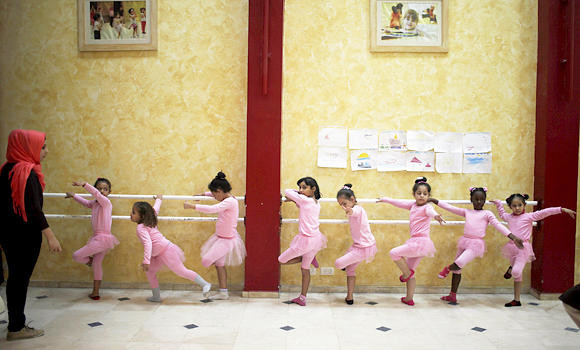
GAZA: The group of girls, ponytailed and dressed in pink, stretched their arms out to the sides and pivoted onto their toes, trying desperately to hold still. Eagle-eyed, the instructor surveyed Gaza’s latest crop of would-be ballerinas.
Fifty girls aged five to eight are now enrolled in the ballet school at the Al-Qattan Center for Children in Gaza, making it one of the most popular classes the arts institute runs, under the watchful eye of a Ukrainian teacher.
Amid the chaos and destruction that has shattered Gaza so often over the past five years, with repeated wars between Israel and Hamas, the school is a haven of calm and order, one many parents are eager for their children to enjoy.
“The ballet project was a dream for many families,” said Heyam Al-Hayek, the head of Qattan’s cultural activities. “They had been asking for ballet courses but we couldn’t find trainers. It was difficult to bring an instructor from abroad.”
The dream began to take shape when they found Tamara, a Ukrainian married to a Palestinian and living in Gaza, who had studied dance and was qualified to teach. She asked not to give her family name.
They started a pilot program in the summer, not sure how many parents would sign up given that Gaza is a conservative society and ballet is hardly a common pastime. Before they knew it, 50 children, all girls, were registered. There is now a waiting list that runs into the hundreds.
In the tiled hall, 14 pupils lined up in unison along the wall, one hand clutching a long metal barre. As Tamara showed them the steps, they copied precisely, angling their feet, bending their knees, one arm outstretched, chins held high.
Some of the children have lived through four wars in their short lifetimes, with Gaza on edge since Hamas seized full control of the enclave in 2007.


Iraqi’s handwritten Qur’an ends 6 years of artistry, craft

Ali Zaman works in a scroll of a massive handwritten manuscript of the Holy Qur’an in Istanbul. (AP)
Updated 5 sec ago
Follow

Iraqi’s handwritten Qur’an ends 6 years of artistry, craft

  • Islamic calligraphy is regarded as one of the most valued artistic traditions

ISTANBUL: Iraqi calligrapher Ali Zaman gazes with pride at his masterpiece — a colossal, handwritten manuscript of the Holy Qur’an that has taken six years of craft and devotion to complete.

The finished work consists of 302 double-sided scrolls, each measuring 4 meters in length and 1.5 meters in width. The sheets, resembling heavy parchment, were custom-made for Zaman with a blend of traditional materials including eggs, cornstarch, and alum.
“Anytime I think of this Qur’an … it gives me a very nice feeling that the mighty God gave me the life to be able to finish this thing and complete it. I feel very proud,” the 54-year-old said at a mosque in Istanbul where the manuscript is kept.

The art of calligraphy was very attractive to me … I felt that I could find my soul in it.

Ali Zaman, Iraqi calligrapher

Islamic calligraphy is regarded as one of the most valued artistic traditions in the Muslim world. 
The art form served to preserve and embellish the holy book and was later also used to adorn mosques, palaces, and manuscripts.
In Turkiye, it flourished during the Ottoman era when the art was supported by the state, and calligraphers developed distinctive styles.
Today, Istanbul is considered an important center for art, known as “hat” in Turkish.
Art expert Umit Coskunsu says that because of the Islamic tradition’s restrictions on depicting figures, calligraphy became a central form of artistic expression. He describes “hat” as a form of worship.
“The art of hat is not just calligraphy; it is seen as a means of worshipping God and coming closer to Him,” Coskunsu said.
Zaman was born in Ranya, a town in Sulaymaniyah governorate, in Iraq’s northern semi-autonomous Kurdish region.
He moved his family to Istanbul in 2017 to pursue his Qur’an project and hone his craft because he says the art of calligraphy is more valued in Turkiye than in his home country.
Zaman says he developed an interest in Islamic calligraphy around age 12, when he first encountered it in Iraq.
“The art of calligraphy was very attractive to me … I felt that I could find my soul in it,” he said.
Each sheet of the manuscript was entirely handwritten. 
Zaman says he labored from dawn to dusk for six years in a small room reserved for him at the Mihrimah Sultan Mosque in Istanbul.
The manuscript is being touted as the world’s largest, though it has not yet received official recognition. 
Zaman’s son remembers long absences while his father worked on the project.
“We only saw him when we would bring him food or when he came home at night to sleep,” said Rekar Zaman. “Thank God, we see more of him now.”
The manuscript is stored in stacked scrolls and covered to protect it from dust and moisture at the mosque where he created it.
His ultimate wish is for it to go to a buyer who can put it on public display.
“I want for this Qur’an to be in a country — in a museum, or in a place that is special for calligraphy — where it can be appreciated and valued,” Zaman said.