


When I first heard the warning sirens in Kuwait, I froze. For a moment, I did not know what to do. Should I run for cover or look up at the sky, wondering what might be coming and when the next siren might sound? All of a sudden, life seemed to be defined by the alarms: times of tense waiting, then short breaks of relief before the alarm sounded again.
War did not seem like something far away or abstract. It felt like it was happening right here. It felt like it was close. It sounded like it was happening outside my window.
As a Kuwaiti citizen, that moment made me think about something that bothered me: How did the Gulf, one of the most important economic areas in the world, become the front line in a war it did not start?
The answer is becoming clearer as Iran’s missile and drone attacks spread across the region. Iranian strikes have hit several Gulf states, including Saudi Arabia, the UAE, Bahrain, Qatar, Oman and Kuwait. Air defense systems in the region have shot down hundreds of missiles and drones, putting civilians and important infrastructure in danger.

Vehicles drive along the highway leading to and from Kuwait City on March 2, 2026. (AFP/file photo)
Iran says that its attacks are only on military targets. But people who live under the paths of these missiles and drones do not believe that claim. In some parts of the region, strikes have hit or threatened civilian areas, like homes, apartment buildings and civilian airports that are important for daily life. Families have seen debris fall into their neighborhoods, flights have been delayed and people have died or been hurt. No matter what the stated goal is, the truth is clear: these attacks are not just happening at military bases. They are getting to the places where everyday life happens.
This situation also raises serious questions about international law. International humanitarian law states that the parties involved in an armed conflict must follow the rules of distinction and proportionality. These rules are meant to protect civilians and their property. Military operations must clearly distinguish between military and civilian targets. Attacks that cause harm to civilians are not allowed. When residential areas, airports and civilian infrastructure are hit or threatened, it becomes harder to say that operations are only aimed at military targets.
More generally, such actions go against the very foundations of international law. Article 2(4) of the UN Charter forbids threatening or using force against the political independence or territorial integrity of any state. Attacking a sovereign country’s territory with missiles is not only a sign of military escalation, but it also breaks one of the most important rules of modern international law.
In the important Nicaragua v. United States case of 1986, the International Court of Justice reaffirmed this principle. It stressed that the principle of nonintervention and the ban on the use of force are basic rules that govern how states interact with each other. Firing missiles across borders and threatening civilian infrastructure are breaches of the laws that are supposed to protect smaller states.

Smoke rises from an Iranian strike in the area where the US Embassy is located in Kuwait City on March 2, 2026. (AFP)
Iran’s repeated threats to disrupt navigation in the Strait of Hormuz further heighten the gravity of the current situation. This strait links the Gulf to the wider global economy and is one of the most strategic maritime chokepoints in the world, carrying roughly a fifth of global seaborne oil and liquefied natural gas exports. Any attempt to obstruct or militarize this passage therefore has consequences far beyond the region.
Under international maritime law, particularly the regime governing international straits in the UN Convention on the Law of the Sea, vessels of all states enjoy the right of transit, which cannot be suspended or impeded by coastal states. The Strait of Hormuz must remain open to global shipping, even during periods of heightened political tension.
Threats to close the strait or attack commercial vessels raise serious legal concerns, as they challenge the principle of freedom of navigation and the stability of international maritime order. At a time when global energy markets and international trade depend heavily on this narrow waterway, such threats risk transforming a regional conflict into a global economic and security crisis.

Vehicles drive along the highway leading to and from Kuwait City on March 2, 2026. (AFP/file photo)
The effects of this war go far beyond the Gulf itself. The Gulf is at the heart of the world’s energy system and problems there quickly spread to other markets around the world. Daniel Yergin, a well-known energy expert, has long said that oil markets react not only to real supply problems but also to the idea of geopolitical risk. Prices go up quickly when instability threatens a region that is responsible for a large part of the world’s energy exports.
The Gulf’s role as a center for global trade and transport is another economic effect. It is now one of the most important places in the world for shipping, aviation, logistics and international finance. Escalation threatens commercial aviation corridors, raises the cost of maritime insurance, messes up supply chains and adds uncertainty to global markets. Things that happen in the Gulf do not stay there; they affect the entire global economy.
History confirms that wars in the Middle East do not stay in one place for long. Lawrence Freedman, a strategic scholar, has noted that conflicts in the region frequently develop in a way that even dominant states find challenging to regulate. External actors often find themselves responding to regional dynamics instead of shaping them.
That warning seems especially important right now.

Smoke rises from a high-rise building following a drone attack in Kuwait City on March 8, 2026. (AFP/file photo)
Iran’s attacks on Gulf states, even after those states have made it clear that they are not involved in the conflict, could turn a small fight into a larger crisis.
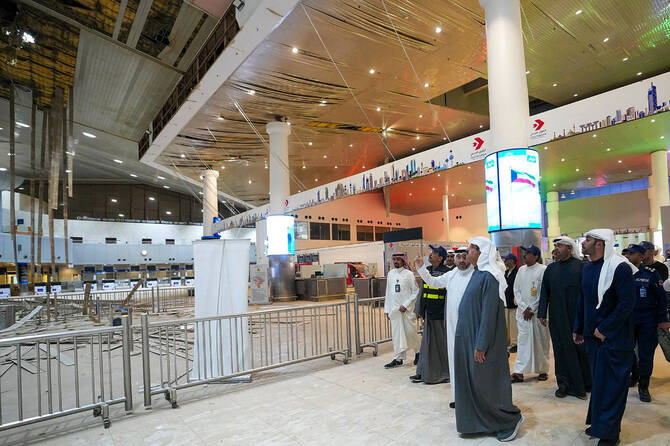
For Kuwait, these changes are not just theoretical. Iranian missile and drone attacks have hit throughout the country, forcing its air defense systems to stop incoming threats and making life difficult for everyone. Such attacks are a direct violation of the sovereignty and territorial integrity of the state of Kuwait and could be a violation of the UN Charter.
Kuwait’s response has, however, been based on restraint and the rule of law. The state has made it clear that its sovereignty is a red line and that it has the right to defend itself under Article 51 of the UN Charter, as long as it follows the principles of necessity and proportionality that are recognized in international law. Kuwait has also asked the rest of the world to follow the laws that protect sovereign equality and maintain peace and safety.
While I write this, life in Kuwait goes on in the quiet times between sirens. And, like a lot of people in the Gulf, I am listening to that silence and hoping it lasts.
• Dr. Bashayer Al-Majed is a professor of law at Kuwait University, and a visiting fellow at Oxford. X: @BashayerAlMajed


