JERUSALEM: US President Donald Trump’s controversial recognition of Jerusalem as Israel’s capital led to a spike in Palestinian support for “armed struggle,” a poll suggested Thursday.
Nearly twice as many Palestinians said they supported “armed struggle” against Israel compared with an identical survey six months previously, while there was also a fall in support for the two-state solution, the joint Israeli and Palestinian poll found.
The poll of 1,270 Palestinians across east Jerusalem, the West Bank and Gaza was conducted in the days after Trump’s December 6 declaration that he would move the US embassy from Tel Aviv to Jerusalem and recognize the city as Israel’s capital.
Palestinians see at least the east of the city as the capital of their future state, and the announcement set off street protests and diplomatic fury.
Given four options for their preference for the next step for Palestinian-Israeli relations, 38.4 percent of Palestinians favored waging an armed struggle, the most popular single answer and compared with only 26.2 percent who called for reaching a peace agreement.
The same poll in June found 21 percent support for armed struggle, while 45 percent backed a peace agreement.
Khalil Shikaki, from the Palestinian Center for Policy and Survey Research and one of the report’s authors, said there had also been significant declines in Palestinian support for a peace process and compromise as well as in the popularity of Palestinian President Mahmoud Abbas.
“There is absolutely no doubt that the Trump statement was the fundamental cause.”
Dahlia Scheindlin from the Tami Steinmetz Center at Tel Aviv University, another report author, said that she expected the support for militancy could fall in the coming months if tension subsides.


![]()
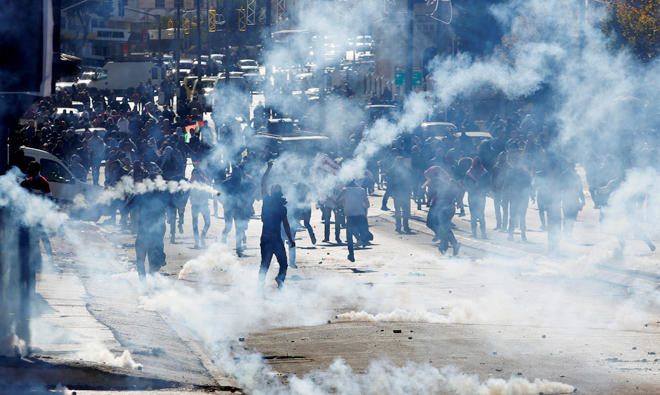
Trump’s Jerusalem move boosts Palestinian support for ‘armed struggle’: Poll
Trump’s Jerusalem move boosts Palestinian support for ‘armed struggle’: Poll


Latest updates


© 2026 SAUDI RESEARCH & PUBLISHING COMPANY, All Rights Reserved And subject to Terms of Use Agreement.