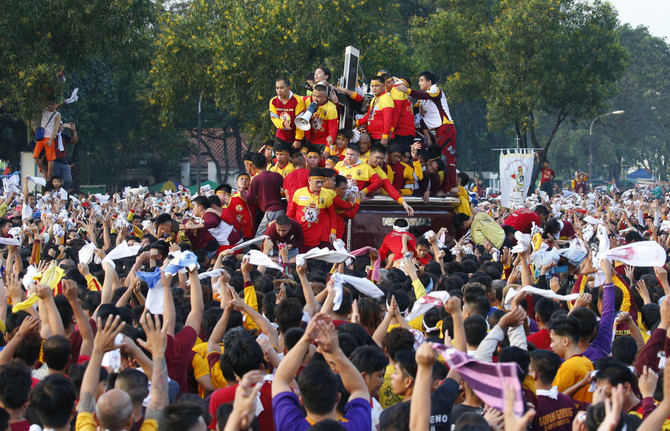
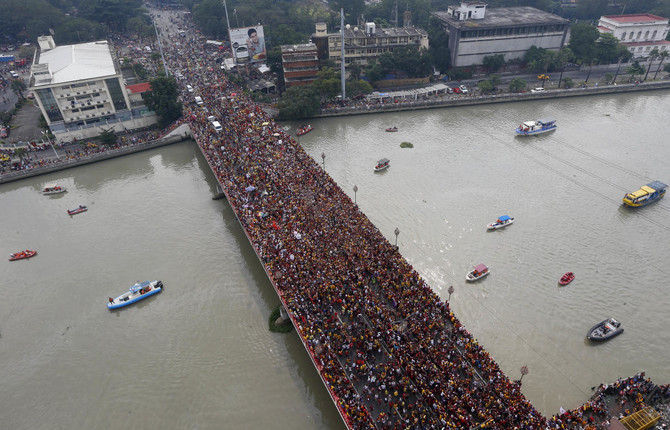
MANILA: A massive crowd of mostly barefoot Filipino Catholics joined a raucous procession of a centuries-old black statue of Jesus Christ under extra-tight security Tuesday after the Philippines came under a disastrous militant attack last year.
Although the Philippine police and military said they have not monitored any specific threat, they deployed more than 6,000 personnel, including snipers and bomb squads backed by a surveillance helicopter and drones, to secure the annual procession of the wooden Black Nazarene along Manila’s streets. More than 700 devotees were treated by Red Cross volunteers, mostly for minor injuries and ailments and exhaustion, by midafternoon.
Authorities imposed a gun ban, cellphone signals were jammed sporadically in the vicinity of the procession and a team of bomb experts walked sniffer dogs along the route ahead of the mammoth crowd. Concrete barriers blocked the route, partly to prevent the kind of attacks that have been witnessed in Europe, where Islamic radicals have rammed vehicles into crowds, a military official said.
Hundreds of local and foreign militants laid siege for five months last year to southern Marawi city, leaving more than 1,100 combatants and civilians dead in the worst Daesh group-linked attack so far in Asia. Troops crushed the uprising in October, but an unspecified number of extremists managed to escape and other small but brutal groups in the country’s south still pose threats.
Security officials said they were also concerned with possible stampedes in a dawn-to-midnight event that some say could draw millions, although it’s difficult even to approximate the crowd size.
Mobs of devotees in maroon shirts dangerously squeezed their way into the tight pack of humanity around a carriage carrying the life-size statue. They threw small towels at volunteers on the carriage, which was being pulled by ropes, to wipe parts of the cross and the statue in the belief that the Nazarene’s powers would cure ailments and foster good health and fortune.
Ronald Malaguinio, a 38-year-old worker, carried a small replica of the Nazarene on a steel platform bedecked with yellow and white flowers for several kilometers (miles) from his home in Manila’s Tondo slum district to join the procession and pray for a son recovering from a heart ailment.
“If the doctor says your son has a 50-50 chance of surviving, where will you go?” Malaguinio asked. “If money can’t cure diseases, the only other option is prayers. Ours have been heard and we’re here to thank the Nazarene.”
Another devotee, Jeffrey Nolasco, said he joined the procession for the fifth year in a row to pray that his four children will finish school, his impoverished family could eat three times a day and he could overcome a bad habit.
“I’m a drunkard,” said Nolasco, who walked barefoot on the hot pavement and carried a small statue of the cross-carrying Nazarene.
Jim Coffin, an anthropology professor from Muncie, Indiana, said he and his wife flew in as tourists and were “absolutely moved” by the massive but peaceful procession and display of religious faith by the devotees, many of them poor.
“We watched them as they threw towels on the statue and rubbed it on their bodies,” Coffin said as the procession inched its way nearby. “If the people in power appreciate how bad off the people are and they truly want to better their lives, the people in power have got to be moved by this.”
Crowned with thorns and bearing a cross, the Nazarene statue is believed to have been brought from Mexico to Manila on a galleon in 1606 by Spanish missionaries. The ship that carried it caught fire, but the charred statue survived. Some believe the statue’s endurance, from fires and earthquakes through the centuries and intense bombings during World War II, is a testament to its powers.
The spectacle reflects the unique brand of Catholicism, which includes folk superstitions, in Asia’s largest Catholic nation. Dozens of Filipinos have themselves nailed to crosses on Good Friday in another tradition to emulate Christ’s suffering that draws huge crowds each year.


Huge Philippine religious procession secured tightly amid terror fears
Huge Philippine religious procession secured tightly amid terror fears
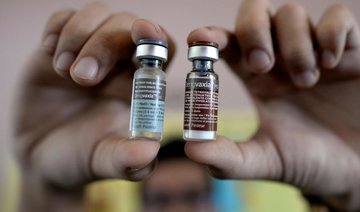

WHO chief says reasons US gave for withdrawing ‘untrue’
- US Secretary of State Marco Rubio and US Health Secretary Robert F. Kennedy Jr. announced in a joint statement Thursday that Washington had formally withdrawn from the WHO
- And in a post on X, Tedros added: “Unfortunately, the reasons cited for the US decision to withdraw from WHO are untrue”
GENEVA: The head of the UN’s health agency on Saturday pushed back against Washington’s stated reasons for withdrawing from the World Health Organization, dismissing US criticism of the WHO as “untrue.”
Tedros Adhanom Ghebreyesus warned that US announcement this week that it had formally withdrawn from the WHO “makes both the US and the world less safe.”
And in a post on X, he added: “Unfortunately, the reasons cited for the US decision to withdraw from WHO are untrue.”
He insisted: “WHO has always engaged with the US, and all Member States, with full respect for their sovereignty.”
US Secretary of State Marco Rubio and US Health Secretary Robert F. Kennedy Jr. announced in a joint statement Thursday that Washington had formally withdrawn from the WHO.
They accused the agency, of numerous “failures during the Covid-19 pandemic” and of acting “repeatedly against the interests of the United States.”
The WHO has not yet confirmed that the US withdrawal has taken effect.
- ‘Trashed and tarnished’ -
The two US officials said the WHO had “trashed and tarnished” the United States, and had compromised its independence.
“The reverse is true,” the WHO said in a statement.
“As we do with every Member State, WHO has always sought to engage with the United States in good faith.”
The agency strenuously rejected the accusation from Rubio and Kennedy that its Covid response had “obstructed the timely and accurate sharing of critical information that could have saved American lives and then concealed those failures.”
Kennedy also suggested in a video posted to X Friday that the WHO was responsible for “the Americans who died alone in nursing homes (and) the small businesses that were destroyed by reckless mandates” to wear masks and get vaccinated.
The US withdrawal, he insisted, was about “protecting American sovereignty, and putting US public health back in the hands of the American people.”
Tedros warned on X that the statement “contains inaccurate information.”
“Throughout the pandemic, WHO acted quickly, shared all information it had rapidly and transparently with the world, and advised Member States on the basis of the best available evidence,” the agency said.
“WHO recommended the use of masks, vaccines and physical distancing, but at no stage recommended mask mandates, vaccine mandates or lockdowns,” it added.
“We supported sovereign governments to make decisions they believed were in the best interests of their people, but the decisions were theirs.”
- Withdrawal ‘raises issues’ -
The row came as Washington struggled to dislodge itself from the WHO, a year after US President Donald Trump signed an executive order to that effect.
The one-year withdrawal process reached completion on Thursday, but Kennedy and Rubio regretted in their statement that the UN health agency had “not approved our withdrawal and, in fact, claims that we owe it compensation.”
WHO has highlighted that when Washington joined the organization in 1948, it reserved the right to withdraw, as long as it gave one year’s notice and had met “its financial obligations to the organization in full for the current fiscal year.”
But Washington has not paid its 2024 or 2025 dues, and is behind around $260 million.
“The notification of withdrawal raises issues,” WHO said Saturday, adding that the topic would be examined during WHO’s Executive Board meeting next month and by the annual World Health Assembly meeting in May.
“We hope the US will return to active participation in WHO in the future,” Tedros said Saturday.
“Meanwhile, WHO remains steadfastly committed to working with all countries in pursuit of its core mission and constitutional mandate: the highest attainable standard of health as a fundamental right for all people.”


