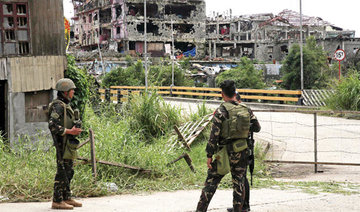
FORT MAGSAYSAY, Nueva Ecija: Troops should prepare for a possible repeat of the Marawi siege in “another city” in the country, Philippine Defense Secretary Delfin Lorenzana told them on Monday.
Lorenzana admitted that more foreign terrorists are reported to have entered Mindanao.
In a speech during the Philippine Army Special Operations Command (SOCOM) turnover ceremony here, the defense chief warned the troops that they will again be called upon later on, or “maybe immediately” as there’s still “some work to do in Mindanao.
“It is not far-fetched that one of these days they (Daesh-inspired militants) will again hold another city for quite some time.”
Lorenzana made the statement after a petition urged the Supreme Court to stop the year-long extension of martial law in Mindanao. The petitioners claimed martial law has no factual and legal basis.
But in a news conference after the turnover ceremony, the defense chief expressed readiness to defend the extension of martial law as there is “continuing rebellion” in the southern Philippines.
“It started in May and continued until October. It is the belief of the armed forces and the police that there is continuing reorganization of the rebellious forces. They would again conduct a Marawi-type operation some time in the future. I also believe that,” Lorenzana said.
He added that “the rebellious forces were not all killed in Marawi.” Quite a number, according to the defense chief, “were able to extricate themselves, and they (now) are somewhere there in Mindanao.
“Some of them are in Central Mindanao, some are in Lanao,” Lorenzana said.
Based on reports from the military, the police and also from civilians, recruitment is in progress and there are also small groups conducting training.
“So we will address those during this martial law extension,” Lorenza stated.
When asked to confirm a statement by a Moro Islamic Liberation Front (MILF) official on the arrival of more foreign fighters in Mindanao, Lorenzana said: “That is also what we got and we are trying to confirm it. That’s also another reason why it bolsters our argument to extend the martial law.”
Lorenzana noted that if it is confirmed that more foreign terrorists have entered the country, “the more we are going to do it strictly in Mindanao, fighting against them using martial law.”
Mohagher Iqbal, chair of the MILF peace panel, earlier told Arab News that despite the liberation of Marawi City in October last year, Daesh-oriented groups in Mindanao have not been completely defeated.
“And as far as an intelligence report is concerned, their recruitment is ongoing in Mindanao,” he said. “Expect that they will surface once again.”
The MILF official added that “reports of the arrival of Daesh personalities from the Middle East is very much happening in Mindanao, especially in the island province of Sulu and Basilan.
“I don’t have the actual count but they are increasing as per information coming from the ground,” Iqbal said, noting that because of what happened to them in Iraq and in Syria where they were practically defeated, remnants of Daesh are now finding ways to survive.
“And they’re finding Mindanao as one of the alternative places where they can survive because they have a natural ally here in the Abu Sayyaf and Daesh-oriented groups in Mindanao. They will find these places as the most natural ones to go.”
Meanwhile, when asked by Arab News if high-value targets had been identified among the foreign terrorists who may already be in Mindanao, Lorenzana said “none so far.” He added, though, that for now the military is going after the Bangsamoro Islamic Freedom Fighters (BIFF).
“We are actually trying to contain the BIFF because they are the ones giving us problems now. They are harassing civilians; they are also fighting our troops. So our attention is now focused on them.”


Another Marawi-type siege may be coming, says Philippines

Another Marawi-type siege may be coming, says Philippines


Zuckerberg says Meta no longer designs apps to maximize screentime
- Meta Platforms CEO faces questioned at a landmark trial over youth social media addiction
- It was the billionaire Facebook founder’s first time testifying in court on Instagram’s effect on the mental health of young users
LOS ANGELES: Meta Platforms CEO Mark Zuckerberg pushed back in court on Wednesday against a lawyer’s suggestion that he had misled Congress about the design of its social media platforms, as a landmark trial over youth social media addiction continues.
Zuckerberg was questioned on his statements to Congress in 2024, at a hearing where he said the company did not give its teams the goal of maximizing time spent on its apps.
Mark Lanier, a lawyer for a woman who accuses Meta of harming her mental health when she was a child, showed jurors emails from 2014 and 2015 in which Zuckerberg laid out aims to increase time spent on the app by double-digit percentage points. Zuckerberg said that while Meta previously had goals related to the amount of time users spent on the app, it has since changed its approach.
“If you are trying to say my testimony was not accurate, I strongly disagree with that,” Zuckerberg said.
The appearance was the billionaire Facebook founder’s first time testifying in court on Instagram’s effect on the mental health of young users.
While Zuckerberg has previously testified on the subject before Congress, the stakes are higher at the jury trial in Los Angeles, California. Meta may have to pay damages if it loses the case, and the verdict could erode Big Tech’s longstanding legal defense against claims of user harm.
The lawsuit and others like it are part of a global backlash against social media platforms over children’s mental health.
Australia has prohibited access to social media platforms for users under age 16, and other countries including Spain are considering similar curbs. In the US, Florida has prohibited companies from allowing users under age 14. Tech industry trade groups are challenging the law in court.
The case involves a California woman who started using Meta’s Instagram and Google’s YouTube as a child. She alleges the companies sought to profit by hooking kids on their services despite knowing social media could harm their mental health. She alleges the apps fueled her depression and suicidal thoughts and is seeking to hold the companies liable.
Meta and Google have denied the allegations, and pointed to their work to add features that keep users safe. Meta has often pointed to a National Academies of Sciences finding that research does not show social media changes kids’ mental health.
The lawsuit serves as a test case for similar claims in a larger group of cases against Meta, Alphabet’s Google, Snap and TikTok. Families, school districts and states have filed thousands of lawsuits in the US accusing the companies of fueling a youth mental health crisis. Over the years, investigative reporting has unearthed internal Meta documents showing the company was aware of potential harm.
Meta researchers found that teens who report that Instagram regularly made them feel bad about their bodies saw significantly more “eating disorder adjacent content” than those who did not, Reuters reported in October.
Adam Mosseri, head of Instagram, testified last week that he was unaware of a recent Meta study showing no link between parental supervision and teens’ attentiveness to their own social media use. Teens with difficult life circumstances more often said they used Instagram habitually or unintentionally, according to the document shown at trial.
Meta’s lawyer told jurors at the trial that the woman’s health records show her issues stem from a troubled childhood, and that social media was a creative outlet for her.


