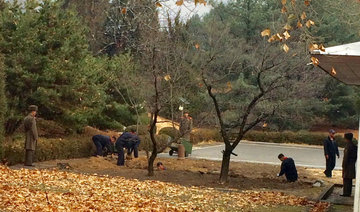
SEOUL: A North Korean soldier escaped to the South on Thursday across the heavily-guarded Demilitarized Zone that divides the peninsula, triggering gunfire on both sides of the tense border in the second defection in successive months.
The “low-ranking” soldier was spotted by South Korean soldiers using surveillance equipment as he crossed the land border near Yeoncheon in thick fog and made his way to a guard post, a spokesman for Seoul’s defense ministry said.
There were no shots at the time, he said, but about 80 minutes later South Korean troops fired around 20 rounds from a K-3 machine gun to warn off Northern guards who approached the border apparently looking for their comrade.
Two bursts of gunfire were later heard in the North, the spokesman said, but there were no indications of any bullets crossing the border.
The incident came a month after a rare and dramatic defection by a Northern soldier under a hail of bullets from his own side at Panmunjom, the truce village where opposing forces confront each other across a concrete dividing line.
On that occasion the defector drove to the heavily-guarded border at speed and ran across the border as North Korean troops fired at him. He was hit at least four times.
Footage showed the badly injured man being pulled to safety by two South Korean soldiers who crawled to reach him just south of the demarcation line.
He has since been recovering in hospital in the South.
Yeoncheon, where Thursday’s defection happened, is in the midwestern part of the DMZ, in Gyeonggi province.
Away from Panmunjom, the rest of the 4-kilometer-wide DMZ bristles with barbed wire and is littered with minefields, making any crossing extremely hazardous.
The latest defection was the fourth by a soldier across the DMZ this year.
But Kim Dong-Yub, defense analyst at the Institute for Far Eastern Studies at Kyungnam University in Seoul, said the sample size was too small to draw conclusions about a trend.
Two North Korean civilians also defected this week after being found drifting in a rickety engineless boat off the South’s eastern coast, Yonhap news agency reported, citing the Unification Ministry, which handles relations with the North.
They were spotted by a South Korean surveillance aircraft and picked up by a nearby navy vessel, it said.
The developments bring this year’s total for the number of people defecting directly to the South to 15, a Joint Chiefs of Staff tally showed — three times as many as in 2016.
Around 30,000 North Koreans have fled repression and poverty in their homeland to reach the South over the decades since the end of the 1950-53 Korean War.
According to Unification ministry data, 1,418 did so in 2016, but in the first 10 months of this year numbers fell 16.8 percent.
Analyst Kim said: “The North’s chronic food shortages, which in the past were the prime reason for North Koreans to flee from the country, have not been so bad in recent years.”
The vast majority of defectors go first to China, with which the North shares a long border, and where they face the risk of being repatriated to an uncertain fate if caught. They travel on to the South later, usually via another country.
In November’s Panmunjom incident, footage showed a North Korean guard briefly crossing the border in hot pursuit before retreating.
The US-led United Nations Command said the North’s forces had violated the 1953 cease-fire that ended Korean War hostilities both by physically crossing the line and firing weapons over it.
The North Korean soldier, 24-year-old Oh Chong-Song, underwent multiple operations for his gunshot wounds at Ajou University Hospital in Seoul and was transferred to a military hospital last week, Yonhap said.
He has recovered enough to get to his feet and walk with help, it added, and has written a letter of thanks to the medical staff who treated him.
Oh wants to become a lawyer, said his surgeon Lee Cook-Jong, who gave him a law book.
“He said while in the North, he was unable to study much because of his military duty,” Lee was quoted as saying. “I just hope he will become a good citizen, whatever kind of occupation he chooses.”

Another North Korean soldier defects via demilitarized zone
Pentagon foresees ‘more limited’ role in deterring North Korea
- South Korea hosts about 28,500 US troops in combined defense against North Korea’s military threat
- In recent years, US officials have signaled a desire to make US forces in South Korea more flexible
The Pentagon foresees a “more limited” role in deterring North Korea, with South Korea taking primary responsibility for the task, according to a policy document released on Friday, a move that could lead to a reduction of US forces on the Korean Peninsula.
South Korea hosts about 28,500 US troops in combined defense against North Korea’s military threat and Seoul has raised its defense budget by 7.5 percent for this year.
“South Korea is capable of taking primary responsibility for deterring North Korea with critical but more limited US support,” the Pentagon said in the 25-page National Defense Strategy document that guides its policies.
“This shift in the balance of responsibility is consistent with America’s interest in updating US force posture on the Korean Peninsula.”
In recent years, US officials have signaled a desire to make US forces in South Korea more flexible, to potentially operate outside the Korean Peninsula in response to a broader range of threats, such as in defending Taiwan and checking China’s growing military reach.
South Korea has resisted the idea of shifting the role of US troops, but has worked to grow its defense capabilities in the past 20 years, with the goal of being able to take on the wartime command of combined US and South Korean forces. South Korea has 450,000 troops.
The Pentagon’s top policy official, Elbridge Colby, is due to travel to Asia next week and is expected to visit South Korea, a US official said.
The wide-ranging document, which each new administration publishes, said the Pentagon’s priority was defending the homeland. In the Indo-Pacific region, the document said, the Pentagon was focused on ensuring that China could not dominate the United States or US allies.
“This does not require regime change or some other existential struggle. Rather, a decent peace, on terms favorable to Americans but that China can also accept and live under, is possible,” the document said, without mentioning Taiwan by name.
China claims democratically governed Taiwan as its own territory and has not ruled out the use of force to take control of the island. Taiwan rejects Beijing’s sovereignty claims and says only the people of Taiwan can decide their future.
The Pentagon document is based on US President Donald Trump’s National Security Strategy, published last year, which said the United States will reassert its dominance in the Western Hemisphere, build military strength in the Indo-Pacific, and possibly reassess its relationship with Europe.
Iran seeks to rebuild military
President Trump said on Thursday the United States has an “armada” heading toward Iran but that he hoped he would not have to use it, as he renewed warnings to Tehran against killing protesters or restarting its nuclear program.
The deployments to the Middle East expand the options available to Trump, both to better defend US forces in the region at a moment of high tension and to take any additional military action after striking Iranian nuclear sites in June.
The Pentagon document said that while Iran had suffered setbacks in recent months, it was aiming to rebuild its military, with Tehran leaving open the possibility that it could “try again to obtain a nuclear weapon.”
Even with US troops heading to the region, the document said Israel was a “model ally” and could be further empowered to defend itself. The United States has had a sometimes strained relationship with Israel over its war in Gaza.
US to remain engaged in Europe
Trump’s National Security Strategy from last year drew an outcry from Europeans after it said that Europe faced “civilizational erasure” and may one day lose its status as a reliable US ally.
The Trump administration is putting pressure on Kyiv to reach a peace deal in the war triggered by Russia’s full-scale invasion in February 2022, with Moscow demanding Kyiv cede its entire eastern industrial area of Donbas before it stops fighting.
The Pentagon’s strategy document was more measured on European allies, saying that while the United States would remain engaged in Europe it would prioritize defending the United States and deterring China.
It said that Russia would remain a “persistent but manageable” threat for NATO’s eastern members, and that the Pentagon would provide Trump with options to “guarantee US military and commercial access to key terrain” in different parts of the world, including in Greenland.
Trump said earlier this week he had secured total and permanent US access to Greenland in a deal with NATO, whose head said allies would have to step up their commitment to Arctic security to ward off threats from Russia and China.
South Korea hosts about 28,500 US troops in combined defense against North Korea’s military threat and Seoul has raised its defense budget by 7.5 percent for this year.
“South Korea is capable of taking primary responsibility for deterring North Korea with critical but more limited US support,” the Pentagon said in the 25-page National Defense Strategy document that guides its policies.
“This shift in the balance of responsibility is consistent with America’s interest in updating US force posture on the Korean Peninsula.”
In recent years, US officials have signaled a desire to make US forces in South Korea more flexible, to potentially operate outside the Korean Peninsula in response to a broader range of threats, such as in defending Taiwan and checking China’s growing military reach.
South Korea has resisted the idea of shifting the role of US troops, but has worked to grow its defense capabilities in the past 20 years, with the goal of being able to take on the wartime command of combined US and South Korean forces. South Korea has 450,000 troops.
The Pentagon’s top policy official, Elbridge Colby, is due to travel to Asia next week and is expected to visit South Korea, a US official said.
The wide-ranging document, which each new administration publishes, said the Pentagon’s priority was defending the homeland. In the Indo-Pacific region, the document said, the Pentagon was focused on ensuring that China could not dominate the United States or US allies.
“This does not require regime change or some other existential struggle. Rather, a decent peace, on terms favorable to Americans but that China can also accept and live under, is possible,” the document said, without mentioning Taiwan by name.
China claims democratically governed Taiwan as its own territory and has not ruled out the use of force to take control of the island. Taiwan rejects Beijing’s sovereignty claims and says only the people of Taiwan can decide their future.
The Pentagon document is based on US President Donald Trump’s National Security Strategy, published last year, which said the United States will reassert its dominance in the Western Hemisphere, build military strength in the Indo-Pacific, and possibly reassess its relationship with Europe.
Iran seeks to rebuild military
President Trump said on Thursday the United States has an “armada” heading toward Iran but that he hoped he would not have to use it, as he renewed warnings to Tehran against killing protesters or restarting its nuclear program.
The deployments to the Middle East expand the options available to Trump, both to better defend US forces in the region at a moment of high tension and to take any additional military action after striking Iranian nuclear sites in June.
The Pentagon document said that while Iran had suffered setbacks in recent months, it was aiming to rebuild its military, with Tehran leaving open the possibility that it could “try again to obtain a nuclear weapon.”
Even with US troops heading to the region, the document said Israel was a “model ally” and could be further empowered to defend itself. The United States has had a sometimes strained relationship with Israel over its war in Gaza.
US to remain engaged in Europe
Trump’s National Security Strategy from last year drew an outcry from Europeans after it said that Europe faced “civilizational erasure” and may one day lose its status as a reliable US ally.
The Trump administration is putting pressure on Kyiv to reach a peace deal in the war triggered by Russia’s full-scale invasion in February 2022, with Moscow demanding Kyiv cede its entire eastern industrial area of Donbas before it stops fighting.
The Pentagon’s strategy document was more measured on European allies, saying that while the United States would remain engaged in Europe it would prioritize defending the United States and deterring China.
It said that Russia would remain a “persistent but manageable” threat for NATO’s eastern members, and that the Pentagon would provide Trump with options to “guarantee US military and commercial access to key terrain” in different parts of the world, including in Greenland.
Trump said earlier this week he had secured total and permanent US access to Greenland in a deal with NATO, whose head said allies would have to step up their commitment to Arctic security to ward off threats from Russia and China.
© 2026 SAUDI RESEARCH & PUBLISHING COMPANY, All Rights Reserved And subject to Terms of Use Agreement.