

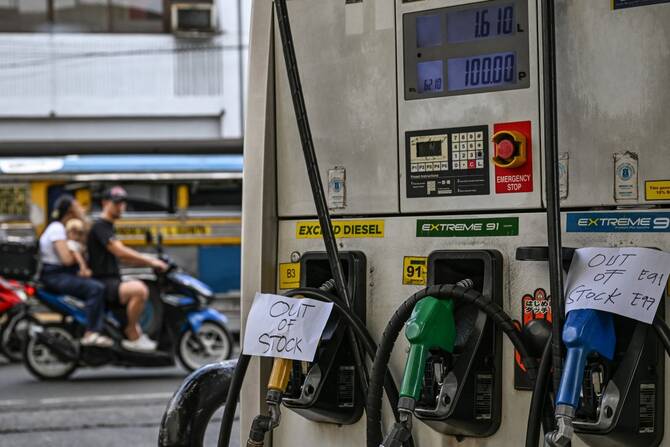

Manila: As he leaves home to start work at 7 a.m., Joseph Platilla no longer expects his wife and children to wait up for him to return. They may already be asleep while he is still driving passengers around Manila to earn his daily wage.
The change in his family’s routine started soon after the US and Israel attacked Iran on Feb. 28. The effective closure of the Strait of Hormuz, through which most of Asia’s energy supply transits, caused sharp rises in the cost of petrol, gas and diesel.
In the Philippines, where most of fuel comes from the Middle East, it was immediately felt as prices increased in the double digits.
“We don’t hear the explosions here, but we’re definitely feeling the effects,” Platilla said.
“It’s becoming really hard for people like me who use gasoline every day to earn a living. The price of gasoline has gotten really high. Before, it was around 54 pesos ($1). Now it’s around 71, and in some places it’s already 79. That’s regular gasoline. Diesel is already 99 pesos.”
Another double-digit spike is expected this week. The Department of Energy announced on Monday that it would be implementing it gradually throughout the week.
Platilla does not know how he will cope. Working as a ride-hailing driver, he used to bring about 1,500 pesos home. Now, it is almost half as much.
“That’s all that’s left from what I earn now driving every day. We have to cut back on spending. If we need to buy three onions, now we buy only one. Before we would buy five eggs and now we only buy three,” he said.
“I start at 7 a.m. and go home around 11 p.m. every day. Before, I could still take breaks, now I just keep going.”
For Joseph Ganodice, who drives a jeepney — a taxibus that is the most popular means of public transportation in the Philippines — the situation is just as challenging, if not more so.
He does not own the vehicle and must pay a daily boundary to the operator before earning anything for himself.
“You have to keep driving until early morning just to complete the boundary. It’s even more difficult because traffic is heavy and passengers are few,” he said.
“The money we’re supposed to use to buy food ends up going to diesel instead. It’s really hard for us.”
Filipinos are already experiencing the war’s knock-on effects not only on the prices of transport, but also food and other daily expenses.
The pressure is spreading to businesses, especially small eateries and shops.
“It’s really more on a tight budget,” said Freda Baslu, who manages a fast-food outlet at one of the biggest shopping centers in Manila.
“Even inside the mall, you can see that there are fewer people. You can also see that people’s spending has decreased.”
Gina Torres, 50, who works at a small canteen in Quezon City, has also observed that her customers are buying less. At the same time, all the items she needs to keep the business running have suddenly become more expensive.
“Everything has become more expensive — cooking oil, eggs, everything,” she told Arab News.
“Our sales have dropped compared to before … Now we have fewer customers. It’s hard to budget money now. You earn a little, but your expenses are high.”
In a country where most live from paycheck-to-paycheck, people are trying to save as much as possible to stay afloat and somehow adjust to the quickly increasing prices. But it may not be easy in the long run.
“It’s really quite hard for us here in the Philippines because we don’t produce oil ... the supply is limited, and therefore, the increase in prices is inevitable and it has affected everyone. It’s really quite damaging to our pockets,” said Xerxes Nitafan, a government employee.
“Workers, the employees, don’t get a raise in salaries, but the prices of goods because of the oil price hike will be affected, there will be an inflationary effect on everything that we have — food, services. Everything is affected.”


