

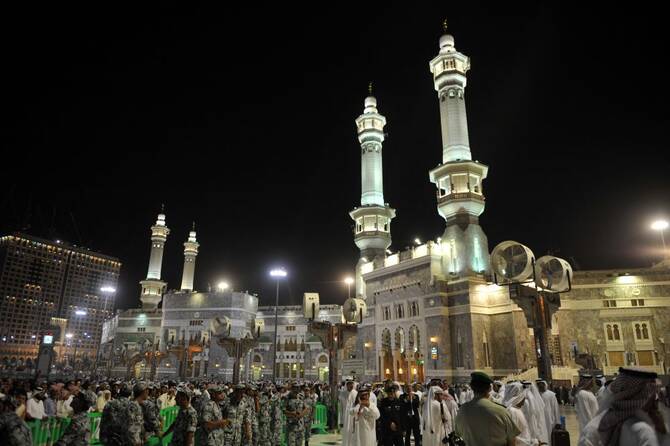


MAKKAH: The call to prayer from the Grand Mosque in Makkah reaches thousands of worshippers inside the mosque and its courtyards each day, and many more around the world through broadcast media.
At the center of this system is the mosque’s loudspeaker infrastructure, which transmits the adhan and the iqama (second call indicating that the prayer is about to start) across the vast complex.
One of the main operational sites is the southern loudspeaker chamber located within the mataf building near the Kaaba. The facility functions as a central point for managing sound across the Grand Mosque and its courtyards.
The chamber includes nine domes and 16 spaces arranged across the basement and ground floor, covering an area of about 500 square meters.
The system relies on approximately 8,000 loudspeakers distributed throughout the mosque and surrounding plazas to ensure the voice of the imam and the muezzin reaches worshippers clearly.
The infrastructure has been upgraded with digital technology and backup systems designed to maintain continuous sound transmission. The facility also includes an air-conditioning system with a capacity of 117 refrigeration tonnes, of which 85 tonnes are allocated for the imam’s prayer area and 32 tonnes for the service rooms, to support the stability of the equipment.
Minutes before each prayer, the system is activated as the call to prayer approaches.
Dr. Mansour Al-Daajani, a researcher in the history of Makkah, said the adhan in the Grand Mosque was first delivered from the roof of the Kaaba during the Conquest of Makkah in the eighth year after the Hijra, when the Prophet Muhammad instructed Bilal bin Rabah to give the call to the noon prayer.
At that time the Grand Mosque consisted mainly of the mataf area and had no surrounding walls, minarets or pulpit.
Al-Daajani said: “When minarets first appeared in 754 during the era of the Abbasid Caliph Abu Jaafar Al-Mansour, who built the first minaret in the Grand Mosque — the Bab Al-Umrah minaret at the western corner on the northern side of the mosque — this minaret and those built after it began to serve as places from which the adhan was raised.”
Al-Daajani said the chief muezzin would give the call to prayer from that minaret, followed by other muezzins on the remaining minarets. In later periods the call was delivered from the Bab Al-Salam minaret and later from the Dome of Zamzam.
Before the use of modern amplification, the Hanafi Maqam served as a location where muezzins repeated the imam’s takbirs to help convey the sound of the prayer to worshippers.
According to Al-Daajani, loudspeakers were first introduced in the Grand Mosque in 1947 during the reign of King Abdulaziz.
The historian Mohammed Tahir Al-Kurdi, in his book “The Upright History of Makkah and the Noble House of God,” recorded the introduction of loudspeakers in 1949.
However, local historian Ahmed Ali Asad Allah Al-Kadhimi wrote in his memoir “Diaries in Makkah” that loudspeakers were proposed in 1947 by Sheikh Abdul Zahir Abu Al-Samah, the imam and khatib of the Grand Mosque.
He requested their installation from the then finance minister, Abdullah bin Suleiman Al-Hamdan, who instructed the Wireless Department to provide the equipment.
The devices were first used at Namirah Mosque during the Day of Arafah sermon, delivered by Sheikh Abdullah bin Hassan Al Al-Sheikh.
Later that year, on Oct. 31, 1947, Sheikh Abu Al-Samah delivered the Friday sermon in the Grand Mosque using a microphone, allowing worshippers to hear the sermon clearly.
The loudspeakers were initially placed at the Hanafi Maqam on the northern side of the mosque. During the first Saudi expansion of the mataf in 1957, most prayer stations were removed and the speakers were relocated to the Shafi’i Maqam above the Zamzam well.
After that structure was removed in 1963, the speakers were installed in a dedicated chamber south of the mataf courtyard near the southern arcade.
This marked the first time the muezzins used a dedicated, independent building for performing the adhan and repeating the takbirs with the imam.
Dr. Nada Al-Qurashi, a Saudi scholarship student in Ohio, said the call to prayer from the Grand Mosque carries special significance for Muslims around the world.
She said the clarity of the sound inside the mosque helps worshippers maintain focus during prayer and allows the imam’s voice to be heard across the complex.
Al-Qurashi stated that all Muslims across every continent yearn to hear the sound of the adhan and prayers within the precincts of the Two Holy Mosques, due to the special status they hold for Muslims, especially during the holy month.
Today the loudspeaker chamber functions as a key operational point in transmitting the adhan and the imam’s voice throughout the Grand Mosque and its courtyards.


