SEOUL: North Korea has reportedly replaced guards and fortified a section of its border with South Korea where a North Korean soldier defected last week, while South Korean and US soldiers have been decorated for their role in the defector’s rescue.
The North Korean defector was shot and wounded by his fellow soldiers as he dashed into the South Korean side of the Joint Security Area (JSA) last week.
The South Korean and US soldiers who led a rescue attempt to drag the gravely injured soldier to safety have been awarded medals, according to US Forces Korea.
A group of senior diplomats based in Seoul visited the JSA on Wednesday morning where they saw five North Korean workers digging a deep trench in the area where the soldier had dashed across the line after getting his jeep stuck in a small ditch, a member of the diplomatic delegation said on Friday.
In a photograph of the visit posted to the Twitter account of acting US ambassador to South Korea, Marc Knapper, North Korean workers could be seen using shovels to dig a deep trench on the North Korean side of the line as soldiers stood guard.
“The workers were being watched very closely by the KPA guards, not just the two in the photo, but others out of shot behind the building,” said the diplomat, who asked not to be identified because of the sensitivity of the situation.
According to an intelligence official cited by South Korea’s Yonhap news agency, the North has replaced the 35-40 soldiers it had guarding the JSA at the time of the incident.
“We’re closely monitoring the North Korean military’s movement in the JSA,” a South Korean defense ministry official told reporters, without confirming the reduction in border guards. “There are limits as to what we can say about things we know.”
Reuters was unable to independently verify the reports, although photos taken by Knapper and other diplomats of soldiers guarding the area where workers were digging the trench showed them dressed in slightly different uniforms to the ones usually worn by North Korea’s JSA guards.
Two new trees had also been planted in the small space between the ditch and the line with the South, the diplomat said, in an apparent effort to make it more difficult for would-be defectors to drive across the ground.
Meanwhile, in South Korea, US Forces Korea (USFK) said it had awarded its own JSA soldiers — three South Korean and three US soldiers — the Army Commendation medal in recognition for their efforts in rescuing the defector.
The medals were personally handed out by USFK Commander Vincent Brooks in a ceremony on Thursday, according to USFK’s Facebook page.
The soldiers had been responsible for dragging the wounded North Korean soldier to safety in a daring rescue seen in security camera footage released by the United Nations Command earlier this week.
Pyongyang has not commented on the defection of its soldier, who is now in stable condition despite sustaining multiple injuries sustained from gunshot wounds to his arm and torso.
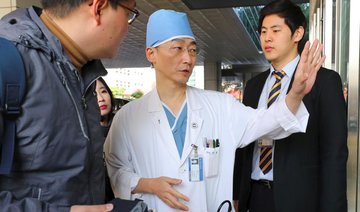
The young soldier, known only by his family name Oh, is a quiet, pleasant man who has nightmares about being returned to the North, his surgeon said on Thursday.


![]()

North Korea replaces soldiers, Seoul awards medals after defector’s border dash
North Korea replaces soldiers, Seoul awards medals after defector’s border dash

Latest updates


© 2026 SAUDI RESEARCH & PUBLISHING COMPANY, All Rights Reserved And subject to Terms of Use Agreement.