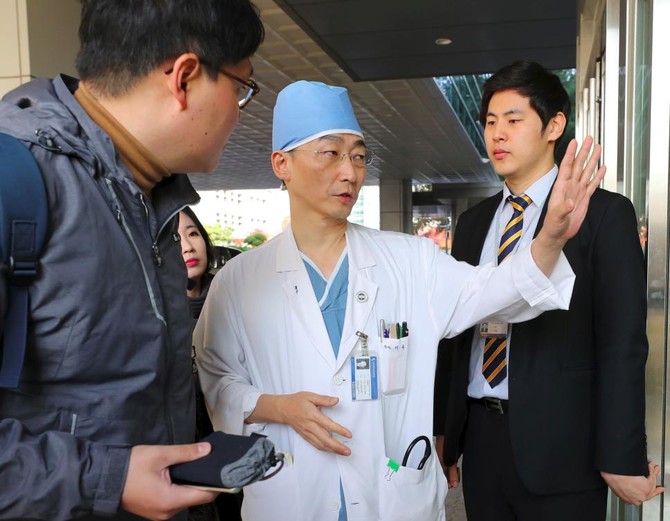
SEOUL: A North Korean soldier shot multiple times while defecting to the South is in a stable condition but riddled with parasites that could complicate his chances of survival, his doctor said Thursday.
The soldier dashed across the border at the Panmunjom truce village on Monday, as former comrades from the North opened fire on him, hitting him at least four times.
He was pulled to safety by three South Korean soldiers who crawled to reach him, just south of the dividing line.
The young man was rushed to hospital in South Korea by helicopter where he has undergone two rounds of emergency surgery.
“Vital signs including his pulse are returning to stability,” attending doctor Lee Cook-Jong told journalists.
However, he warned, the un-named soldier could rapidly deteriorate at any moment.
“We’re paying close attention to prevent possible complications,” said Lee, who on Wednesday said “an enormous number of parasites” including roundworms had been found in the small intestine.
“I’ve never seen anything like this in my 20 years as a physician,” he said, adding the longest worm he removed was 27 centimeters (11 inches).
Parasites, especially roundworms, are widespread in North Korea — as they are in many developing countries — where people eat uncooked vegetables that have been fertilized with human feces, experts say.
They were also common in South Korea until the 1980s when the country was wealthier and the use of commercial fertilizers became widespread.
“The contamination... was very severe, and the future course of his medical condition is likely to be worse than that of general trauma patients as he was in a state of shock for a long while due to massive bleeding,” he said.
South Korean officials have said that troops from the North fired at least 40 rounds.
Doctors originally said the defector had been hit six times, but have now revised that down to four after determining that some of the wounds were caused when bullets exited his body.
One of the worst wounds was in the man’s abdomen, where the bullet shattered his pelvis.
It is very rare for troops to defect at Panmunjom, a major tourist attraction and the only part of the border where forces from the two sides come face-to-face.
Unlike the rest of the frontier, the village is not fortified with minefields and barbed wire, with the demarcation line marked only by a low concrete divider.
North Korean sentry guards at Panmunjom are all carefully screened and vetted before being deployed there.
No personal details have been released but the soldier’s uniform suggested he was low-ranking.
The US-led United Nations Command (UNC), which monitors Panmunjom, said the soldier had driven close to the military demarcation line separating the two Koreas.
He then dashed from the vehicle and ran toward the border as other North Korean soldiers opened fire.
South Korean troops did not return fire.
Dozens of North Korean soldiers have fled to the South through the heavily-fortified border over the decades since the peninsula was divided, including two soldiers who crossed the frontier in June.
More than 30,000 North Korean civilians have also fled their homeland since the two nations came into being in 1948, but it is rare for them to cross the closely guarded border.

North Korean soldier shot while defecting to South Korea stable, but riddled with parasites
Japan reaffirms no-nukes pledge after senior official suggests acquiring weapons
- The unnamed official said Japan needed nuclear weapons because of a worsening security environment
- At a regular press briefing in Tokyo, Chief Cabinet Secretary Minoru Kihara said Japan’s nuclear policy had not changed
TOKYO: Japan reaffirmed its decades-old pledge never to possess nuclear weapons on Friday after local media reported that a senior security official suggested the country should acquire them to deter potential aggressors. The unnamed official said Japan needed nuclear weapons because of a worsening security environment but acknowledged that such a move would be politically difficult, public broadcaster NHK and other outlets reported, describing the official as being from Prime Minister Sanae Takaichi’s office.
At a regular press briefing in Tokyo, Chief Cabinet Secretary Minoru Kihara said Japan’s nuclear policy had not changed, but declined to comment on the remarks or to say whether the person would remain in government. There is a growing political and public willingness in Japan to loosen its three non-nuclear principles not to possess, develop or allow nuclear weapons, a Reuters investigation published in August found.
This is driven in part by doubts over the reliability of US security guarantees under President Donald Trump and growing threats from nuclear-armed China, Russia and North Korea.
Japan hosts the largest overseas concentration of US military forces and has maintained a security alliance with Washington for decades.
Some lawmakers within Takaichi’s ruling Liberal Democratic Party have said the United States should be allowed to bring nuclear weapons into Japan on submarines or other platforms to reinforce deterrence. Takaichi last month stirred debate on her own stance by declining to say whether there would be any changes to the three principles when her administration formulates a new defense strategy next year.
“Putting these trial balloons out creates an opportunity to start to build consensus around the direction to move on changes in security policy,” said Stephen Nagy, professor at the department of politics and international studies at the International Christian University in Tokyo.
Beijing’s assertiveness and growing missile cooperation between Moscow and Pyongyang are “creating the momentum to really change Japan’s thinking about security,” he added.
Discussions about acquiring or hosting nuclear weapons are highly sensitive in the only country to have suffered atomic bombings, and risk unsettling neighboring countries, including China.
Ties between Tokyo and Beijing worsened last month after Takaichi said a Chinese attack on Taiwan that also threatened Japan could constitute a “survival-threatening situation” and trigger a military response.
At a regular press briefing in Tokyo, Chief Cabinet Secretary Minoru Kihara said Japan’s nuclear policy had not changed, but declined to comment on the remarks or to say whether the person would remain in government. There is a growing political and public willingness in Japan to loosen its three non-nuclear principles not to possess, develop or allow nuclear weapons, a Reuters investigation published in August found.
This is driven in part by doubts over the reliability of US security guarantees under President Donald Trump and growing threats from nuclear-armed China, Russia and North Korea.
Japan hosts the largest overseas concentration of US military forces and has maintained a security alliance with Washington for decades.
Some lawmakers within Takaichi’s ruling Liberal Democratic Party have said the United States should be allowed to bring nuclear weapons into Japan on submarines or other platforms to reinforce deterrence. Takaichi last month stirred debate on her own stance by declining to say whether there would be any changes to the three principles when her administration formulates a new defense strategy next year.
“Putting these trial balloons out creates an opportunity to start to build consensus around the direction to move on changes in security policy,” said Stephen Nagy, professor at the department of politics and international studies at the International Christian University in Tokyo.
Beijing’s assertiveness and growing missile cooperation between Moscow and Pyongyang are “creating the momentum to really change Japan’s thinking about security,” he added.
Discussions about acquiring or hosting nuclear weapons are highly sensitive in the only country to have suffered atomic bombings, and risk unsettling neighboring countries, including China.
Ties between Tokyo and Beijing worsened last month after Takaichi said a Chinese attack on Taiwan that also threatened Japan could constitute a “survival-threatening situation” and trigger a military response.
© 2025 SAUDI RESEARCH & PUBLISHING COMPANY, All Rights Reserved And subject to Terms of Use Agreement.