Hariri says Iran to blame for Lebanon crisis, promises to return to his country 'very soon'

1 / 2
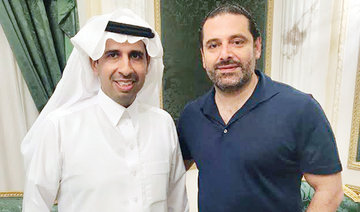
Lebanon's resigned Prime Minister Saad Hariri being interviewed on Future TV on Sunday.
2 / 2
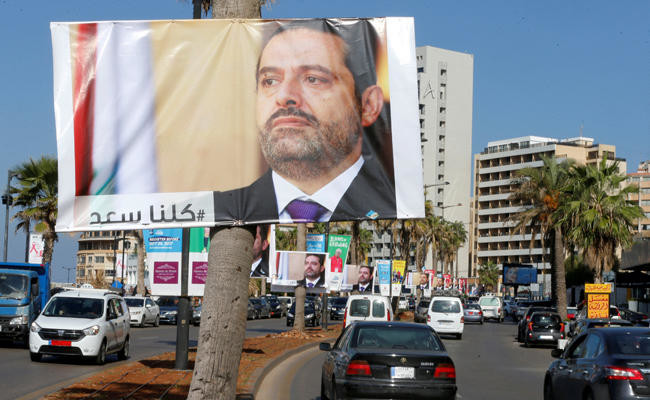
Posters depicting Lebanon's Prime Minister Saad al-Hariri, who has resigned from his post, are seen in Beirut, Lebanon, on November 10, 2017. (REUTERS/Mohamed Azakir/File Photo)
Updated 13 November 2017
Follow

Hariri says Iran to blame for Lebanon crisis, promises to return to his country 'very soon'

JEDDAH: Hezbollah’s domination of Lebanon at the behest of Iran is the cause of the country’s political crisis and his own resignation as prime minister, Saad Hariri said in a dramatic and emotional TV interview on Sunday night. 
“I am not against Hezbollah as a political party but it should not be the cause of the destruction of Lebanon,” Hariri said. 
He also said he would return to Lebanon “very soon,” and may even withdraw his resignation if Hezbollah respected Lebanon’s policy of staying out of regional conflicts. 
Hariri quit on Nov. 4 in Riyadh, because of Iran’s influence in Lebanon, and said he feared for his life. In his interview with Future TV, he said the decision was his alone, and that the aim was to cause “a positive shock” that would draw Lebanon’s attention to the dangers it was facing. 
King Salman of Saudi Arabia treated him as his own son, Hariri said, and he had the greatest respect for Crown Prince Mohammed bin Salman. In the TV interview, broadcast from Riyadh, he said the stability of Lebanon was important for both the king and the crown prince. Saudi Arabia more than any other country had helped Lebanon after the 2006 war with Israel, he said. 
“Lebanon is a small country and it needs to be nonaligned, and Saudi Arabia always demands the best for Lebanon and stresses the importance of distancing itself. What would happen to 400,000 Lebanese in the Gulf if we join an axis?” he said. 
“Iran must stop meddling in the affairs of Arab countries and we refuse to be taken by Iran to an axis against Arab countries. I will not be drawn to building relations with the Syrian regime, which does not want me. Things have to be straightened out to keep Lebanon away from regional conflicts.”
Hariri admitted that he had lost popularity with the Lebanese people when he agreed to a political settlement for a consensus government with Hezbollah ministers, “but the others did not live up to their commitment. I can’t be the only one making concessions while the others do whatever they want.”
Hariri said he had visited the UAE last week to explain to Sheikh Mohammed bin Zayed Al-Nahyan, crown prince of Abu Dhabi, his position and the need to protect Lebanon. He described their meeting as “brotherly and positive.’’
He also denied that he had any connection with the anti-corruption investigation launched in Saudi Arabia last week. 
“I wish we could fight corruption in Lebanon like Saudi Arabia is doing, but fighting corruption in Saudi Arabia is an internal affair that we have nothing to do with. I have not been subjected to any questioning in the context of the campaign in Saudi Arabia.” 
Hariri said his fears of being assassinated, as his father Rafiq Hariri was, were genuine, but that he was still free to return to Lebanon. “I am free to travel tomorrow if I want to. I will be back in Lebanon in a few days.
“I don’t care about my life — what matters to me is that Lebanon stays safe.”


Ceasefire with Kurdish-led force extended for another 15 days, Syrian army says

Updated 25 January 2026
Follow

Ceasefire with Kurdish-led force extended for another 15 days, Syrian army says

  • The defense ministry said the extension was in support of an operation by US forces to transfer accused Daesh militants to Iraq
  • The Kurdish-led Syrian Democratic Forces confirmed the ceasefire extension

RAQQA, Syria: Hours after the expiration of a four-day truce between the Syrian government and Kurdish-led fighters Saturday, Syria’s defense ministry announced the ceasefire had been extended by another 15 days.
The defense ministry said in a statement that the extension was in support of an operation by US forces to transfer accused Daesh militants who had been held in prisons in northeastern Syria to detention centers in Iraq.
The Kurdish-led Syrian Democratic Forces confirmed the ceasefire extension.
“Our forces affirm their commitment to the agreement and their dedication to respecting it, which contributes to de-escalation, the protection of civilians, and the creation of the necessary conditions for stability,” the group said in a statement.
Over the past three weeks, there have been intense clashes between government forces and the SDF, in which the SDF lost large parts of the area they once controlled.
Earlier in the day, the Kurdish-led force called on the international community to prevent any escalation.
The end of the truce came as government forces have been sending reinforcements to Syria’s northeast.
Syria’s interim government signed an agreement last March with the SDF for it to hand over territory and to eventually merge its fighters with government forces. In early January, a new round of talks failed to make progress over the merger, leading to renewed fighting between the two sides.
A new version of the accord was signed last weekend, and a four-day ceasefire was declared Tuesday. Part of the new deal is that SDF members will have to merge into the army and police forces as individuals.
The SDF said in a statement Saturday that military buildups and logistical movements by government forces have been observed, “clearly indicating an intent to escalate and push the region toward a new confrontation.” The SDF said it will continue to abide by the truce.
On Saturday, state TV said authorities on Saturday released 126 boys under the age of 18 who were held at the Al-Aqtan prison near the northern city of Raqqa that was taken by government forces Friday. The teenagers were taken to the city of Raqqa where they were handed over to their families, the TV station said.
The prison is also home to some of the 9,000 members of the Daesh group who are held in northeastern Syria. Most of them remain held in jails run by the SDF. Government forces have so far taken control of two prisons while the rest are still run by the SDF.
Earlier this week, the US military said that some 7,000 Daesh detainees will be transferred to detention centers in neighboring Iraq.
On Wednesday, the US military said that 150 prisoners have been taken to Iraq.