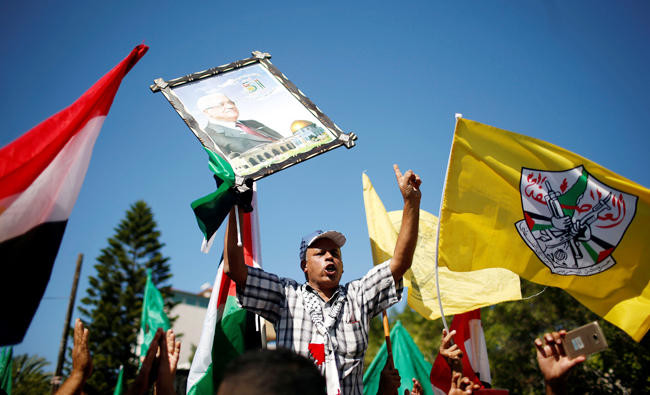
GAZA CITY: Hamas has warned that Palestinian President Mahmoud Abbas’s delay in easing sanctions on Gaza was putting at risk a landmark unity deal signed last week.
“The continuation of the punitive measures against our people in Gaza a month after the dissolution of the administrative council spoils the general atmosphere for reconciliation,” a party spokesman said in a statement to Hamas media.
Hamas last month agreed to dissolve its administrative council, seen as a rival government in Gaza, and return civilian power in the enclave to the Palestinian Authority a decade after seizing it in a near civil war.
Chief among their demands, however, was that Abbas drop a series of measures taken against Gaza.
Among these were reductions in energy payments for the territory which left its 2 million residents with only a few hours of mains electricity per day.
Hamas is due to hand over Gaza’s border crossings by Nov. 1 ahead of a full transfer of power by Dec. 1.
The PA’s top border official visited Gaza on Monday.
Previous reconciliation agreements between Hamas and Abbas’ Fatah, based in the occupied West Bank, have collapsed over implementation of specific issues.
Security control of the Gaza Strip is expected to be a major stumbling block, with Hamas refusing to disarm its 25,000-strong armed wing.

Unity deal at risk if Abbas does not end sanctions: Hamas
Arab and Islamic states reject Israel’s recognition of Somaliland
- Israel formally recognized Somaliland as an “independent and sovereign state” on Friday
- Saudi Arabia on Friday expressed full support for sovereignty, unity, territorial integrity of Somalia
A group of foreign ministers from Arab and Islamic countries, alongside the Organisation of Islamic Cooperation (OIC), have firmly rejected Israel’s announcement of its recognition of the Somaliland region within Somalia.
In a joint statement issued on Saturday, the ministers condemned Israel’s decision, announced on December 26, warning that the move carries “serious repercussions for peace and security in the Horn of Africa and the Red Sea region” and undermines international peace and security, the Jordan News Agency reported.
The statement described the recognition as an unprecedented and flagrant violation of international law and the charter of the United Nations, which uphold the principles of state sovereignty, unity and territorial integrity, JNA added.
Israel formally recognized Somaliland as an “independent and sovereign state” and signed an agreement to establish diplomatic ties, as the region’s leader hailed its first-ever official recognition.
The ministers reaffirmed their full support for the sovereignty of Somalia, rejecting any measures that would undermine its unity or territorial integrity.
They warned that recognizing the independence of parts of states sets a dangerous precedent and poses a direct threat to international peace and security.
The statement also reiterated categorical opposition to any attempt to link the move with plans to displace the Palestinian people outside their land, stressing that such proposals are rejected “in form and substance.”
Alongside the Jordanian foreign ministry, the joint statement was issued by the foreign ministers of Egypt, Algeria, Comoros, Djibouti, The Gambia, Iran, Iraq, Kuwait, Libya, Maldives, Nigeria, Oman, Pakistan, Palestine, Qatar, Somalia, Sudan, Turkiye and Yemen, as well as the OIC.
Saudi Arabia on Friday expressed full support for the sovereignty, unity, and territorial integrity of Somalia, and expressed its rejection of the declaration of mutual recognition between Israel and Somaliland.