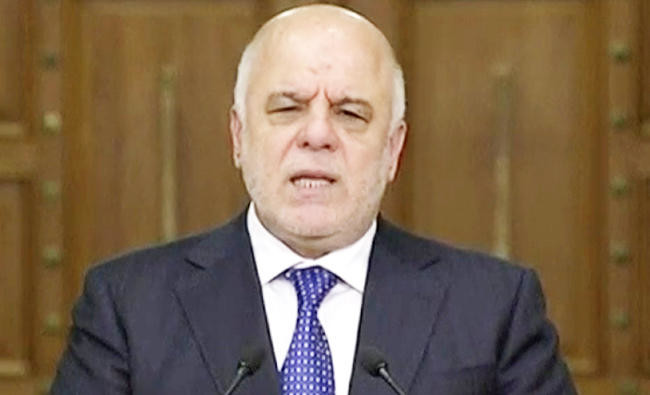
BAGHDAD: Amid fears in Iraqi Kurdistan that economic and financial sanctions imposed by Baghdad will hurt them soon, Iraqi Prime Minister Haider Al-Abadi said on Monday his government would not target or punish the Kurdish people.
Al-Abadi demanded that Kurdish leaders annul their independence referendum, commit fully to Iraq’s constitutional unity and cease provocations in areas they have “illegally seized.”
These are the conditions for talks with Irbil after last month’s controversial referendum in which more than 90 percent of voters in the Kurdistan Region of Iraq supported independent statehood, the prime minister’s spokesman said.
“They must deal with Baghdad as the federal authority that has federal power inside the region,” Ehssan Al-Shimiri, an adviser to the prime minister, told Arab News.
“Imposing the international flight ban was a message that federal authority applies in the region, and that the government has a right to take further measures against the Kurdish leaders.”
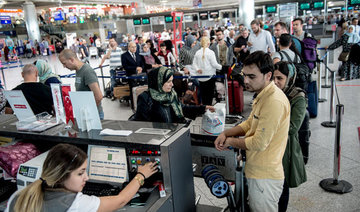
Baghdad says the referendum was illegal and unconstitutional, and imposed a ban on international flights to and from Irbil and Sulaymaniyah airports. Kurdish leaders insist the result of the referendum must be the basis for talks with the government.
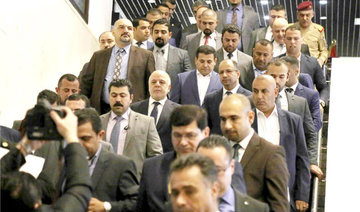
Kurdish Regional Government (KRG) President Masoud Barazani and other Kurdish leaders arrived in Kirkuk on Monday to meet commanders of their peshmerga militia. The commanders included Kamal Kirkuki, Mustafa Chao Rish, Sierwan Barazani and Jaafar Shiekh Mustafa.
Kirkuk is an oil hub with a majority Kurdish population, but is not officially part of the Kurdistan Region, but Barzani said: “The identity of Kirkuk is Kurdish and the referendum was a tool to legitimize the decision of the people.”

Iraqi sanctions will not punish Kurdish people, says Al-Abadi
Arab and Islamic states reject Israel’s recognition of Somaliland
- Israel formally recognized Somaliland as an “independent and sovereign state” on Friday
- Saudi Arabia on Friday expressed full support for sovereignty, unity, territorial integrity of Somalia
A group of foreign ministers from Arab and Islamic countries, alongside the Organisation of Islamic Cooperation (OIC), have firmly rejected Israel’s announcement of its recognition of the Somaliland region within Somalia.
In a joint statement issued on Saturday, the ministers condemned Israel’s decision, announced on December 26, warning that the move carries “serious repercussions for peace and security in the Horn of Africa and the Red Sea region” and undermines international peace and security, the Jordan News Agency reported.
The statement described the recognition as an unprecedented and flagrant violation of international law and the charter of the United Nations, which uphold the principles of state sovereignty, unity and territorial integrity, JNA added.
Israel formally recognized Somaliland as an “independent and sovereign state” and signed an agreement to establish diplomatic ties, as the region’s leader hailed its first-ever official recognition.
The ministers reaffirmed their full support for the sovereignty of Somalia, rejecting any measures that would undermine its unity or territorial integrity.
They warned that recognizing the independence of parts of states sets a dangerous precedent and poses a direct threat to international peace and security.
The statement also reiterated categorical opposition to any attempt to link the move with plans to displace the Palestinian people outside their land, stressing that such proposals are rejected “in form and substance.”
Alongside the Jordanian foreign ministry, the joint statement was issued by the foreign ministers of Egypt, Algeria, Comoros, Djibouti, The Gambia, Iran, Iraq, Kuwait, Libya, Maldives, Nigeria, Oman, Pakistan, Palestine, Qatar, Somalia, Sudan, Turkiye and Yemen, as well as the OIC.
Saudi Arabia on Friday expressed full support for the sovereignty, unity, and territorial integrity of Somalia, and expressed its rejection of the declaration of mutual recognition between Israel and Somaliland.