BAGHDAD/IRBIL: Baghdad piled pressure on Iraq’s Kurds on Wednesday, demanding they cancel their vote for independence while Parliament urged the Iraqi central government to send troops to take control of vital oil fields held by Kurdish forces.
Stepping up efforts to isolate autonomous Kurdish-held northern Iraq, which backed secession in a referendum on Monday that angered neighboring countries, Baghdad demanded that foreign governments close their diplomatic missions in the Kurdish capital, Irbil.
The referendum has fueled fears of a new regional conflict. A delegation from Iraq’s armed forces headed to neighboring Iran to coordinate military efforts, apparently as part of retaliatory measures taken by the government in Baghdad following the vote.
Iran and Turkey also oppose any move toward Kurdish secession and their armies have started joint exercises near their borders with Iraqi Kurdistan in recent days. Iraq and Turkey have also held joint military drills.
Foreign airlines began suspending flights to Kurdish airports after the Iraqi Civil Aviation Authority said international flights to Irbil and Sulaimaniya would be suspended at 1500 GMT on Tuesday.
Kurdish authorities rejected Baghdad’s demands that they annul the referendum as a condition for dialogue and hand over control of their international airports.
Turkey, which has threatened to impose sanctions on the Kurds, said its border with northern Iraq remained open, although it may not remain so. The number of trucks passing through had however decreased.
Iraqi Kurdish leader Masoud Barzani announced on Tuesday evening that the “yes” vote had won.
The outcome has caused anger in Baghdad, where Parliament, in a session boycotted by Kurdish lawmakers, asked Prime Minister Haider Al-Abadi to send troops to the Kurdish-held region of Kirkuk to take control of its oilfields.
Kurdish Pehsmerga forces took Kirkuk, a multiethnic region, in 2014 when the Iraqi Army fled in the face of Daesh militants who overran about a third of Iraq. The Kurds prevented Kirkuk’s huge oil resources from falling into the militants’ hands.
“The government has to bring back the oilfields of Kirkuk under the control of the Oil Ministry,” the resolution backed by Parliament in Baghdad said.
The area, long claimed by the Kurds, is also home to Turkmen and Arab communities, who opposed the independence vote, although the Kurdistan Regional Government (KRG) included the area in the referendum.
The US State Department said it was “deeply disappointed” by the decision to conduct the referendum, while the EU regretted that the Kurds had failed to heed its call not to hold the vote.
The Kurds were left without a state of their own when the Ottoman empire crumbled a century ago. Around 30 million are scattered in northern Iraq, southeastern Turkey and parts of Syria and Iran.


![]()
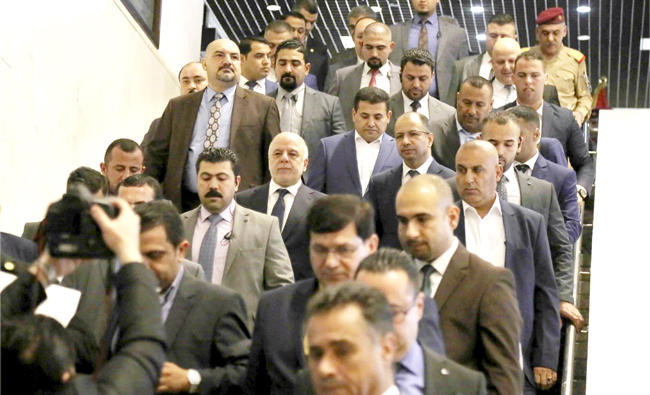
Baghdad piles pressure on Iraqi Kurds to reverse vote
Baghdad piles pressure on Iraqi Kurds to reverse vote
Latest updates


© 2026 SAUDI RESEARCH & PUBLISHING COMPANY, All Rights Reserved And subject to Terms of Use Agreement.