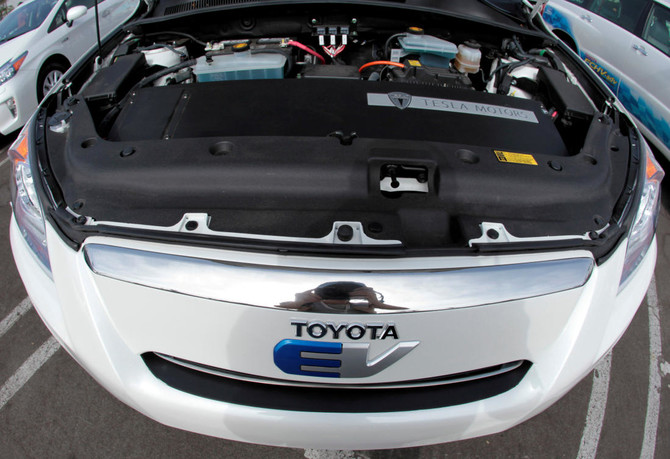
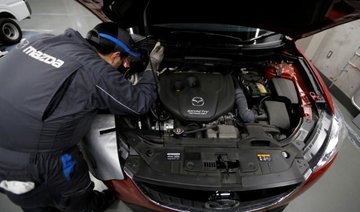
TOKYO: Toyota Motor Corp. has established a new venture to develop electric vehicle technology with partner Mazda Motor Corp, seeking to catch up with rivals in an increasingly frenetic race to produce more battery-powered cars.
Policymakers in key markets like China are pushing a shift to electric cars over the next two to three decades, while relatively new rival Tesla Inc. is gaining momentum, pressuring traditional automakers to crank up plans for fully electric vehicles (EVs).
At the same time, declining battery costs are enabling more power to be packed into cars, making an electric car future easier to imagine.
Toyota said in a statement the new company will develop technology for a range of electric cars, including minivehicles, passenger cars, SUVs and light trucks.
Toyota will take a 90 percent stake in the joint venture, called EV Common Architecture Spirit Co. Ltd, while Mazda and Denso Corp, Toyota’s biggest supplier, will each take 5 percent.
The plans build on a partnership announced in August when Japan’s biggest automaker agreed to take a 5 percent stake in Mazda and two said they would jointly develop affordable electric vehicle technologies.
Although Toyota is providing most of the financial firepower and existing EV know-how, Mazda’s engineers have gained the admiration of the industry with break-through technologies such as its compression ignition engine announced last month.
Shares in Mazda surged to end the day 3 percent higher, while those in Denso rose 1.8 percent. Toyota shares were flat.
Both automakers are somewhat behind rivals, with neither having a fully electric passenger car on the market yet.
After years of focusing on bringing hydrogen fuel cell vehicles to the market, Toyota last year set up a division to develop electric cars which is led by President Akio Toyoda, and said it plans to introduce EVs in China in the coming years.
That division would continue as a separate entity from the new joint venture, a Toyota spokeswoman said, while adding that the two teams would co-operate on technology development.
Mazda has an R&D budget a fraction of Toyota’s, which has made it difficult to develop electric cars on its own. Even so, it has said it plans to launch EVs in 2020.
By comparison, Nissan Motor Co. has the world’s top selling electric car, the Leaf, and it and partner Renault SA expect electric models to account for 30 percent of their vehicle sales by 2022.
Competition from unexpected quarters is also heating up. Just this week, James Dyson, the billionaire British inventor of the bagless vacuum cleaner, said his company was working on developing an electric car to be launched by 2020.


![]()
Toyota to form electric car technology venture with Mazda
Toyota to form electric car technology venture with Mazda

Latest updates


Recommended


© 2026 SAUDI RESEARCH & PUBLISHING COMPANY, All Rights Reserved And subject to Terms of Use Agreement.