TOKYO: Japanese automakers Toyota and Mazda said on Friday they plan to build a $1.6 billion (SR6 billion) US assembly plant and jointly develop electric vehicle technologies.
The plant, which is set to start operating in 2021, will be capable of producing 300,000 vehicles a year, with production divided between the two automakers, and employ about 4,000 people, the companies said in regulatory filings.
The plan on electric vehicles comes as tightening global emissions regulations prompt more automakers to develop battery-powered cars. Toyota and Mazda will also work together to develop in-car information technologies and automated driving functions.
Toyota will take a 5 percent stake in its smaller rival as part of the new joint venture, while Mazda will take a 0.25 percent stake in Toyota.
The automakers plan to produce Toyota Corollas and a new Mazda SUV crossover at the new plant.
A new auto plant would be a major boost to US President Donald Trump, who campaigned on promises to increase manufacturing and expand employment for American autoworkers.
Global carmakers are facing massive costs to quickly develop new technologies in lower-emission cars and self-driving cars.
Toyota has been courting a number of Japanese automakers in the past few years, announcing in February that it and compact car maker Suzuki Motor Corp. planned to cooperate in R&D projects while Toyota would tap its smaller rival’s expertise in emerging Asian markets.
It also has a long-standing partnership with Subaru, under which the two automakers jointly developed a compact sports car model which is manufactured by Subaru.
Mazda, whose annual global vehicle sales are one-eighth that of Toyota, caters to a specific audience largely in North America with its design-conscious sedans and SUVs, and has been focusing on developing more fuel-efficient gasoline engines.
With a limited R&D budget of around ¥140 billion this year — a fraction of around ¥1 trillion at Toyota — Mazda has said that it lacks the funds to develop electric cars on its own, a view also shared by Subaru and Suzuki.
Toyota has set a goal for all of its vehicles to be zero emission by 2050. Last year it established a division to develop full-sized EVs, shifting gears after long favoring EVs only for short-distance commuting given their limited driving range and lengthy charging time.


Toyota, Mazda to build $1.6 billion US assembly plant
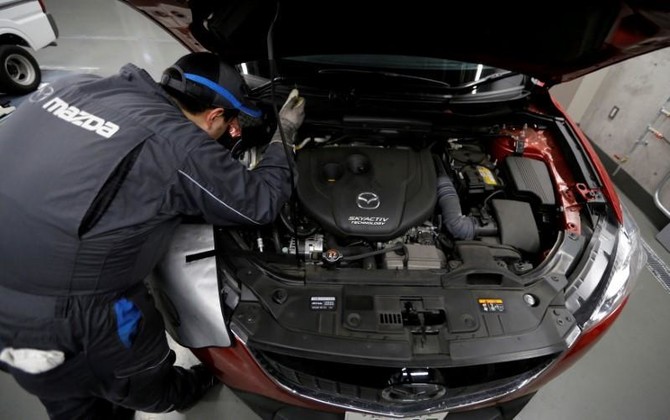
Toyota, Mazda to build $1.6 billion US assembly plant


UAE homebuilders to prioritize cash conservation amid regional conflict: Fitch
RIYADH: UAE homebuilders are expected to pivot toward preserving liquidity in the wake of the recent geopolitical shock in the Middle East, according to Fitch Ratings.
The credit ratings agency noted that while the immediate impact on the sector has seen a drop in on-site viewings, a substantial backlog of pre-sales and funds held in escrow should provide a cushion for rated companies in the near term.
The escalation of regional hostilities is presenting the first significant challenge to the UAE’s property boom.
Since Feb. 27, the last day of trading before the conflict began and subsequent market closure, shares of major developers have trended downward. Aldar Properties has seen its share price decline by 22.2 percent, while Emaar Properties has dropped 21.9 percent to date.
Fitch’s analysis focused on a portfolio of UAE developers clustered at the “B+” and “BB-” rating levels.
“Even before the conflict, the region was exposed to geopolitical risks. Booming housing construction was already reliant on overseas demand, which we expect to be subdued due to the conflict,” Fitch said.
Citing data from Property Monitor, the agency noted that resident demand constitutes only 40 percent of end-users in Dubai, highlighting the market’s exposure to fluctuations in global investor confidence.
“Housing demand in some cities, such as Dubai or Sharjah, partly aligns with new business infrastructure and locations, while other housing demand is more investment-focused,” the report added.
The rated homebuilders operate primarily on an off-plan sales model, where purchaser funds are held in escrow and released to developers upon achieving construction milestones. Fitch noted that projects already substantially pre-sold are likely to reach completion, even if broader supply chains face disruptions.
The agency expected the more agile construction firms to deliver these projects on time and on budget.
The feasibility of future developments is now under scrutiny as these projects typically rely on debt as seed capital and are vulnerable to potential declines in average selling prices.
“The main cash outflow and need for debt is for funding land — 20 percent of end-value — and initial infrastructure spend,” the report stated.
Developers generally require a pre-sale threshold of 60–65 percent to begin construction viably. While end-profit margins for these projects remain healthy at a minimum of 20 percent, Fitch emphasized that capturing those profits is currently secondary to ensuring group-wide liquidity.
Looking ahead, Fitch indicated that future rating actions will depend heavily on how companies manage cash conservation and the visibility they have before committing to new debt-funded investments.
The agency anticipated that UAE authorities would step in to support the crucial real estate industry, which is integral to various cities’ strategies for infrastructure growth and investment.
Potential government measures could include deferred payment plans for land purchases, greater flexibility in escrow mechanisms, or financing initiatives to attract buyers.
Fitch cautioned that in past downturns, homebuilders have resorted to providing direct financing or loosening payment plans for purchasers, measures that ultimately increased the developers’ own debt burdens.


