Toyota to form electric car technology venture with Mazda

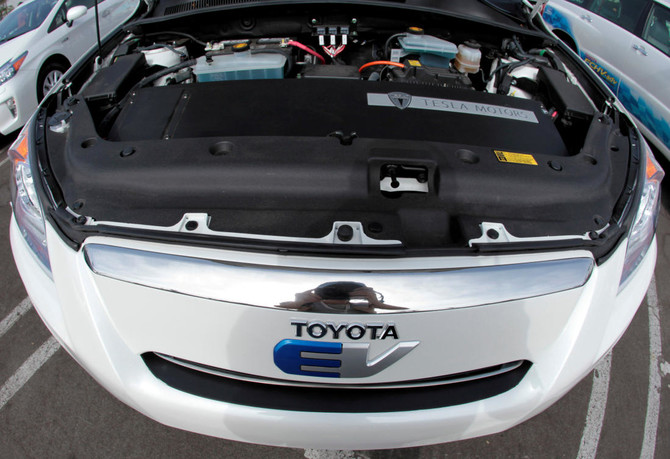
Above, a Toyota RAV4 EV car with a Tesla battery on display at the sixth annual Alternative Transportation Expo and Conference in Santa Monica, California in 2011. (Reuters)
Updated 28 September 2017
Follow

Toyota to form electric car technology venture with Mazda

TOKYO: Toyota Motor Corp. has established a new venture to develop electric vehicle technology with partner Mazda Motor Corp, seeking to catch up with rivals in an increasingly frenetic race to produce more battery-powered cars.
Policymakers in key markets like China are pushing a shift to electric cars over the next two to three decades, while relatively new rival Tesla Inc. is gaining momentum, pressuring traditional automakers to crank up plans for fully electric vehicles (EVs).
At the same time, declining battery costs are enabling more power to be packed into cars, making an electric car future easier to imagine.
Toyota said in a statement the new company will develop technology for a range of electric cars, including minivehicles, passenger cars, SUVs and light trucks.
Toyota will take a 90 percent stake in the joint venture, called EV Common Architecture Spirit Co. Ltd, while Mazda and Denso Corp, Toyota’s biggest supplier, will each take 5 percent.
The plans build on a partnership announced in August when Japan’s biggest automaker agreed to take a 5 percent stake in Mazda and two said they would jointly develop affordable electric vehicle technologies.
Although Toyota is providing most of the financial firepower and existing EV know-how, Mazda’s engineers have gained the admiration of the industry with break-through technologies such as its compression ignition engine announced last month.
Shares in Mazda surged to end the day 3 percent higher, while those in Denso rose 1.8 percent. Toyota shares were flat.
Both automakers are somewhat behind rivals, with neither having a fully electric passenger car on the market yet.
After years of focusing on bringing hydrogen fuel cell vehicles to the market, Toyota last year set up a division to develop electric cars which is led by President Akio Toyoda, and said it plans to introduce EVs in China in the coming years.
That division would continue as a separate entity from the new joint venture, a Toyota spokeswoman said, while adding that the two teams would co-operate on technology development.
Mazda has an R&D budget a fraction of Toyota’s, which has made it difficult to develop electric cars on its own. Even so, it has said it plans to launch EVs in 2020.
By comparison, Nissan Motor Co. has the world’s top selling electric car, the Leaf, and it and partner Renault SA expect electric models to account for 30 percent of their vehicle sales by 2022.
Competition from unexpected quarters is also heating up. Just this week, James Dyson, the billionaire British inventor of the bagless vacuum cleaner, said his company was working on developing an electric car to be launched by 2020.


Lebanese social entrepreneur Omar Itani recognized by Schwab Foundation

Updated 23 January 2026
Follow

Lebanese social entrepreneur Omar Itani recognized by Schwab Foundation

  • FabricAID co-founder among 21 global recipients recognized for social innovation

DAVOS: Lebanon’s Omar Itani is one of 21 recipients of the Social Entrepreneurs and Innovators of the Year Award by the Schwab Foundation for Social Entrepreneurship.

Itani is the co-founder of social enterprise FabricAID, which aims to “eradicate symptoms of poverty” by collecting and sanitizing secondhand clothing before placing items in stores in “extremely marginalized areas,” he told Arab News on the sidelines of the World Economic Forum in Davos, Switzerland.

With prices ranging from $0.25 to $4, the goal is for people to have a “dignified shopping experience” at affordable prices, he added.

FabricAID operates a network of clothing collection bins across key locations in Lebanon and Jordan, allowing people to donate pre-loved items. The garments are cleaned and sorted before being sold through the organization’s stores, while items that cannot be resold due to damage or heavy wear are repurposed for other uses, including corporate merchandise.

Since its launch, FabricAID has sold more than 1 million items, reached 200,000 beneficiaries and is preparing to expand into the Egyptian market.

Amid uncertainty in the Middle East, Itani advised young entrepreneurs to reframe challenges as opportunities.

“In Lebanon and the Arab world, we complain a lot,” he said. Understandably so, as “there are a lot of issues” in the region, resulting in people feeling frustrated and wanting to move away. But, he added, “a good portion of the challenges” facing the Middle East are “great economic and commercial opportunities.”

Over the past year, social innovators raised a combined $970 million in funding and secured a further $89 million in non-cash contributions, according to the Schwab Foundation’s recent report, “Built to Last: Social Innovation in Transition.”

This is particularly significant in an environment of geopolitical uncertainty and at a time when 82 percent report being affected by shrinking resources, triggering delays in program rollout (70 percent) and disruptions to scaling plans (72 percent).

Francois Bonnici, director of the Schwab Foundation for Social Entrepreneurship and a member of the World Economic Forum’s Executive Committee, said: “The next decade must move the models of social innovation decisively from the margins to the mainstream, transforming not only markets but mindsets.”

Award recipients take part in a structured three-year engagement with the Schwab Foundation, after which they join its global network as lifelong members. The program connects social entrepreneurs with international peers, collaborative initiatives, and capacity-building support aimed at strengthening and scaling their work.