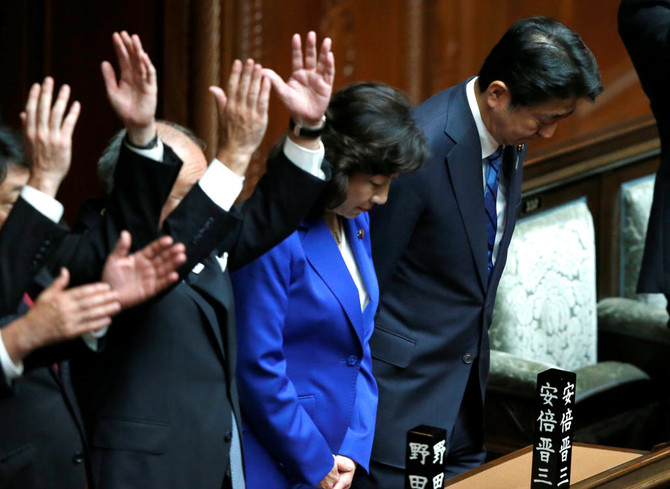
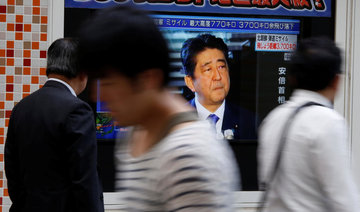
TOKYO: Japanese Prime Minister Shinzo Abe on Thursday called a snap election, as fresh opinion polls showed a fledgling conservative party led by popular Tokyo Governor Yuriko Koike was gaining momentum ahead of the expected October 22 vote.
Abe, a conservative who returned to power in 2012, is hoping a boost in his voter support in recent months will help his Liberal Democratic Party-led (LDP) coalition maintain a simple majority. It currently holds a two-thirds “super” majority. Koike’s new Party of Hope — only formally launched on Wednesday — has upended the election outlook after the former LDP member announced she would lead the group herself.
“This will be a tough battle, but it’s all about how we will protect Japan, and the lives and peaceful existence of the Japanese people,” Abe told a group of lawmakers. The cabinet will formally decide the date of the poll later on Thursday.
A number of opposition lawmakers boycotted a session at which the lower house was dissolved to protest Abe’s calling the election and creating a potential political vacuum at a time when tensions are high with North Korea.
Koike, a media-savvy former defense minister often floated as a candidate to become Japan’s first female prime minister, said on Wednesday she would not run for a seat herself, but speculation that she will persists.
A survey by the Mainichi newspaper showed 18 percent of voters plan to vote for Koike’s Party of Hope compared to 29 percent for Abe’s ruling Liberal Democratic Party (LDP).
An Asahi newspaper poll showed 13 percent planned to vote for Koike’s party versus 32 percent for the LDP. Both surveys asked voters their preference for proportional representation districts where ballots are cast for parties rather than specific candidates.
“It is unavoidable that Abe is going to lose some seats to the Party of Hope, and while the most likely scenario is that he will retain a majority, if he loses too many his ability to implement policy will be diminished,” said Yuji Saito, director of the foreign exchange division at Credit Agricole Bank in Tokyo.
Abe’s personal ratings have risen to around 50 percent from around 30 percent in July, partly on the back of his leadership during the current North Korea crisis.
But opposition parties charge he called the election to escape questioning in parliament about suspected cronyism scandals that sliced his support to below 30 percent in July.
The emergence of Koike’s party — which she describes as pro-reform and conservative — has thrown the main opposition Democratic Party into turmoil. The Democrats are struggling with defections and single-digit ratings and now appear in danger of being absorbed by the Party of Hope.
Democratic Party leader Seiji Maehara will propose that the party allow its members to run under the Party of Hope flag, domestic media reports said.
The proposal could end up splitting the party, an often-fractious mix of conservatives and liberals whose rocky 2009-2012 reign tainted its image with many voters.
Koike, 65, defied the LDP to run successfully for Tokyo governor last year and her novice local party then crushed the LDP in a metropolitan assembly election in July.
Her Party of Hope shares policy space with the business-friendly LDP, but Koike has staked out different stances on two issues likely to appeal to voters.
She wants to freeze a planned rise in the national sales tax to 10 percent from 8 percent in 2019. Abe says he will raise the tax but spend more revenue on childcare and education instead of paying back public debt.
Koike is also calling for Japan to abandon nuclear power, while Abe’s government plans to keep atomic power as a key part of the energy mix despite public worries about safety after the 2011 Fukushima nuclear crisis.
Koike has also criticized Abe for risking a political vacuum by calling the snap poll at a time of rising regional tensions over North Korea’s nuclear and missile programs.
Recent reforms will reduce the number of lower house seats to 465 from 475 in the coming election.

Japan’s Abe calls for a snap election after parliament dissolved
Greenland villagers focus on ‘normal life’ amid stress of US threat
- Proudly showing off photographs on her tablet of her grandson’s first hunt, Dorthe Olsen refuses to let the turmoil sparked by US president Donald Trump take over her life
SARFANNGUIT: Proudly showing off photographs on her tablet of her grandson’s first hunt, Dorthe Olsen refuses to let the turmoil sparked by US president Donald Trump take over her life in a small hamlet nestled deep in a Greenland fjord.
Sarfannguit, founded in 1843, is located 36 kilometers (22 miles) east of El-Sisimiut, Greenland’s second-biggest town, and is accessible by boat in summer and snowmobile or dogsled in winter if the ice freezes.
The settlement has just under 100 residents, most of whom live off from hunting and fishing.
On this February day, only the wind broke the deafening silence, whipping across the scattering of small colorful houses.
Most of them looked empty. At the end of a gravel road, a few children played outdoors, rosy-cheeked in the bitter cold, one wearing a Spiderman woolly hat.
“Everything is very calm here in Sarfannguit,” said Olsen, a 49-year-old teacher, welcoming AFP into her home for coffee and traditional homemade pastries and cakes.
In the background, a giant flat screen showed a football match from England’s Premier League.
Olsen told AFP of the tears of pride she shed when her grandson killed his first caribou at age 11, preferring to talk about her family than about Trump.
The US president has repeatedly threatened to seize the mineral-rich island, an autonomous territory of Denmark, alleging that Copenhagen is not doing enough to protect it from Russia and China.
He nevertheless climbed down last month and agreed to negotiations.
Greenland’s health and disability minister, Anna Wangenheim, recently advised Greenlanders to spend time with their families and focus on their traditions, as a means of coping with the psychological stress caused by Trump’s persistent threats.
The US leader’s rhetoric “has impacted a lot of people’s emotions during many weeks,” Wangenheim told AFP in Nuuk.
’Powerless’
Olsen insisted that the geopolitical crisis — pitting NATO allies against each other in what is the military alliance’s deepest crisis in years — “doesn’t really matter.”
“I know that Greenlanders can survive this,” she said.
Is she not worried about what would happen to her and her neighbors if the worst were to happen — a US invasion — especially given her settlement’s remote location?
“Of course I worry about those who live in the settlements,” she said.
“If there’s going to be a war and you are on a settlement, of course you feel powerless about that.”
The only thing to do is go on living as normally as possible, she said, displaying Greenland’s spirit of resilience.
That’s the message she tries to give her students, who get most of their news from TikTok.
“We tell them to just live the normal life that we live in the settlement and tell them it’s important to do that.”
The door opened. It was her husband returning from the day’s hunt, a large plastic bag in hand containing a skinned seal.
Olsen cut the liver into small pieces, offering it with bloodstained fingers to friends and family gathered around the table.
“It’s my granddaughter’s favorite part,” she explained.
Fishing and hunting account for more than 90 percent of Greenland’s exports.
No private property
Back in El-Sisimiut after a day out seal hunting on his boat, accompanied by AFP, Karl-Jorgen Enoksen stressed the importance of nature and his profession in Greenland.
He still can’t get over the fact that an ally like the United States could become so hostile toward his country.
“It’s worrying and I can’t believe it’s happening. We’re just trying to live the way we always have,” the 47-year-old said.
The notion of private property is alien to Inuit culture, characterised by communal sharing and a deep connection to the land.
“In Greenlandic tradition, our hunting places aren’t owned. And when there are other hunters on the land we are hunting on, they can just join the hunt,” he explained.
“If the US ever bought us, I can for example imagine that our hunting places would be bought.”
“I simply just can’t imagine that,” he said, recalling that his livelihood is already threatened by climate change.
He doesn’t want to see his children “inherit a bad nature — nature that we have loved being in — if they are going to buy us.”
“That’s why it is we who are supposed to take care of OUR land.”
Sarfannguit, founded in 1843, is located 36 kilometers (22 miles) east of El-Sisimiut, Greenland’s second-biggest town, and is accessible by boat in summer and snowmobile or dogsled in winter if the ice freezes.
The settlement has just under 100 residents, most of whom live off from hunting and fishing.
On this February day, only the wind broke the deafening silence, whipping across the scattering of small colorful houses.
Most of them looked empty. At the end of a gravel road, a few children played outdoors, rosy-cheeked in the bitter cold, one wearing a Spiderman woolly hat.
“Everything is very calm here in Sarfannguit,” said Olsen, a 49-year-old teacher, welcoming AFP into her home for coffee and traditional homemade pastries and cakes.
In the background, a giant flat screen showed a football match from England’s Premier League.
Olsen told AFP of the tears of pride she shed when her grandson killed his first caribou at age 11, preferring to talk about her family than about Trump.
The US president has repeatedly threatened to seize the mineral-rich island, an autonomous territory of Denmark, alleging that Copenhagen is not doing enough to protect it from Russia and China.
He nevertheless climbed down last month and agreed to negotiations.
Greenland’s health and disability minister, Anna Wangenheim, recently advised Greenlanders to spend time with their families and focus on their traditions, as a means of coping with the psychological stress caused by Trump’s persistent threats.
The US leader’s rhetoric “has impacted a lot of people’s emotions during many weeks,” Wangenheim told AFP in Nuuk.
’Powerless’
Olsen insisted that the geopolitical crisis — pitting NATO allies against each other in what is the military alliance’s deepest crisis in years — “doesn’t really matter.”
“I know that Greenlanders can survive this,” she said.
Is she not worried about what would happen to her and her neighbors if the worst were to happen — a US invasion — especially given her settlement’s remote location?
“Of course I worry about those who live in the settlements,” she said.
“If there’s going to be a war and you are on a settlement, of course you feel powerless about that.”
The only thing to do is go on living as normally as possible, she said, displaying Greenland’s spirit of resilience.
That’s the message she tries to give her students, who get most of their news from TikTok.
“We tell them to just live the normal life that we live in the settlement and tell them it’s important to do that.”
The door opened. It was her husband returning from the day’s hunt, a large plastic bag in hand containing a skinned seal.
Olsen cut the liver into small pieces, offering it with bloodstained fingers to friends and family gathered around the table.
“It’s my granddaughter’s favorite part,” she explained.
Fishing and hunting account for more than 90 percent of Greenland’s exports.
No private property
Back in El-Sisimiut after a day out seal hunting on his boat, accompanied by AFP, Karl-Jorgen Enoksen stressed the importance of nature and his profession in Greenland.
He still can’t get over the fact that an ally like the United States could become so hostile toward his country.
“It’s worrying and I can’t believe it’s happening. We’re just trying to live the way we always have,” the 47-year-old said.
The notion of private property is alien to Inuit culture, characterised by communal sharing and a deep connection to the land.
“In Greenlandic tradition, our hunting places aren’t owned. And when there are other hunters on the land we are hunting on, they can just join the hunt,” he explained.
“If the US ever bought us, I can for example imagine that our hunting places would be bought.”
“I simply just can’t imagine that,” he said, recalling that his livelihood is already threatened by climate change.
He doesn’t want to see his children “inherit a bad nature — nature that we have loved being in — if they are going to buy us.”
“That’s why it is we who are supposed to take care of OUR land.”
© 2026 SAUDI RESEARCH & PUBLISHING COMPANY, All Rights Reserved And subject to Terms of Use Agreement.