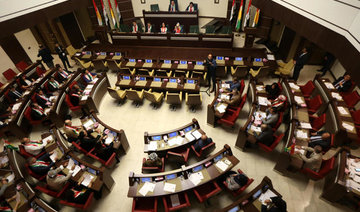
JEDDAH: Kurdish leaders will decide in the next two days whether to postpone this month’s controversial independence referendum, a leading political figure from Irbil told Arab News on Sunday.
A Kurdish delegation will travel to Baghdad to assess what is on offer from the Iraqi government. “Only after studying the various options will the Kurdish leadership be able to make a decision on postponing it,” former MP Mahmoud Othman said.
“There are ongoing contacts between the Kurdish leadership and Baghdad and we will see final results in the next two days.
“With so much pressure from Baghdad, the US, Turkey and Iran, it will not be easy to go ahead with the vote. The Kurds will have to rethink their position.”
Othman dismissed a proposal on Saturday by Iraqi President Fuad Masum, himself a Kurd.
“Nobody listens to him,” he said. “His is a ceremonial position. He does not carry weight. The real power and decision-making is with Iraqi Prime Minister Haider Al-Abadi.”
He said the Kurds were in a difficult position and the leadership was to blame for not having studied the pros and cons before deciding to go ahead with the referendum.
“They did not anticipate the massive opposition to the referendum decision; they should have thought about how the major countries would respond. Obviously the Kurdish leadership did not do that.”
Othman said the Kurdish people were all in favor of the referendum. “Now, if the vote is canceled, the people will be demoralized and that is why I say the leadership should have thought about all this beforehand.”
Meanwhile, Turkish President Recep Tayyip Erdogan will meet Al-Abadi this week to discuss their concerns about the referendum.
Turkey, the US and other Western powers have advised authorities in the semi-autonomous region to cancel the vote, worrying that tensions it would generate might be an unwelcome distraction from the war on Daesh in Iraq and Syria.
With the largest Kurdish population in the region, Turkey also fears that a “Yes” vote would fuel separatism in its southeast, where militants of the outlawed Kurdistan Workers Party (PKK) have waged an insurgency for three decades.
Ankara and Baghdad have the same view of the referendum, Erdogan said before leaving for New York to attend the UN General Assembly.
“We will have a meeting with Mr. Abadi in the United States, and from what we can see our goal is the same. Our goal is not dividing Iraq,” he said.
Kurdish leader Massoud Barzani said on Friday the referendum would go ahead as planned on Sept. 25. Erdogan said the Turkish government had therefore brought forward planned national security council and Cabinet meetings to Sept. 22, after which Turkey would announce its position on the issue.
Turkey has good relations with Barzani’s administration, founded on strong economic links and shared suspicions of other Kurdish groups and Iraq’s central government.
The Kurdish Regional Government, led by Barzani’s KDP party, exports hundreds of thousands of barrels of oil a day via Turkey to world markets.

Kurdish leaders will decide on referendum in two days, Arab News told
School materials enter Gaza after being blocked for two years, UN agency says
- Thousands of kits, including pencils, exercise books and wooden cubes to play with, have now entered the enclave, UNICEF said
GENEVA: The UN children’s agency said on Tuesday it had for the first time in two-and-a-half years been able to deliver school kits with learning materials into Gaza after they were previously blocked by Israeli authorities.
Thousands of kits, including pencils, exercise books and wooden cubes to play with, have now entered the enclave, UNICEF said.
“We have now, in the last days, got in thousands of recreational kits, hundreds of school-in-a-carton kits. We’re looking at getting 2,500 more school kits in, in the next week, because they’ve been approved,” UNICEF spokesperson James Elder said.
COGAT, the arm of the Israeli military that oversees aid flows into the Gaza Strip, did not immediately respond to a request for comment.
Children in Gaza have faced an unprecedented assault on the education system, as well as restrictions on the entry of some aid materials, including school books and pencils, meaning teachers had to make do with limited resources, while children tried to study at night in tents without lights, Elder said. During the conflict some children missed out on education altogether, facing basic challenges like finding water, as well as widespread malnutrition, amid a major humanitarian crisis.
“It’s been a long two years for children and for organizations like UNICEF to try and do that education without those materials. It looks like we’re finally seeing a real change,” Elder stated. UNICEF is scaling up its education to support half of children of school age — around 336,000 — with learning support. Teaching will mainly happen in tents, Elder said, due to widespread devastation of school buildings in the enclave during the war which was triggered by Hamas’ assault on Israel on October 2023.
At least 97 percent of schools sustained some level of damage, according to the most recent satellite assessment by the UN in July.
Israel has previously accused Hamas and other militant groups of systematically embedding in civilian areas and structures, including schools, and using civilians as human shields. The bulk of the learning spaces supported by UNICEF will be in central and southern areas of the enclave, as it remains difficult to operate in the north, parts of which were badly destroyed in the final months of the conflict, Elder said.
The Hamas-led attack in October 2023 killed 1,200 people, according to Israeli tallies. Israel’s assault has killed 71,000 Palestinians, Gaza’s health authorities say. More than 20,000 children were reported killed, including 110 since the October 10 ceasefire last year, UNICEF said, citing official data.
Thousands of kits, including pencils, exercise books and wooden cubes to play with, have now entered the enclave, UNICEF said.
“We have now, in the last days, got in thousands of recreational kits, hundreds of school-in-a-carton kits. We’re looking at getting 2,500 more school kits in, in the next week, because they’ve been approved,” UNICEF spokesperson James Elder said.
COGAT, the arm of the Israeli military that oversees aid flows into the Gaza Strip, did not immediately respond to a request for comment.
Children in Gaza have faced an unprecedented assault on the education system, as well as restrictions on the entry of some aid materials, including school books and pencils, meaning teachers had to make do with limited resources, while children tried to study at night in tents without lights, Elder said. During the conflict some children missed out on education altogether, facing basic challenges like finding water, as well as widespread malnutrition, amid a major humanitarian crisis.
“It’s been a long two years for children and for organizations like UNICEF to try and do that education without those materials. It looks like we’re finally seeing a real change,” Elder stated. UNICEF is scaling up its education to support half of children of school age — around 336,000 — with learning support. Teaching will mainly happen in tents, Elder said, due to widespread devastation of school buildings in the enclave during the war which was triggered by Hamas’ assault on Israel on October 2023.
At least 97 percent of schools sustained some level of damage, according to the most recent satellite assessment by the UN in July.
Israel has previously accused Hamas and other militant groups of systematically embedding in civilian areas and structures, including schools, and using civilians as human shields. The bulk of the learning spaces supported by UNICEF will be in central and southern areas of the enclave, as it remains difficult to operate in the north, parts of which were badly destroyed in the final months of the conflict, Elder said.
The Hamas-led attack in October 2023 killed 1,200 people, according to Israeli tallies. Israel’s assault has killed 71,000 Palestinians, Gaza’s health authorities say. More than 20,000 children were reported killed, including 110 since the October 10 ceasefire last year, UNICEF said, citing official data.
© 2026 SAUDI RESEARCH & PUBLISHING COMPANY, All Rights Reserved And subject to Terms of Use Agreement.