Kurdish parliament votes to move ahead with referendum

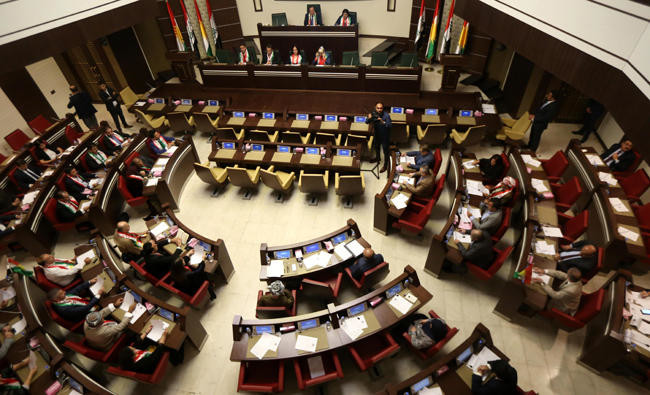
A picture taken on September 15, 2017 shows a general view of Kurdish MPs sitting during a session of Kurdistan's regional parliament in Arbil, the capital of the autonomous Kurdish region of northern Iraq. (AFP / SAFIN HAMED)
Updated 15 September 2017
Follow

Kurdish parliament votes to move ahead with referendum

IRBIL, Iraq: The Kurdish region’s parliament voted Friday evening to approve the holding of a controversial referendum on support for independence Sept. 25, according to broadcasts of the session by local television. Kurdish leaders have come under increasing pressure from key ally the United States, as well as neighboring Turkey and Iran, to call off the vote fearing it could plunge the region into greater instability as the fight against the Daesh group grinds to a close.
Earlier Friday, Turkish President Recep Tayyip Erdogan said his country plans to hold a high-level security meeting on Sept. 22 to decide what response to take over the Kurdish referendum, accused leaders of Iraq’s autonomous region of “serious political inaptitude” for going ahead with plans to hold the vote.
Also Friday, Iraq’s Prime Minister received a call from his Turkish counterpart who underscored his rejection of the Kurdish vote, according to a statement released by Haider Al-Abadi’s office Friday evening.
Iraq’s Kurdish region plans to hold a referendum on support for independence from Iraq on Sept. 25 in three governorates that make up their autonomous region, and in disputed areas like Kirkuk that are controlled by Kurdish forces but claimed by Baghdad.
The planned vote has escalated tensions with Baghdad as well as neighboring Turkey and Iran — countries home to sizeable Kurdish populations.
During the call between the Turkish and Iraqi leaders, Prime Minister Binali Yildirim expressed concerns that the vote is a danger to “the security of the region and the safety of its people,” and “affirmed Turkey’s support for all the steps taken by the Iraqi government to preserve the unity of Iraq,” the statement from Al-Abadi’s office said.
Just a year ago relations between Baghdad and Ankara were at a significant low with Al-Abadi and Turkish President Recep Tayyip Erdogan trading schoolyard insults. The scuffle was sparked by the presence of some 500 Turkish troops at a base north of Mosul. Baghdad said the troops were there without permission and called on them to withdraw. Ankara refused, insisting they would play a role in retaking Mosul.
Thursday, a senior US official announced that Brussels, Washington, Paris, London and Baghdad had cooperatively developed an alternative plan to the contentious referendum. While providing no details on the alternative, Brett McGurk, US special presidential envoy to the anti-Islamic State coalition said at a news conference in Irbil he had presented it to Kurdish leaders.
“There’s an alternative on the table. It’s decision time,” he said.
The Kurdish region’s parliament decision Friday appears to be a rebuff of that alternative.
Iraq’s Kurdish region has enjoyed a high degree of autonomy since the US imposed a no-fly zone over northern Iraq after the 1990 Gulf War. It has its own parliament and armed forces, flies its own flag, and has been a close US ally against IS and other militant groups.


First responders enter devastated Aleppo neighborhood after days of deadly fighting

Updated 10 sec ago
Follow

First responders enter devastated Aleppo neighborhood after days of deadly fighting

  • The US-backed SDF, which have played a key role in combating the Daesh group in large swaths of eastern Syria, are the largest force yet to be absorbed into Syria’s national army

ALEPPO, Syria: First responders on Sunday entered a contested neighborhood in Syria’ s northern city of Aleppo after days of deadly clashes between government forces and Kurdish-led forces. Syrian state media said the military was deployed in large numbers.
The clashes broke out Tuesday in the predominantly Kurdish neighborhoods of Sheikh Maqsoud, Achrafieh and Bani Zaid after the government and the Syrian Democratic Forces, the main Kurdish-led force in the country, failed to make progress on how to merge the SDF into the national army. Security forces captured Achrafieh and Bani Zaid.
The fighting between the two sides was the most intense since the fall of then-President Bashar Assad to insurgents in December 2024. At least 23 people were killed in five days of clashes and more than 140,000 were displaced amid shelling and drone strikes.
The US-backed SDF, which have played a key role in combating the Daesh group in large swaths of eastern Syria, are the largest force yet to be absorbed into Syria’s national army. Some of the factions that make up the army, however, were previously Turkish-backed insurgent groups that have a long history of clashing with Kurdish forces.
The Kurdish fighters have now evacuated from the Sheikh Maqsoud neighborhood to northeastern Syria, which is under the control of the SDF. However, they said in a statement they will continue to fight now that the wounded and civilians have been evacuated, in what they called a “partial ceasefire.”
The neighborhood appeared calm Sunday. The United Nations said it was trying to dispatch more convoys to the neighborhoods with food, fuel, blankets and other urgent supplies.
Government security forces brought journalists to tour the devastated area, showing them the damaged Khalid Al-Fajer Hospital and a military position belonging to the SDF’s security forces that government forces had targeted.
The SDF statement accused the government of targeting the hospital “dozens of times” before patients were evacuated. Damascus accused the Kurdish-led group of using the hospital and other civilian facilities as military positions.
On one street, Syrian Red Crescent first responders spoke to a resident surrounded by charred cars and badly damaged residential buildings.
Some residents told The Associated Press that SDF forces did not allow their cars through checkpoints to leave.
“We lived a night of horror. I still cannot believe that I am right here standing on my own two feet,” said Ahmad Shaikho. “So far the situation has been calm. There hasn’t been any gunfire.”
Syrian Civil Defense first responders have been disarming improvised mines that they say were left by the Kurdish forces as booby traps.
Residents who fled are not being allowed back into the neighborhood until all the mines are cleared. Some were reminded of the displacement during Syria’s long civil war.
“I want to go back to my home, I beg you,” said Hoda Alnasiri.