ANKARA: Russia said it is preparing to ship its S-400 anti-ballistic missile system to Turkey despite opposition from the latter’s key NATO allies.
As Turkey boasts the second-largest army in the alliance after the US, the purchase of Russian-made, high-tech defense equipment has sparked intense debate about its interoperability with NATO radars.
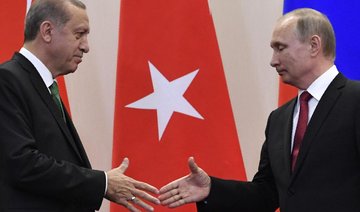
Turkish President Recep Tayyip Erdogan on Sunday said his country had already paid a deposit to Russia for the S-400s.
“If we’re having issues in acquiring certain defense instruments and our attempts are met with obstacles, we’ll take care of ourselves,” he said, alluding to difficulties Turkey has faced in purchasing armed drones from allied countries.
Technical experts say it is necessary to create an interface program to ensure the compatibility and interoperability of the S-400 system with NATO’s missile defense.
“But there’s a need for political consensus on this between the parties, which isn’t likely at all,” Prof. Mustafa Kibaroglu, director of the Center for International Security Studies and Strategic Research at MEF University in Istanbul, told Arab News.
“Acquiring air defense systems is likely to increase Turkey’s deterrent capability, which in turn might enhance its self-confidence and help bring more stability to its relations with other countries in the region.”
Underlining that Turkey, despite being a NATO member, is not obligated to buy military equipment from a particular group of countries, Kibaroglu said Russia is a legitimate supplier for air defense systems.
“In an age of worsening relations between the West and Russia, the recent bid has caused grave concerns” among NATO members, he added.
The S-400 deal alone is unlikely to make Turkey and Russia strategic partners overnight, and does not suggest a major deviation from Ankara’s foreign and security policies, Kibaroglu said.
“Existing differences, and ad hoc cooperation between Turkey and Russia in handling terrorism threats emanating from Iraq and Syria, won’t be dramatically affected by the deal, at least in the foreseeable future,” he added.
Can Kasapoglu, a defense analyst at the Istanbul-based Center for Economics and Foreign Policy Studies, said interoperability between the S-400 and NATO’s integrated ballistic missile defense architecture is not possible.
“This doesn’t arise merely from technical difficulties, but from greater political-military concerns,” he told Arab News.
“Anyone who monitored NATO’s Wales and Warsaw summits could have detected the extremely negative mood regarding Russia, especially after Moscow’s annexation of Crimea.”
Kasapoglu said while Turkey does not plan to drift away from NATO’s systems, diversification of its military cooperation portfolio and procurement makes it resilient in the face of diplomatic fluctuations. But he highlighted two drawbacks regarding the S-400 deal.
“First, Turkey’s defense budget might be overstretched by running two defensive strategic weapons agendas, one for the Russian SAM and the other for a NATO-friendly system with EUROSAM,” Kasapoglu said.
“Second, any further strains in the strategic balance between NATO and Russia would put Turkey’s S-400 deal under the spotlight. Furthermore, an undeclared war has been going on in the eastern part of Ukraine, and there’s no way Turkey’s Foreign Ministry could recognize the illegal annexation of Crimea.”
Elli Kytomaki, an arms control expert and analyst at SaferGlobe, a Finnish think-tank, told Arab News that the purchase of the S-400 “would make Turkey the first NATO member to use the system within the alliance.”
He said: “The US has already raised concerns over the purchase, but it doesn’t seem to be a deal-breaker or a cause for sanctions by NATO or Turkey’s other Western allies, such as the EU.”
Kytomaki added that Turkey wants to frame a more independent foreign policy and gain more knowhow in missile technology.
“The Russian system is also said to be cheaper than the alternatives that were on the table when the purchase was first being considered,” she said.
In light of tensions in Turkey’s security partnership with the US, experts said the S-400 deal could spark further disagreement between Ankara and Washington.
“But even if Turkey were to reconsider its decision” to procure the S-400, “I don’t think it would make the Pentagon withdraw its support” for the Syrian-Kurdish Democratic Union Party (PYD), Kasapoglu said.
“Nevertheless, many of Turkey’s competitors would use the S-400 issue to claim that Ankara is shifting from its traditional alliance to a more pro-Russia position. This propaganda could affect the US stance vis-a-vis Turkey when discussing the PYD issue.”


![]()
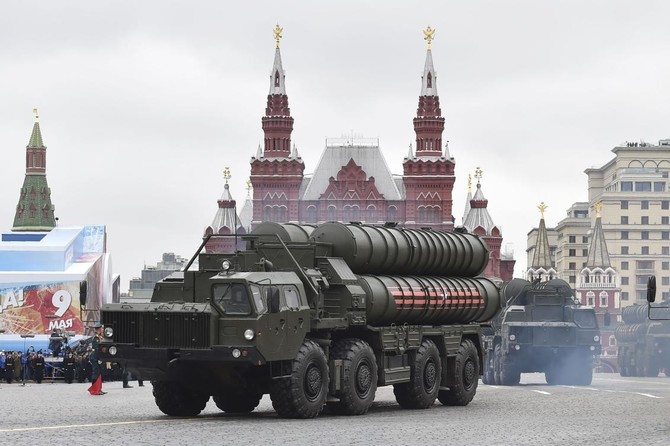
Turkey and Russia to go ahead with arms deal
Turkey and Russia to go ahead with arms deal


Latest updates


© 2026 SAUDI RESEARCH & PUBLISHING COMPANY, All Rights Reserved And subject to Terms of Use Agreement.